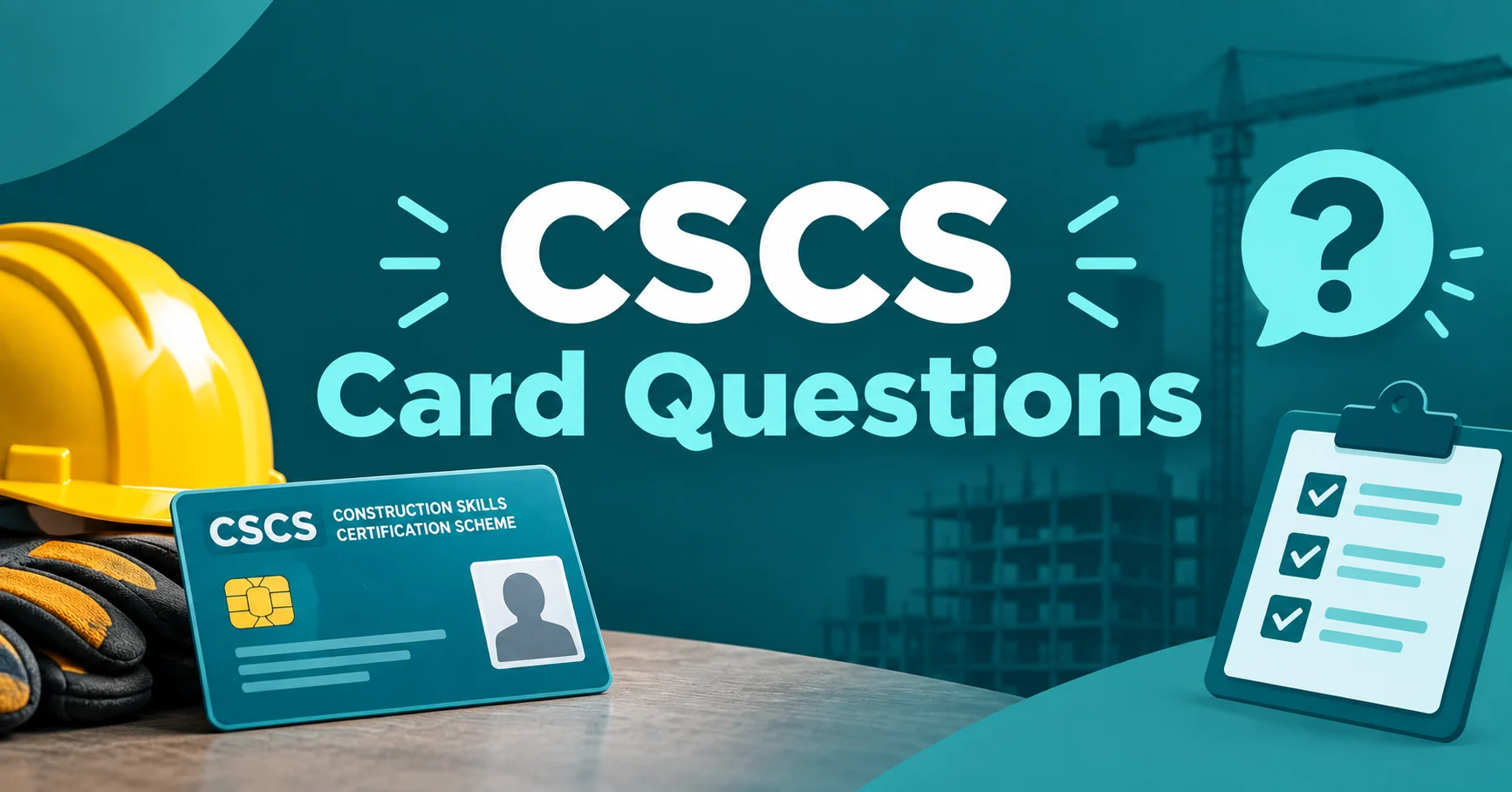
CSCS Card Questions 2026: Full Guide, Samples & Pass Marks
Sitting the CITB test in a few weeks and staring down a stack of revision material with no idea where to start? Every CSCS card question on that screen follows the same 50-question, multiple-choice format, no matter which card you’re going for, and once you’ve seen the pattern, the nerves usually settle. This guide walks through exactly what to expect, with real worked examples, so you go in knowing the shape of the exam rather than guessing at it.
Having reviewed hundreds of these test papers over the years, I can tell you the questions rarely trip people up on knowledge, it’s the wording. Below you’ll find how many questions to expect, how they’re marked, the topics they cover, and ten worked CSCS card questions across the highest-yield categories, plus the traps that catch even experienced site workers out.
What Are CSCS Card Questions?
CSCS card questions are the multiple-choice items that make up the CITB Health, Safety and Environment (HS&E) test, the exam every construction worker in the UK must pass before applying for a CSCS card. The scheme itself, run by the Construction Skills Certification Scheme, exists to prove a worker understands site health and safety before setting foot on a job.
Every version of the test, whether for a Green Card labourer or a Black Card manager, draws its CSCS card questions from the same core bank, just weighted differently by role. Operatives face general site-safety topics; Managers and Professionals get extra questions on legal duties and CDM regulations layered on top.
How Many CSCS Card Questions Are There?
Every version of the CITB test contains exactly 50 multiple-choice questions, regardless of whether you’re sitting the Operatives, Specialists, Supervisors, or Managers and Professionals paper. What changes between card types is the topic distribution, not the total count.
You get 45 minutes to answer all 50 CSCS card questions, which works out to under a minute per question on average. That sounds tight until you realise most questions are short scenario-based prompts, not long passages, so the time pressure is rarely the reason people fail.
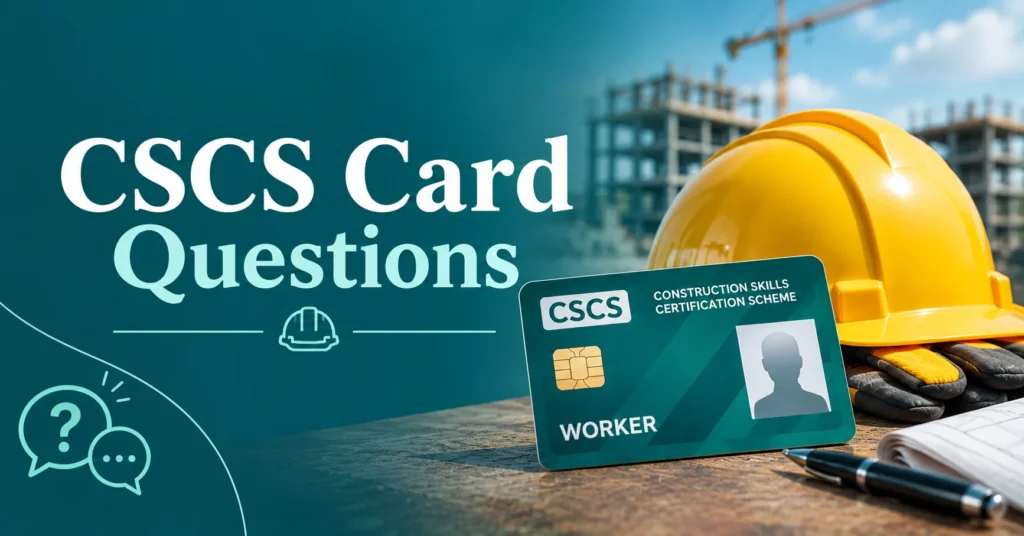
Which CSCS Card Questions Apply to Your Card?
Not every worker sees the same CSCS card questions. Green Card labourers and groundworkers sit the Operatives test; skilled tradespeople with an NVQ typically sit the same paper but for a Blue Card outcome; supervisors with a Level 3 qualification move up to the Supervisors test for a Gold Card.
Managers, quantity surveyors and architects sit the Managers and Professionals (MAP) paper, which layers legal and management questions on top of the core content. Specialist trades, demolition, plumbing, tunnelling and similar, add a further set of CSCS card questions specific to that activity on top of whichever base test applies.
CSCS Card Questions by Topic
CSCS card questions are drawn from a fixed set of subject areas grouped into four sections: working environment, occupational health, safety, and high-risk activities. Between them these sections cover general responsibilities, PPE, manual handling, hazardous substances, fire prevention, electrical safety, working at height and more.
| Section | Example Topics |
| Working environment | General responsibilities, accident reporting, first aid, environmental awareness |
| Occupational health | Dust and fumes, noise and vibration, health and welfare, manual handling |
| Safety | Safety signs, fire prevention, electrical safety and tools |
| High-risk activities | Site transport, working at height, excavations, hazardous substances |
Specialist trades add their own topic layer on top of this core list. A demolition worker’s paper includes demolition-specific CSCS card questions; a plumber’s includes JIB-specific ones, and so on, alongside the shared foundation every candidate answers.
What Format Do CSCS Card Questions Follow?
Every CSCS card question presents a scenario or factual prompt with four possible answers labelled A to D. Most are single-answer, but a small proportion, typically 4-6 per paper, are “select two” questions, where both chosen answers must be correct to score the mark.
Beyond standard multiple choice, you may also encounter drag-and-drop, hotspot, hot-area and reasoned-adjustment question styles, particularly on the digital Pearson VUE platform. Questions are written in plain English, and an on-screen audio reader is available if you’d rather listen than read.
Sample CSCS Card Questions and Answers
Working through real examples is the fastest way to get a feel for the exam. Below are worked CSCS card questions across some of the highest-yield topics, each with the correct answer and a short explanation of the reasoning behind it.
Working at height: What is the minimum guardrail height on a working platform? (950 mm, under the Work at Height Regulations 2005, with an intermediate rail and 150 mm toe board.)
Manual handling: What does the TILE approach stand for? (Task, Individual, Load, Environment the foundation of every manual handling risk assessment.)
Fire prevention: Which extinguisher suits a cooking-oil fire in a site canteen? (Wet chemical (yellow) water or foam would spread a Class F fire dangerously.)
Accident reporting: How quickly must a specified injury be reported under RIDDOR? (Immediately, then confirmed in writing to the HSE within 10 days.)
Electrical safety: What’s the standard voltage for portable site tools? (110 V centre-tapped earth, which limits shock severity by capping each conductor at 55 V to earth.)
Most Common CSCS Card Question Types
CSCS card questions tend to fall into five recurring patterns once you’ve sat enough of them. Numerical recall questions test whether you’ve memorised specific figures, like noise action levels or ladder angles, these are the easiest once revised, the hardest if you haven’t.
Hazard-identification and correct-response questions describe a site scenario and ask what you should do; the cautious, “stop and report” answer is almost always correct. Negation questions, phrased as “which is NOT,” and near-identical distractors like “every 7 days” versus “every 14 days” are the single biggest source of careless mistakes, so slow down whenever you see them.
How CSCS Card Questions Are Scored Pass Mark
Each correct answer scores one mark, with no negative marking for wrong or unanswered CSCS card questions, so there’s never a reason to leave one blank. Select-two questions require both selections to be correct; getting one of two right scores zero for that question.
The pass mark sits at 45 out of 50, or 90%, across every version of the test since 2025. That means you can afford five wrong answers, which sounds generous until a timed mock reveals how quickly negation misreads and time pressure can eat into that buffer.
How Long CSCS Card Questions Stay Relevant Test and Card Validity
Passing the CITB test doesn’t lock in your CSCS card questions knowledge forever. The HS&E test result itself must generally have been passed within the last two years at the point you apply for or renew a card, so timing your application matters as much as passing the exam.
CSCS cards themselves are typically valid for around five years depending on card type, after which renewal usually requires resitting the relevant test. Because the syllabus behind the CSCS card questions gets revised periodically, it’s worth checking the current topic list before assuming last year’s revision material still matches this year’s paper.
Strategies for Answering CSCS Card Questions
Eliminate obviously wrong options first, even without certainty, this moves your odds from 25% to 50% on a guess. Flag anything you’re unsure of and come back to it on a second pass, rather than losing time on one question in the middle of the test.
Research on multiple-choice exams consistently shows candidates change correct answers to wrong ones more often than the reverse, so trust your first instinct unless you have a clear new reason to switch. Above all, never leave a CSCS card question blank, since a guess carries a real chance of a mark and a blank guarantees zero.
Conclusion
Getting the right answers to common cscs card questions can make the application and test process much easier to understand. Whether you are preparing for the CITB test, checking eligibility, choosing the correct card, or wondering what happens after passing, having clear information helps you move forward with confidence.
Requirements can vary depending on your role, qualifications, and the type of CSCS card you need, so it is always worth checking the latest guidance before applying.Take time to prepare properly, keep your documents in order, and make sure you understand the requirements for your specific occupation. A little preparation can make the whole process smoother and help you take the next step in your construction career.
FAQs
Author

Hi, I’m Alex, and I enjoy learning through quizzes, trivia, and interactive questions. I love discovering new conversation starters, relationship topics, and educational challenges. This website is my go-to place for fun, practical, and reliable question-based content. I’m always excited to learn something new and share it with others.