
50 Hard Science Questions That Will Test Your Brain
Some science questions look simple until you actually have to answer them. You may remember the basic facts from school, but a harder question can make you stop and think twice. That is exactly what makes hard science questions so useful. They test more than memorization by asking you to connect ideas, apply what you know, and reason through unfamiliar situations.
Whether you are preparing for a science quiz, challenging yourself with friends, or simply curious about how the world works, difficult questions can reveal where your knowledge is strong and where you need another look. This guide brings together science trivia questions across biology, physics, chemistry, space, ecology, and more, with easier questions included along the way to build your confidence.
Science Trivia Questions
Science trivia becomes much more interesting when the questions move beyond basic facts. Instead of simply asking you to remember a term, a good question may ask why something happens, what would change under different conditions, or how two scientific ideas are connected.
Here are a few examples:
- What force keeps planets in orbit around the Sun?
- Which organelle is primarily responsible for producing ATP in cells?
- What is the chemical symbol for tungsten?
- Which particle carries a negative electric charge?
- What layer of Earth’s atmosphere contains most of the ozone?
These questions cover different branches of science, so they are useful for warming up before moving into more challenging material.
Science Trivia Questions With Answers
Having the answer immediately available makes trivia practice more useful. If you miss a question, you can identify the concept you need to review instead of simply moving on.
Question: What is the largest organ in the human body?
Answer: The skin.
Question: What gas do plants absorb during photosynthesis?
Answer: Carbon dioxide.
Question: What is the approximate speed of light in a vacuum?
Answer: About 300,000 kilometers per second.
Question: What is the basic unit of life?
Answer: The cell.
The best approach is to answer each question before checking the answer. That turns a simple list into an active learning exercise.
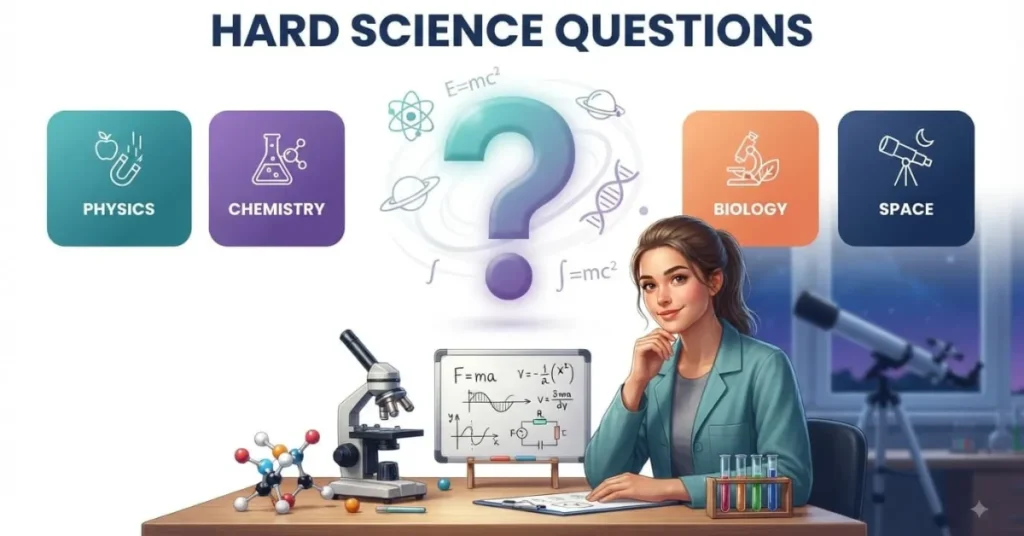
Science Quiz Questions
A strong science quiz should include different difficulty levels. If every question is extremely easy, you may finish quickly without learning much. If every question is extremely difficult, the quiz can become frustrating.
A balanced quiz might begin with basic facts, move into concepts, and finish with questions that require reasoning.
For example, instead of asking only what photosynthesis is, a harder question might ask what would happen to a plant’s glucose production if one of the necessary inputs were limited.
That small change makes the question much more about understanding than memorization.
Easy Science Trivia Questions
Easy questions are useful for beginners and make a good starting point for a larger quiz.
- How many planets are in our solar system?
- What do humans breathe in to survive?
- What is H₂O commonly called?
- Which planet is known as the Red Planet?
- What part of a plant usually absorbs water from the soil?
Answers:
- Eight
- Oxygen
- Water
- Mars
- Roots
These questions may seem straightforward, but mastering the basics gives you a foundation for more advanced science concepts.
Medium Science Trivia Questions
Medium-level questions require a little more knowledge and attention.
- Why does ice float on liquid water?
- What type of blood cells help fight infections?
- What causes Earth’s seasons?
- What is the pH of a neutral solution at standard conditions?
- Which law states that energy cannot be created or destroyed?
Answers:
- Ice is less dense than liquid water.
- White blood cells.
- Earth’s axial tilt as it orbits the Sun.
- The law of conservation of energy.
Hard Science Trivia Questions
This is where science trivia gets genuinely challenging. Hard science questions often require you to combine facts instead of recalling one isolated piece of information.
1. What happens to the frequency of a wave if its wavelength decreases while its speed remains constant?
Answer: The frequency increases.
2. Why can a person feel weightless while still being affected by gravity?
Answer: Weightlessness can occur when a person and their surroundings are in free fall together, producing no normal force against the body.
3. Which process allows genetic information to be copied from DNA into RNA?
Answer: Transcription.
4. Why does increasing temperature generally increase the rate of a chemical reaction?
Answer: Higher temperature gives particles more kinetic energy, increasing the frequency and energy of effective collisions.
5. What is the primary reason stars appear to have different colors?
Answer: Their surface temperatures differ. Hotter stars tend to appear bluer, while cooler stars appear redder.
These questions are harder because the answer depends on understanding a relationship, not simply remembering a definition.
Biology Science Questions
Biology covers everything from microscopic cells to entire ecosystems. That makes it one of the easiest subjects to turn into a challenging quiz.
Try these:
- What structure controls what enters and leaves a cell?
- What is the role of ribosomes?
- Why is DNA important to living organisms?
- What is the difference between mitosis and meiosis?
- How does natural selection affect populations over generations?
Answers:
- The cell membrane.
- They help build proteins.
- DNA stores genetic information.
- Mitosis generally produces two genetically similar cells, while meiosis produces cells with half the chromosome number and contributes to genetic variation.
- Traits that improve reproductive success can become more common in a population over generations.
Physics Science Questions
Physics questions can become difficult quickly because they often require you to understand how variables affect one another.
Consider this example:
If the mass of an object doubles while the net force acting on it stays the same, what happens to its acceleration?
Using Newton’s second law, F=ma, the acceleration becomes half as large.
Other questions might explore momentum, energy, electricity, waves, gravity, or thermodynamics.
The key with difficult physics questions is to identify what you know first. Write down the relevant quantities, determine how they are related, and then work through the problem rather than guessing.
Chemistry Science Questions
Chemistry is full of questions that test patterns and relationships.
- What determines the atomic number of an element?
- What happens when an acid reacts with a base?
- Why are noble gases generally unreactive?
- What is an isotope?
- What does a catalyst do in a chemical reaction?
Answers:
- The number of protons in its nucleus.
- They typically undergo a neutralization reaction.
- Their outer electron shells are generally complete.
- Atoms of the same element with different numbers of neutrons.
- It provides an alternative reaction pathway with lower activation energy.
Chemistry becomes much easier when you stop treating every reaction as a separate fact and start looking for patterns.
Space Science Questions
Space science gives you plenty of opportunities for challenging questions.
Why do astronauts appear weightless while orbiting Earth?
They are continuously falling around Earth while moving forward at high speed. This orbital free-fall creates the sensation of weightlessness.
Another interesting question is:
Why does the Moon appear to change shape throughout the month?
The Moon does not actually change shape. We see different portions of its sunlit side as it moves around Earth.
Questions like these are useful because they challenge common assumptions while reinforcing fundamental concepts.
Basic Science Questions
Before tackling the hardest questions, it helps to have the fundamentals under control.
Basic science questions might ask:
- What is matter?
- What is an atom?
- What is gravity?
- What is a cell?
- What is energy?
- What is an ecosystem?
- What is a chemical reaction?
These concepts may sound elementary, but they appear repeatedly in more advanced science. A weak understanding of the basics can make harder questions much more difficult than they need to be.
Common Basic Science Questions for Beginners
Beginners often have the same questions when starting science.
What is science?
Science is a systematic way of studying the natural world through observation, testing, evidence, and reasoning.
What are the main branches of science?
Major branches include biology, chemistry, physics, Earth science, and astronomy, along with many specialized fields.
Why is science important?
Science helps us understand natural processes and develop evidence-based explanations and technologies.
Do you need to memorize everything?
No. Understanding concepts and knowing how ideas connect is often more valuable than memorizing isolated facts.
Photosynthesis Questions
Photosynthesis is a common topic in biology quizzes because it connects plants, energy, gases, and ecosystems.
What is photosynthesis?
It is the process by which plants, algae, and some microorganisms use light energy to convert carbon dioxide and water into chemical energy, producing glucose and releasing oxygen.
Where does photosynthesis mainly occur?
In plant cells containing chloroplasts.
What provides the energy for photosynthesis?
Light energy, primarily from the Sun.
Why is photosynthesis important?
It provides the foundation for much of the energy entering many ecosystems and contributes oxygen to Earth’s atmosphere.
Photosynthesis Questions and Answers
Question: What gas is used during photosynthesis?
Answer: Carbon dioxide.
Question: What gas is released as a major product?
Answer: Oxygen.
Question: What pigment captures much of the light energy?
Answer: Chlorophyll.
Question: What happens to water during photosynthesis?
Answer: Water is used in the light-dependent reactions, where it is split and oxygen is released.
Question: Where does the Calvin cycle take place?
Answer: In the stroma of the chloroplast.
Understanding these steps makes it easier to answer harder questions about plant biology instead of relying on memorized phrases.
Conclusion
The best science quizzes do more than test whether you can remember a fact. They show whether you understand how ideas connect, from the way cells function to the forces shaping planets and the reactions happening at the molecular level. That is why practicing hard science questions can be so valuable, even when you get a few wrong along the way.
Use the easier questions to strengthen your foundation, then gradually work toward medium and harder problems. When a question leaves you unsure, don’t just memorize the answer. Take a moment to understand why it is correct. That small habit can turn science from a list of facts into something you can actually reason through and enjoy.
If you want, I can also turn this into a much more comprehensive 50–100 question science trivia article with answers, while keeping the same SEO structure and natural blogging style.
FAQs
Author

Hi, I’m Alex, and I enjoy learning through quizzes, trivia, and interactive questions. I love discovering new conversation starters, relationship topics, and educational challenges. This website is my go-to place for fun, practical, and reliable question-based content. I’m always excited to learn something new and share it with others.






2 Comments