
25+ Powerful Direct Examination Questions for Strong Testimony
When you are preparing to question a witness, it is easy to focus on what you want them to say and forget how important the questions themselves are. A strong witness can become difficult to understand if the questions are confusing, too broad, or poorly ordered. On the other hand, simple, well-planned questions can help a witness explain what happened in a clear and believable way.
That is why direct examination questions matter so much. They guide the witness without putting words in their mouth, while giving the judge or jury a logical story to follow. Whether you are a law student, preparing for a mock trial, or simply learning courtroom procedure, this guide explains how direct examination works, which questions are most useful, common mistakes to avoid, and how to prepare questions that allow testimony to come through naturally.
Direct Examination
Direct examination is the questioning of a witness by the attorney who called that witness to testify. Its purpose is generally to establish facts that support the attorney’s case through the witness’s own testimony.
A good direct examination usually feels like a conversation with a clear purpose. The attorney asks questions, the witness provides the information, and the attorney uses follow-up questions to develop important details.
For example:
Attorney: Where were you on the afternoon of June 12?
Witness: I was leaving the grocery store.
Attorney: What happened after you left the store?
Witness: I walked toward my car and saw a vehicle approaching the intersection.
The questions are simple, but together they begin building a timeline.
Direct Examination Questions
The best direct examination questions are usually clear, focused, and open enough for the witness to provide the information in their own words.
Common questions include:
- What happened next?
- Where were you at the time?
- What did you observe?
- Who was present?
- What did you do after that?
- How did you recognize the person?
- What did you notice about the vehicle?
- What happened when you arrived?
- What did you say?
- What happened afterward?
The exact questions depend on the witness and the facts of the case. There is no universal list that works for every direct examination.
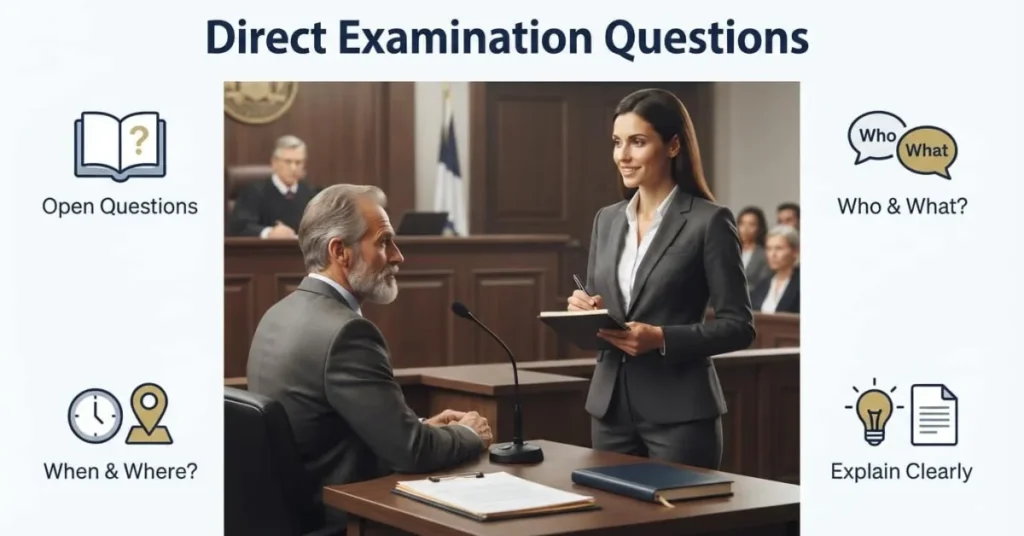
What Are Direct Examination Questions?
Direct examination questions are questions an attorney asks their own witness during the witness’s testimony. They are designed to introduce relevant facts, establish background, explain events, and support the issues being presented to the court.
Unlike cross-examination, direct examination generally avoids questions that suggest the desired answer.
Instead of asking:
“The light was red, wasn’t it?”
an attorney might ask:
“What color was the traffic light?”
The second question gives the witness room to provide the answer independently.
Examples of Direct Examination Questions
Here are examples that demonstrate how attorneys can move through a witness’s testimony.
Background Questions
- Please state your name.
- Where do you live?
- What do you do for work?
- How long have you worked there?
- How are you familiar with the people involved?
Event Questions
- Where were you that afternoon?
- What were you doing?
- What happened next?
- What did you see?
- What did you hear?
- Who was there?
Identification Questions
- Did you see anyone at the scene?
- How were you able to identify that person?
- Where was the person standing?
- What, if anything, helped you recognize them?
Follow-Up Questions
Follow-up questions are often where useful details emerge.
For example:
Attorney: What happened next?
Witness: The driver got out of the vehicle.
Attorney: What did the driver do after getting out?
That second question narrows the testimony without telling the witness what to say.
Direct Examination Techniques
Good direct examination is more than creating a long list of questions. The order and wording of those questions can make a major difference.
Start With Foundation
Before asking about an important event, establish why the witness has personal knowledge of it.
For example, rather than immediately asking what happened inside a building, establish that the witness was actually there.
Use a Logical Sequence
A chronological structure is often easy for both the witness and the fact-finder to follow:
Before the event → Event → Immediate aftermath → Later events
This prevents the testimony from jumping randomly between subjects.
Ask One Thing at a Time
Questions containing several different ideas can confuse witnesses.
Instead of:
“Where were you, who was with you, and what did you see when you arrived?”
break it into separate questions.
This gives the witness a better opportunity to answer accurately.
Listen to the Answer
One common mistake is becoming so focused on the prepared script that the attorney ignores what the witness actually says.
A witness’s answer may reveal an important detail that deserves a follow-up question.
Open-Ended Questions
Open-ended questions allow witnesses to explain events using their own words.
Examples include:
- What happened?
- What did you observe?
- What happened after you arrived?
- How did you respond?
- What did you notice?
- Can you describe what you saw?
Open-ended questions are especially useful when the attorney wants the witness to provide a narrative rather than simply answer yes or no.
For example, compare:
“Did the car hit your vehicle?”
with:
“What happened when the vehicles reached the intersection?”
The second question gives the witness more room to explain the event.
Leading Questions
A leading question generally suggests the answer within the question itself.
For example:
“You were standing outside the store, correct?”
The question points toward a particular response.
Leading questions are generally restricted during direct examination because the attorney is expected to obtain testimony from their own witness rather than supply the witness’s answers.
There can be exceptions depending on the circumstances and applicable rules. For example, courts may allow some leading questions when dealing with preliminary matters or certain witnesses.
Because courtroom rules vary, attorneys and students should check the applicable rules and court procedures rather than assume every leading question is prohibited or permitted.
Direct Examination Script
A direct examination script can help organize a witness’s testimony, but it should not become a speech that the attorney simply reads word for word.
A basic structure might look like this:
1. Introduction
- Please state your name.
- What do you do?
- How are you familiar with this matter?
2. Setting the Scene
- Where were you on the date in question?
- What were you doing there?
- Who else was present?
3. Main Event
- What happened?
- What did you observe?
- What happened next?
4. Important Details
- What did you do?
- What did you notice?
- How did you respond?
5. Closing the Testimony
- What happened afterward?
- Is there anything else you observed that day?
The script should serve as a roadmap. The witness’s actual answers should determine the necessary follow-up questions.
Direct Examination of Expert Witnesses
Direct examination of an expert witness is different from questioning an ordinary fact witness.
An expert may be asked about their education, training, experience, methodology, opinions, and the basis for those opinions.
Typical areas include:
- Education
- Professional training
- Certifications
- Work experience
- Specialized knowledge
- Prior experience with similar matters
- Materials reviewed
- Methods used
- Opinions reached
- Basis for those opinions
For example:
Attorney: What is your area of professional expertise?
Expert: I specialize in accident reconstruction.
Attorney: What experience do you have in that field?
The attorney may then establish the expert’s qualifications before moving into the specific opinion relevant to the case.
Direct Examination Witnesses
Not every witness should be questioned in exactly the same way.
A witness who personally observed an event may provide factual testimony. An expert may provide specialized opinions. Another witness may establish background information or explain records.
Before preparing direct examination questions, consider:
- What does this witness personally know?
- Why is their testimony relevant?
- Which facts can they establish?
- What documents or exhibits may be discussed?
- What questions will help explain their testimony?
- Are there weaknesses that need to be addressed?
The goal is not to ask every possible question. It is to obtain the testimony that actually matters.
Roles in a Personal Injury Trial
In a personal injury case, several people may play different roles.
The plaintiff is generally the person bringing the claim. The defendant is the person or entity being sued.
Witnesses may include:
- The plaintiff
- The defendant
- Eyewitnesses
- Medical professionals
- Accident reconstruction experts
- Employers
- Family members
- Other individuals with relevant personal knowledge
During direct examination, an attorney may ask the plaintiff about the incident, injuries, treatment, limitations, expenses, and other relevant facts.
The exact subjects depend on the case and the evidence.
Effective Direct Examination Questions
Effective questions are usually easier to answer when they are specific and purposeful.
Compare:
Weak:
“Tell us everything about what happened.”
More focused:
“Where were you when you first noticed the other vehicle?”
The second question gives the witness a clear starting point.
Another useful technique is to move from broad questions to specific details:
“What happened?”
Then:
“What did you see?”
Then:
“Where was the vehicle when you first saw it?”
Then:
“What happened immediately afterward?”
This approach can make complicated events easier for the judge or jury to follow.
Disability Judge Trick Questions
People preparing for a disability hearing sometimes worry that a judge will deliberately ask “trick questions.” Usually, it is more useful to think of these as questions that may require careful, accurate answers rather than traps.
Questions may address a person’s daily activities, work history, limitations, treatment, symptoms, or ability to perform certain tasks.
For example, a judge might ask:
- What does a typical day look like for you?
- How often can you perform that activity?
- What happens when you try to work or complete the task?
- What treatment have you received?
- What medications or other treatments have you tried?
- Why did you stop working?
- What prevents you from performing your previous job?
The safest approach is to answer honestly and specifically. Do not exaggerate limitations, but do not minimize genuine difficulties either.
For legal advice about an individual disability claim, a qualified attorney or accredited representative can provide guidance based on the person’s circumstances.
Common Disability Judge Trick Questions and How to Prepare
Preparation is less about memorizing perfect answers and more about understanding your own records and being able to explain your circumstances clearly.
Before a hearing, review important dates, work history, medical appointments, treatments, and daily activities. If you do not remember something, it is generally better to say that you do not remember than to guess.
Also remember that being able to perform an activity occasionally does not necessarily mean you can perform it consistently for an entire workday or workweek. If that distinction is relevant to your situation, explain it accurately when asked.
Interrogation Questions
The term interrogation questions usually refers to questioning intended to obtain information from someone, often in an investigative or law-enforcement context. That is different from direct examination in a courtroom.
Direct examination is part of a formal legal proceeding and follows rules of evidence and courtroom procedure.
Interrogation may involve different goals, procedures, and legal protections. Because the two concepts are often confused, it is important not to treat interrogation questions as a substitute for direct examination questions.
Conclusion
Strong direct examination is not about asking the largest number of questions. It is about asking the right questions in the right order so the witness can provide clear, relevant testimony.
Start with the foundation. Give the witness room to explain what they personally know, then use focused follow-up questions to develop the important details. Keep questions understandable, avoid unnecessary repetition, and pay attention to the answers instead of simply rushing through a script.
Whether you are studying trial advocacy, preparing for a mock trial, or learning how courtroom testimony works, practice matters. The best direct examination questions often look simple on paper because they are designed to let the witness, rather than the attorney, tell the story.
FAQs
Author

Hi, I’m Alex, and I enjoy learning through quizzes, trivia, and interactive questions. I love discovering new conversation starters, relationship topics, and educational challenges. This website is my go-to place for fun, practical, and reliable question-based content. I’m always excited to learn something new and share it with others.