50+ Periodic Table Questions to Test Your Chemistry Skills
If you’ve ever stared at the periodic table wondering why fluorine practically bites and helium won’t react with anything, you’re not alone these periodic table questions trip up students every single year. I’ve spent years explaining atomic structure to confused ninth-graders, and the confusion almost always traces back to a few core ideas about groups, periods, and electron configuration.
This guide answers the periodic table questions people actually ask from “what is the periodic table” to full practice sets with worked solutions. No jargon dump, no memorization drills that don’t explain why. Just clear answers, real examples, and enough practice to make the table finally make sense.
Periodic Table Questions and Answers
Most periodic table questions start in the same place: confusion about how 118 elements got organized into a grid that somehow predicts chemical behavior. Dmitri Mendeleev built the first working version in 1869, arranging elements by atomic weight rather than atomic number, since protons hadn’t been discovered yet.
The seven explainer questions below cover the concepts that show up in almost every classroom test and homework set on this topic periods, groups, periodicity, reactivity, and the history behind the table’s design.
What Is the Periodic Table?
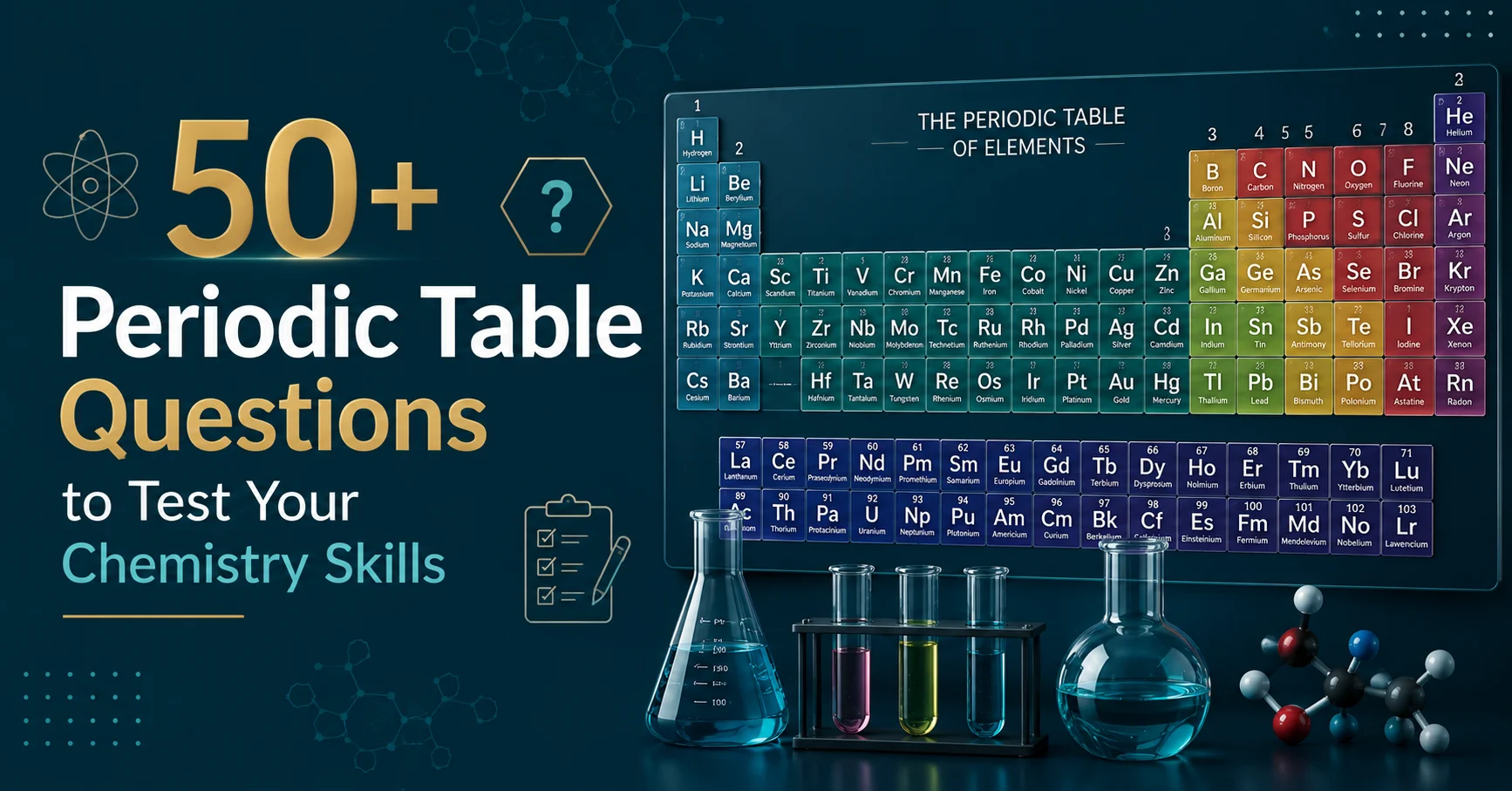
The periodic table is a chart that organizes every known chemical element by increasing atomic number and shared chemical properties. Atomic number counts the protons in an atom’s nucleus the one number that never changes for a given element, no matter how many neutrons or electrons it happens to have.
What Are Groups and Periods in the Periodic Table?
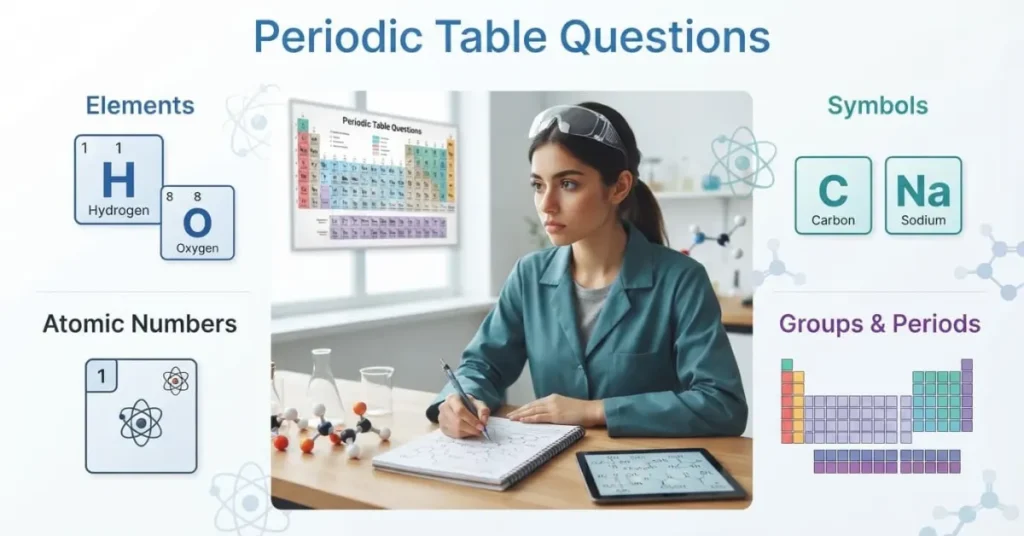
Rows are called periods; columns are called groups. Elements in the same period share the same outer electron shell, while elements in the same group share the same number of valence electrons which is why they behave alike chemically, even though their atomic size and mass differ significantly.
What Are Periodic Table Trends or Periodicity?
Periodicity describes how properties repeat in predictable patterns as you move across or down the table. Atomic radius shrinks left to right and grows top to bottom. Electronegativity and ionization energy do the reverse climbing across a period, dropping down a group because nuclear charge and electron shielding shift in opposite directions.
Electron affinity follows a looser version of the same logic: it generally increases across a period as atoms get hungrier for one more electron to complete their outer shell, though it doesn’t decrease as reliably down a group. These four trends atomic radius, electronegativity, electron affinity, ionization energy account for most periodic table questions on standardized tests.
Who Invented the Periodic Table?
Dmitri Mendeleev is credited as the inventor, though several chemists built partial versions before him. His 1869 table is the one that most closely resembles today’s, and he famously left gaps for undiscovered elements, correctly predicting properties elements hadn’t even been found yet.
Why Are the Noble Gases So Inert?
Noble gases sit in Group 18 with a completely full outer electron shell, which means they have no chemical incentive to lose, gain, or share electrons. Losing or gaining even one electron would actually make a noble gas atom less stable, which is the opposite of what drives reactivity in every other group.
Why Are the Halogens So Reactive?
Halogens sit one column over from the noble gases and are only one electron short of that same stable configuration. That single missing electron makes fluorine, chlorine, bromine, and iodine aggressively reactive they’ll form a bond with almost anything that lets them complete their outer shell.
What Are the Periodic Table Groups?
The periodic table’s groups carry names, not just numbers: alkali metals, alkaline earth metals, transition metals, basic metals, metalloids, nonmetals, halogens, and noble gases. Lanthanides and actinides are technically a specialized subset of the transition metals, pulled into their own two rows purely for layout convenience.
Periodic Table Chemistry Questions with Solutions
Q1. Which element has zero valency? Answer: Helium. A full outer shell means it forms zero bonds.
Q2. Moving down a group, how does metallic character change? Answer: It increases. Extra electron shells make it easier for atoms to lose electrons, which is what defines metallic behavior.
Q3. What is the relationship between electronegativity, ionization energy, and electron affinity (Mulliken’s scale)? Answer: Electronegativity = (Ionization Energy + Electron Affinity) / 2 Mulliken defined it as the average of the two.
Q4. What is the maximum number of electrons the first (K) shell can hold? Answer: 2 electrons. Each shell after that holds more 8, then 18, then 32.
Q5. Why do elements in the same group share similar properties? Answer: They have the same number of valence electrons, which is the main driver of chemical behavior.
Q6. An element has atomic number 12. What’s its group, period, and metal/nonmetal status? Answer: Electron configuration is 2, 8, 2 two valence electrons puts it in Group 2, three shells puts it in Period 3, and it’s a metal.
Practise Questions on Periodic Table
Try these without checking answers first that struggle is where the learning actually happens:
- Rank the electron affinities of N, O, S, and Cl from lowest to highest.
- Which alkali metal ion has the highest ionic mobility in water: Na⁺, K⁺, Rb⁺, or Li⁺?
- If the electronegativity difference between X and Y exceeds 1.7 in compound XY, what solvent will it dissolve in?
- An element’s first five ionization energies jump sharply between the second and third value. What does that jump tell you about its valence electron count?
- Explain, in your own words, the difference between electron gain enthalpy and electronegativity.
30 Periodic Table Quiz Questions & Answers
A multiple-choice format tests recall differently than open-response questions useful for quick self-checks before a test:
| # | Question | Answer |
| 1 | What is the chart organizing elements by atomic number called? | Periodic table |
| 2 | How many known elements does the periodic table currently list? | 118 |
| 3 | What are the periodic table’s rows called? | Periods |
| 4 | What are the periodic table’s columns called? | Groups |
| 5 | Which element has atomic number 1? | Hydrogen |
| 6 | What group name applies to Group 18? | Noble gases |
| 7 | What group name applies to Group 17? | Halogens |
| 8 | What group name applies to Group 1? | Alkali metals |
| 9 | What group name applies to Group 2? | Alkaline earth metals |
| 10 | What are the two bottom rows of the table called? | Lanthanides and actinides |
(Full 30-question set available in the downloadable PDF below.)
More Periodic Table Questions
Readers keep asking a handful of questions that don’t fit neatly into the categories above the ones that come up in casual curiosity rather than homework:
- Is the periodic table “finished”? Not really new superheavy elements are still being synthesized in labs, though anything beyond element 118 remains theoretical and extremely short-lived.
- Why doesn’t hydrogen get its own dedicated spot? Hydrogen is genuinely ambiguous it shares hydrogen bonds like an alkali metal (one valence electron) but also needs one more electron like a halogen, so different tables place it differently.
- Which element is liquid at room temperature besides mercury? Bromine is the only other one everything else on the table is solid or gas at standard conditions.
Download Periodic Table Questions & Answers for Free
Want a printable version to work through offline or hand out in a classroom? A downloadable PDF combining the explainer answers, worked solutions, and quiz questions above makes for a faster review session than scrolling useful before a test or as a homework packet.
Conclusion
Working through periodic table questions is a practical way to strengthen your understanding of chemistry and become more comfortable with elements, symbols, atomic numbers, groups, and periods. Whether you are preparing for an exam, reviewing classwork, or simply testing your knowledge, practicing different types of questions can reveal which topics you understand and where you need more review.
The key is to focus on understanding patterns rather than memorizing every detail. With regular practice, the periodic table becomes much easier to read and use. Keep challenging yourself with questions of varying difficulty, check your mistakes carefully, and use each one as a learning opportunity. A little consistent practice can make chemistry feel far less complicated.
FAQs
Author

Hi, I’m Alex, and I enjoy learning through quizzes, trivia, and interactive questions. I love discovering new conversation starters, relationship topics, and educational challenges. This website is my go-to place for fun, practical, and reliable question-based content. I’m always excited to learn something new and share it with others.