
100 Moral Dilemma Questions That Will Test Your Values
Some questions are easy to answer because you already know what feels right. Moral dilemma questions are different. They put two values against each other and make you pause: Would you tell the truth if it hurt someone you care about? Would you protect a friend who made a serious mistake? What if doing the fair thing meant making your own life harder?
That hesitation is exactly what makes these questions interesting. They reveal how people think about honesty, loyalty, fairness, responsibility, and consequences. There isn’t always one perfect answer, either.
Whether you’re looking for questions for a conversation, classroom debate, team activity, or a deeper discussion with friends, this collection gives you plenty of situations to explore. Some are serious, some surprisingly funny, and a few may leave you thinking long after you’ve answered them.
What Is a Moral Dilemma Question?
A moral dilemma question presents a situation where you have to choose between two or more options that involve competing values. In many cases, every choice has a consequence, which makes the decision harder than simply choosing between right and wrong.
For example, imagine your best friend asks you to keep a secret, but the secret could seriously affect another person. Do you respect your friend’s trust or speak up to prevent possible harm?
That tension is the heart of a moral dilemma.
These questions aren’t necessarily designed to find the “correct” answer. They are useful because they encourage people to explain why they would make a particular choice. Two people can face the same situation and reach completely different conclusions based on their experiences, priorities, and beliefs.
Moral Dilemma Questions for Everyday Life
Everyday decisions can involve more ethical thinking than we realize. These situations are especially useful because they’re easy to imagine and don’t require a background in philosophy.
Try these:
- Would you tell a friend that their new haircut looks bad if they asked for your honest opinion?
- If a cashier accidentally gave you too much change, would you return it?
- Would you tell your friend if you knew their partner was lying to them?
- If you found a lost wallet with cash inside, what would you do?
- Would you keep a secret if you knew revealing it could help someone?
- If someone took credit for your idea, would you confront them or let it go?
- Would you admit making a mistake if nobody else knew about it?
- If telling the truth could embarrass someone, would you still tell it?
- Would you give up your place in line to someone who was running late?
- If a friend asked you to lie for them, would you agree?
- Would you return something you bought if you later realized the seller accidentally undercharged you?
- If you saw someone being treated unfairly, would you speak up even if you were the only person doing so?
The interesting part isn’t just the answer. Ask the person explaining their choice what would change their mind. That’s often where the real conversation begins.
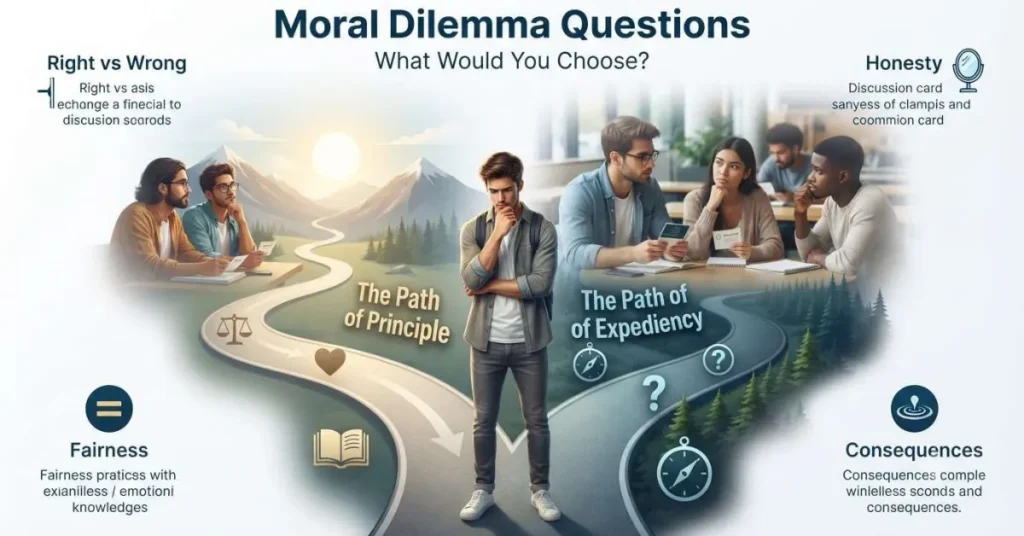
Hard Moral Dilemma Questions That Test Your Values
Hard moral dilemma questions force you to choose between values that both matter. There may be no comfortable option, which is why these are particularly good for serious conversations.
- Would you protect someone you love if they had done something seriously wrong?
- Is it ever acceptable to lie if the truth would cause unnecessary harm?
- Would you sacrifice your own opportunity so someone else could have theirs?
- If you could prevent one person’s suffering but cause a smaller problem for many others, would you do it?
- Should people always be judged by their actions, or should their intentions matter just as much?
- Would you expose a friend’s wrongdoing if you knew it could permanently damage your friendship?
- If following a rule would clearly produce an unfair result, should you break the rule?
- Is keeping a promise still important when circumstances have completely changed?
- Would you forgive someone who sincerely regretted something that seriously hurt you?
- If you had to choose between loyalty and fairness, which would come first?
- Should someone receive a second chance after making a serious mistake?
- Is it more important to have good intentions or produce good results?
These questions work especially well when everyone explains the principle behind their answer. One person may focus on consequences while another may care more about rules, loyalty, or personal responsibility.
Funny Moral Dilemma Questions
Not every ethical question needs to become a serious philosophical debate. Sometimes a ridiculous situation makes people reveal their reasoning in the funniest way.
Try these lighter moral dilemmas:
- If your friend made terrible food and proudly asked whether you liked it, would you tell the truth?
- Would you let your friend believe they won a game fairly if you secretly knew they had cheated?
- If you could only save your favorite snack or your phone from a spilled drink, which would you choose?
- Would you tell someone they had been wearing their shirt backward all day?
- If your friend sent you a terrible selfie and asked you to choose the best one, would you be honest?
- Would you give the last slice of pizza to your friend if you wanted it just as badly?
- If you accidentally became famous because of an embarrassing video, would you admit it was you?
- Would you let your friend win a board game because they were having a terrible day?
- If your sibling blamed the family pet for something you did, would you correct them?
- Would you tell someone their joke wasn’t funny if they kept telling it?
- If you could eat only one dessert forever but your friend wanted the same one, would you share?
- Would you pretend to understand a complicated explanation rather than admit you were completely lost?
The best funny dilemmas are harmless but still make people choose. They can quickly turn a quiet group into a surprisingly lively conversation.
Moral Dilemma Questions for Relationships and Friendship
Friendships and relationships often create difficult choices because emotions and loyalty are involved. What seems obvious from the outside can feel very different when someone you care about is involved.
- Would you tell your friend if you thought their relationship was unhealthy?
- Should you forgive a friend who broke your trust once?
- Would you keep a friend’s secret if you disagreed with what they were doing?
- If two close friends had an argument, would you refuse to take sides?
- Would you tell your friend that someone was talking badly about them?
- Is loyalty more important than honesty in a friendship?
- If your friend apologized but repeated the same mistake, would you give them another chance?
- Would you distance yourself from a friend whose values had changed significantly?
- If a friend asked for honest advice but clearly wanted reassurance, what would you give them?
- Should you forgive someone who never apologizes?
- Would you choose your oldest friendship over a newer friendship that feels healthier?
- If telling your friend the truth could end your friendship, would you still say it?
These questions can reveal what people value most in relationships. Some prioritize honesty, while others believe protecting a friend’s feelings can sometimes be the kinder choice.
Moral Dilemma Questions for Work and Leadership
Workplace dilemmas often involve responsibility, fairness, loyalty, and pressure. These questions are useful for team discussions, leadership activities, and professional development.
- Would you report a coworker’s mistake if it could affect the whole team?
- Should a manager treat every employee exactly the same?
- Would you take credit for a successful project if your contribution was much larger than everyone else’s?
- If your manager asked you to do something you believed was unfair, would you refuse?
- Should a talented employee receive special treatment if they consistently produce excellent work?
- Would you tell your boss if a coworker was being treated unfairly?
- If a team member wasn’t contributing but had personal problems, should the team make up for their work?
- Is it ethical to hire the most qualified candidate if you know another candidate needs the job more?
- Would you admit a mistake that could hurt your chances of getting promoted?
- Should a leader prioritize employee happiness or business results when the two conflict?
- If you discovered a colleague was secretly taking credit for other people’s work, would you report it?
- Should employees ever break company rules to help a customer?
There is rarely a simple answer in workplace dilemmas. Leadership often means balancing what is fair to individuals with what is best for the larger group.
Moral Dilemma Questions for Students and Classroom Debates
A good classroom dilemma doesn’t simply ask students what they think. It gives them something worth defending.
Here are some debate-friendly questions:
- Should students be allowed to use AI for school assignments?
- Is it ever acceptable to break a school rule for a good reason?
- Should students receive the same grade when they contribute different amounts to a group project?
- Is copying homework always wrong?
- Should schools punish students for things they post outside school?
- Should a student tell a teacher if their friend cheated on a test?
- Is it fair to give extra help to students who are struggling?
- Should schools prioritize academic achievement or student well-being?
- Is a good intention enough to excuse a bad decision?
- Should students be allowed to challenge a teacher’s decision publicly?
- Is it fair to judge someone for a mistake they made when they were younger?
- Should everyone get the same opportunity even if people have very different circumstances?
For classroom discussions, ask students to explain their reasoning and consider the strongest argument from the opposite side. That turns a simple question into a genuine critical-thinking exercise.
Morality Questions for Deep Conversations
Some moral questions don’t have an obvious stopping point. One answer leads naturally to another, making them ideal for long conversations.
- What makes an action truly good?
- Can someone be a good person and still do bad things?
- Is intention more important than consequence?
- Do people have a moral responsibility to help strangers?
- Can breaking a rule ever be the most ethical choice?
- Should forgiveness always be offered?
- Is fairness more important than equality?
- Can something be morally right even if most people think it’s wrong?
- Do people become responsible for consequences they didn’t intend?
- Is it possible to be completely objective when making moral decisions?
- Should people be judged by who they are now or by what they have done in the past?
- Does having more power create greater moral responsibility?
These questions become more interesting when you resist the urge to find a quick answer. Sometimes the reasoning matters more than the final position.
Funny Philosophical Questions
Philosophy doesn’t always have to sound serious. A strange question can sometimes lead to a surprisingly deep conversation.
- If you could know exactly when someone was lying, would you want that ability?
- If everyone forgot a mistake you made, would you still feel responsible for it?
- If an identical copy of you existed, would that person have the same responsibilities as you?
- If you could erase one embarrassing memory, should you?
- If nobody could see your good actions, would you still do them?
- If a robot could perfectly imitate human emotions, should we treat it like a person?
- If you could know the truth about everything but could never change anything, would you want to know?
- If everyone always told the truth, would society actually become better?
- If you could live forever but everyone you loved could not, would you choose immortality?
- If two people remember the same event differently, does one of them have to be wrong?
The fun comes from how quickly these questions move from silly to surprisingly complicated.
Ethical Questions to Ask
Ethical questions are useful when you want to explore how people make decisions rather than simply what decisions they make.
- What should matter most when making a difficult decision?
- Is honesty always the best policy?
- When does loyalty become harmful?
- Should consequences determine whether an action is right or wrong?
- Do people have an obligation to speak up when they see injustice?
- Is it ethical to prioritize yourself sometimes?
- Should good actions require good intentions?
- Can doing nothing be an unethical choice?
- Does power make people more responsible for their decisions?
- Should people be held responsible for mistakes they didn’t intend to make?
- Is it possible for something to be legal but still unethical?
- Should everyone receive forgiveness after making a serious mistake?
These work particularly well in small groups because different answers often reveal very different ideas about responsibility and fairness.
Big Questions for Debate
If you want a discussion that gets people thinking, choose questions where reasonable people can defend opposing positions.
- Is freedom more important than security?
- Should everyone be treated equally or according to their needs?
- Can censorship ever be justified?
- Should personal privacy be sacrificed to protect public safety?
- Is punishment more important than rehabilitation?
- Should wealth influence access to important opportunities?
- Is it ever acceptable for the majority to limit a minority’s freedom?
- Should people be judged primarily by their actions or their intentions?
- Can a society be truly fair if people begin life with very different advantages?
- Should technology be used whenever it can solve a problem, even if there are unknown consequences?
- Is breaking an unjust law morally acceptable?
- Should future generations influence the decisions we make today?
For a strong debate, don’t stop at asking which side someone supports. Ask them what evidence, principle, or situation could change their mind.
Deep Moral Questions to Ask
When you’re having a serious conversation, the best moral questions are often the ones that make you reconsider your first answer.
- What do you owe to people who have done nothing for you?
- Can a morally good person make an unforgivable choice?
- Is protecting someone’s feelings ever more important than telling the truth?
- When does self-interest become selfishness?
- Should people be judged by their worst mistake?
- Is forgiveness a moral responsibility or a personal choice?
- Can someone deserve compassion without deserving trust?
- Is doing nothing a decision?
- How much responsibility should people take for consequences they could not predict?
- Does having good intentions make a harmful action more acceptable?
- Is loyalty still valuable when the person you’re loyal to is wrong?
- What matters more: being a good person or doing good things?
- Can justice exist without compassion?
- Are there situations where the right thing is also the most painful thing to do?
- If nobody would ever know about your decision, would your moral choice change?
These are the questions worth lingering over. They don’t have to end with agreement. Sometimes the most valuable part is discovering why another person sees the same situation so differently.
How to Use Moral Dilemma Questions
The setting can change how these questions work. With friends, start with funny or everyday dilemmas before moving toward deeper subjects. In a classroom, give everyone time to think before asking for explanations. For a team discussion, choose situations connected to fairness, leadership, responsibility, or decision-making.
A simple follow-up can make almost any question more interesting:
“Why?”
Then try:
“What would change your answer?”
Those two questions move the conversation beyond quick opinions and into actual reasoning. You may also find that people become more thoughtful when they hear an argument they hadn’t considered before.
Why Moral Dilemma Questions Are Worth Asking
The value of a moral dilemma isn’t necessarily in solving it. It’s in the conversation that follows.
These questions can show how people think about honesty, loyalty, fairness, responsibility, forgiveness, and consequences. They can also reveal that two people can value the same principle but apply it differently.
That’s what makes them useful for friendships, classrooms, workplaces, family conversations, and debates. You don’t need everyone to reach the same answer. In fact, disagreement is often what makes the discussion worthwhile.
The next time you’re looking for a question that goes beyond small talk, choose a dilemma that doesn’t have an easy answer. Give everyone a moment to think, hear the reasoning behind each response, and see where the conversation goes.
Sometimes the most interesting answer isn’t the choice itself. It’s why someone made it.
Conclusion
Moral dilemma questions have a simple way of turning an ordinary conversation into something much more meaningful. They make us think about what we value, where we draw our boundaries, and whether our choices would change when the circumstances get complicated.
There isn’t always a perfect answer, and that’s part of the appeal. A question about honesty might become a conversation about loyalty. A debate about fairness might reveal completely different ideas about responsibility.
Whether you’re using these questions with friends, students, coworkers, or family, don’t worry about reaching the same conclusion. Ask people to explain their reasoning, listen to the other side, and consider what might change their minds. You may learn something about them and perhaps a little more about yourself, too.
FAQs
Author

Hi, I’m Alex, and I enjoy learning through quizzes, trivia, and interactive questions. I love discovering new conversation starters, relationship topics, and educational challenges. This website is my go-to place for fun, practical, and reliable question-based content. I’m always excited to learn something new and share it with others.

One Comment