
25+ Essential Psych Evaluation Questions You Should Know Beforehand
You might know that you need a mental health evaluation, yet still wonder what you’ll actually be asked. Will the psychiatrist focus on your mood? Your past? Your relationships? Maybe you’re worried you’ll say the “wrong” thing or forget an important detail. Those concerns are common, especially if this is your first evaluation.
Psych evaluation questions are designed to help a mental health professional understand what you’re experiencing, how it affects your daily life, and what may be contributing to it. The conversation can cover symptoms, emotions, behavior, medical history, medications, family history, sleep, stress, and other parts of your life.
This guide walks you through the questions you may encounter, what they are trying to uncover, how to prepare, and what you can ask during your own appointment.
What Is a Psychiatric Evaluation?
A psychiatric evaluation is a professional assessment used to better understand a person’s mental health concerns. Rather than relying on one question or one test, a provider may consider your symptoms, thoughts, feelings, behavior, medical history, family history, medications, and how you’re functioning in everyday life.
Depending on the situation, an evaluation may include an interview, questionnaires, a review of your medical history, and sometimes a physical examination or laboratory testing when a physical health condition could be contributing to symptoms.
The goal isn’t to give you a test that you can pass or fail. The more accurate picture you can give your provider, the easier it may be for them to understand what you’re experiencing and discuss appropriate next steps.
Common Psych evaluation questions
There isn’t one fixed list of questions that every psychiatrist uses. Your questions will depend on why you’re seeking help, your symptoms, your history, and the type of evaluation you’re receiving.
You may be asked things such as:
- What brought you in today?
- When did you first notice the problem?
- How often does it happen?
- How has it affected your daily life?
- Have your symptoms changed over time?
- How have you been sleeping?
- Have you noticed changes in your appetite or energy?
- How well can you concentrate?
- Have you received mental health treatment before?
- Are you currently taking any medications or supplements?
- Has anyone in your family experienced mental health problems?
Providers may also ask about substance use, major life changes, relationships, work or school, and other circumstances that could affect your mental health.
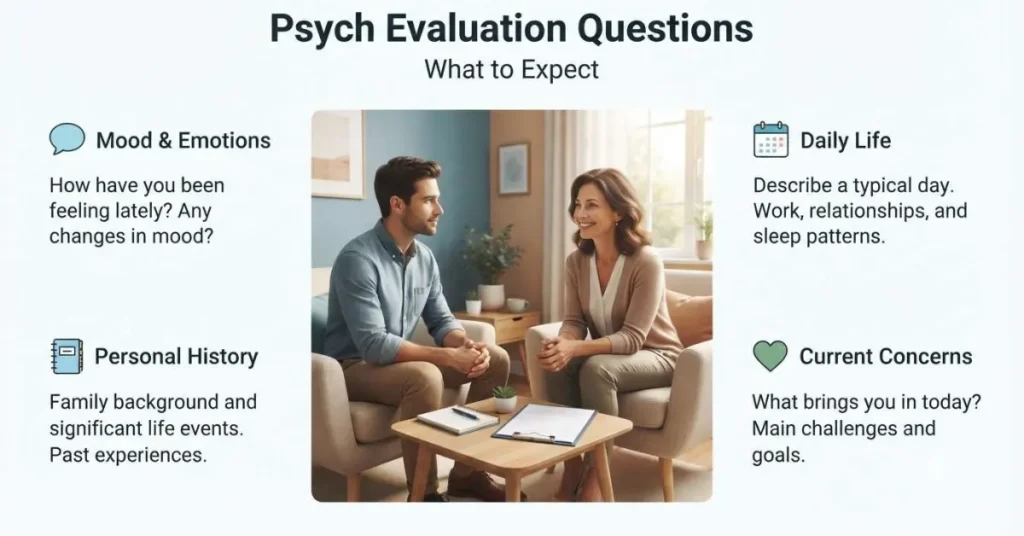
What Questions Are Asked During a Psychological Assessment?
A psychological assessment can involve psych evaluation questions about your mood, thinking, behavior, memory, relationships, and everyday functioning. You might answer questions verbally, complete standardized questionnaires, or discuss your answers with the professional conducting the assessment.
For example, you may be asked whether you’ve noticed changes in your concentration, motivation, sleep, emotions, or ability to handle normal responsibilities.
The important thing is to answer honestly rather than trying to guess which response sounds best. A mental health professional needs your actual experience, not a perfect answer.
Mental Health Assessment Questions: What to Expect
Mental health assessment questions often look at several areas at once. A provider may want to understand what you’re experiencing, when it started, how severe it is, and how it affects your life.
Questions may cover:
- Mood and emotions
- Anxiety and stress
- Sleep and appetite
- Energy and concentration
- Thoughts and behavior
- Relationships and social life
- School or work
- Previous treatment
- Medications and supplements
- Medical history
- Family mental health history
- Alcohol or drug use
This broader picture can help a provider consider different possible explanations for your symptoms instead of focusing on one symptom in isolation.
Questions You Can Expect During a Psychiatric Evaluation
1. What brings you in today?
This is often a natural starting point. You might explain what has been bothering you, what changed, or why someone recommended an evaluation.
You don’t need a perfect explanation. A simple description of what you’ve noticed is enough to begin the conversation.
2. When did you first notice these symptoms?
Your provider may want to know whether the problem started recently, gradually developed, or has been happening for a long time.
They may also ask whether something changed around the time your symptoms began.
3. How are these symptoms affecting your daily life?
A provider may ask about school, work, relationships, responsibilities, sleep, concentration, and activities you normally enjoy.
This helps show not only what you’re feeling but also how those experiences are affecting your functioning.
4. Have you experienced anything similar before?
Past episodes or previous mental health concerns can provide useful context. Your provider may also ask whether you’ve previously seen a psychiatrist, therapist, counselor, or another mental health professional.
5. Are you taking any medications or supplements?
Tell your provider about prescription medications, over-the-counter medicines, vitamins, and supplements you’re taking. NIMH specifically recommends preparing a medication list before a mental health appointment.
Psych evaluation questions About Mood and Emotions
Your provider may ask how you’ve been feeling emotionally and whether your mood has changed.
Possible questions include:
- How would you describe your mood lately?
- Have you been feeling unusually sad or low?
- Have you felt unusually irritable?
- Have you lost interest in activities you normally enjoy?
- Have you experienced periods of feeling unusually energized or active?
- Do your emotions seem difficult to control?
- Have you noticed significant changes in your motivation?
You may also be asked about feelings of hopelessness, guilt, worry, or emotional numbness.
Try to describe what actually happens rather than choosing the answer you think your provider expects.
Psychiatric Evaluation Questions About Anxiety and Stress
An evaluation may explore both everyday stress and symptoms of anxiety.
You could be asked:
- What situations make you feel anxious?
- How often do you feel worried?
- Is it difficult to control your worries?
- Do you avoid certain situations because of fear or anxiety?
- Have you experienced sudden episodes of intense fear?
- Has stress affected your sleep or concentration?
- Have there been major changes in your life recently?
Stressful events and life changes can be important parts of the mental health picture, so your provider may ask about them directly.
Psych evaluation questions About Behavior and Daily Life
Mental health isn’t only about emotions. Providers may also ask about changes in your behavior and everyday routines.
Questions can include:
- How have you been sleeping?
- Has your appetite changed?
- How is your energy?
- Are you having trouble concentrating?
- Have you stopped doing activities you normally enjoy?
- How are things going at school or work?
- Have your relationships changed?
- Are you finding it difficult to keep up with responsibilities?
These questions help connect symptoms with real-life functioning rather than looking at each symptom separately.
Psych evaluation questions About Medical and Family History
Your physical health and family history can be relevant during a psych evaluation questions .
A provider may ask about:
- Previous medical conditions
- Past mental health diagnoses
- Current medications
- Previous treatments
- Family history of mental health conditions
- Significant medical events
- Sleep problems
- Previous evaluations
Family history can provide useful information because some mental health conditions tend to run in families.
A provider may also consider whether a physical health issue or medication could be contributing to symptoms. In some circumstances, medical examinations or laboratory tests may be used to investigate possible physical causes.
Questions to Ask a Psychiatrist During Your Visit
Remember that the appointment isn’t only about answering questions. You can ask questions too.
Useful questions include:
- What might be contributing to what I’m experiencing?
- Do you need more information before making an assessment?
- What treatment options might be appropriate?
- What are the possible benefits and side effects of treatment?
- Are there non-medication options?
- What should I expect at the next appointment?
- How will we know whether treatment is helping?
- Are there other professionals I should see?
NIMH recommends preparing questions before an appointment and speaking openly with your provider if you have concerns about a diagnosis or treatment recommendation.
How to Prepare for a psych evaluation questions
You don’t need to memorize your entire history. A little preparation can make the appointment easier.
Before your visit, consider writing down:
- Your main concerns
- When symptoms began
- Important changes you’ve noticed
- Current medications and supplements
- Previous mental health treatment
- Relevant medical conditions
- Family mental health history
- Questions you want to ask
It can also help to note examples. Instead of saying, “My sleep is bad,” you might write down what has actually changed and when you noticed it.
NIMH recommends preparing questions and medication information ahead of time and notes that some people find it helpful to bring a trusted friend or relative for support.
Most importantly, be honest. You don’t have to make your experiences sound better or worse than they are. Specific, truthful information gives your provider a clearer picture.
What Happens After a psych evaluation questions ?
What happens next depends on what the evaluation finds and what you and your provider discuss.
You may receive an explanation of the provider’s assessment, recommendations for further evaluation, treatment options, referrals, or a plan for follow-up. Some people may need additional information before a diagnosis or treatment plan becomes clear.
Treatment can vary considerably. Depending on the situation, it may involve psychotherapy, medication, other forms of support, or a combination of approaches.
Don’t feel that you have to understand everything before leaving the appointment. If something is unclear, ask your provider to explain it in simpler terms or write down the next steps.
Psych evaluation questions
“Psych eval questions” is a common way people refer to the questions asked during a psychiatric or psychological evaluation.
They may cover much more than a person’s current mood. Expect questions about symptoms, thoughts, behavior, sleep, daily functioning, medical history, family history, medications, previous treatment, and significant life events.
The exact questions vary from one evaluation to another. There isn’t a universal script, and you don’t need to prepare answers that sound perfect.
If you’re nervous, bringing a short written list of symptoms and questions can give you something to refer to during the appointment.
Recovery Questions
If you’re already receiving mental health care, you may also have questions about recovery and progress.
You might ask:
- How will we measure progress?
- What changes should I look for?
- How long might improvement take?
- What should I do if symptoms return?
- What should I do if treatment isn’t helping?
- When should we review the treatment plan?
Recovery isn’t necessarily a straight line. Your provider can help you understand what progress may look like for your particular situation.
Fun Questions to Ask Dementia Patients
When talking with someone who has dementia, simple and familiar questions can encourage conversation without making the interaction feel like a test.
Try questions such as:
- What was your favorite game growing up?
- What music did you enjoy when you were younger?
- What was your favorite holiday?
- What kind of food did you love as a child?
- What was your favorite place to visit?
- What was your first job like?
- What hobbies did you enjoy?
The goal is connection, not testing memory. If a person doesn’t remember something, gently move the conversation in another direction.
Questions to Ask Elderly People
Older adults often have a lifetime of experiences that can make wonderful conversation starters.
You could ask:
- What was your hometown like when you were young?
- What did you enjoy doing after school?
- What was your favorite family tradition?
- Who influenced you most when you were younger?
- What kind of music did you enjoy?
- What is a skill you’re proud of learning?
- What advice would you give your younger self?
Open-ended questions tend to create a better conversation than questions that can be answered with only “yes” or “no.”
Questions to Ask Children
Questions for children should match their age and communication abilities. Keep them simple and give them time to answer.
Examples include:
- What was the best part of your day?
- What made you laugh today?
- Is anything bothering you?
- Who do you like spending time with?
- What is something you’re proud of?
- What would you change about your day?
- What are you looking forward to?
For a child’s formal mental health evaluation, professionals may gather information from parents or caregivers and, when appropriate, from the child, school, or other relevant sources.
Long Term Care Memory Questions
Memory questions in long-term care settings should be used thoughtfully. A person’s response can depend on many factors, including their health, communication abilities, environment, and the situation at the time.
Conversation-based questions might include:
- What did you enjoy doing this morning?
- Would you like to tell me about your favorite hobby?
- What kind of music do you like?
- Would you like to talk about a favorite meal?
- What activities would you enjoy doing today?
For formal memory concerns, assessment should be handled by an appropriate healthcare professional rather than relying on casual questions alone.
Psychiatric Evaluation FAQs
How long does a psych evaluation questions take?
The length varies depending on the purpose of the evaluation, the provider, and how much information needs to be reviewed. Some assessments may be relatively brief, while more comprehensive evaluations can take longer.
Should I prepare for psych evaluation questions?
Yes. You don’t need to memorize answers, but writing down your main concerns, symptoms, medications, relevant history, and questions can help you remember important details.
Should I be completely honest during a psychiatric evaluation?
Being honest and specific is important. Your provider needs accurate information about your symptoms and circumstances to understand your situation and discuss appropriate care.
Can a psychiatric evaluation include questions about physical health?
Yes. Medical history can be relevant, and providers may consider whether a physical condition or medication could contribute to symptoms. Depending on the situation, a physical exam or laboratory tests may also be appropriate.
Can I ask questions during the evaluation?
Absolutely. You can ask about the assessment, possible explanations for your symptoms, treatment choices, next steps, and anything you don’t understand. NIMH recommends preparing questions and discussing concerns openly with your provider.
What if I don’t know how to answer a question?
It’s okay to say that you don’t know, don’t remember, or aren’t sure. You can also ask the provider to explain the question differently. The purpose of the conversation is to understand your situation, not to give you a test you have to pass.
Are psychiatric evaluations the same for everyone?
No. The questions depend on the person’s concerns, history, age, symptoms, and reason for the evaluation. A child, teenager, and adult may have different assessment processes.
What should I bring to a psychiatric evaluation?
Consider bringing a list of medications and supplements, relevant medical information, notes about your concerns and symptoms, and questions you want to ask. NIMH recommends preparing these details before the appointment.
What is the most important thing to remember?
You don’t need to have everything figured out before an evaluation. Your job is to describe what you’ve been experiencing as clearly and honestly as you can. The mental health professional’s job is to listen, ask follow-up questions, and help determine the appropriate next steps.
If you’re experiencing severe or distressing mental health symptoms, reaching out to a qualified healthcare professional is a good place to start. NIMH recommends talking with a healthcare provider when symptoms are interfering with everyday life or causing significant distress.
Conclusion
Preparing for psych evaluation questions can feel uncomfortable, especially when you don’t know what the conversation will involve. But you don’t need perfect answers or a carefully rehearsed story. The most useful information is usually the honest, everyday detail: what changed, how long you’ve noticed it, what makes things harder, and how it is affecting your life.
A short list of psych evaluation questions symptoms, medications, important history, and questions can make the appointment easier to navigate. Most importantly, remember that an evaluation is a conversation designed to help a professional understand your situation. If you don’t understand something, ask. If you aren’t sure about an answer, say so. Being open gives you and your provider a better starting point for deciding what comes next.
FAQs
Author

Hi, I’m Alex, and I enjoy learning through quizzes, trivia, and interactive questions. I love discovering new conversation starters, relationship topics, and educational challenges. This website is my go-to place for fun, practical, and reliable question-based content. I’m always excited to learn something new and share it with others.






2 Comments