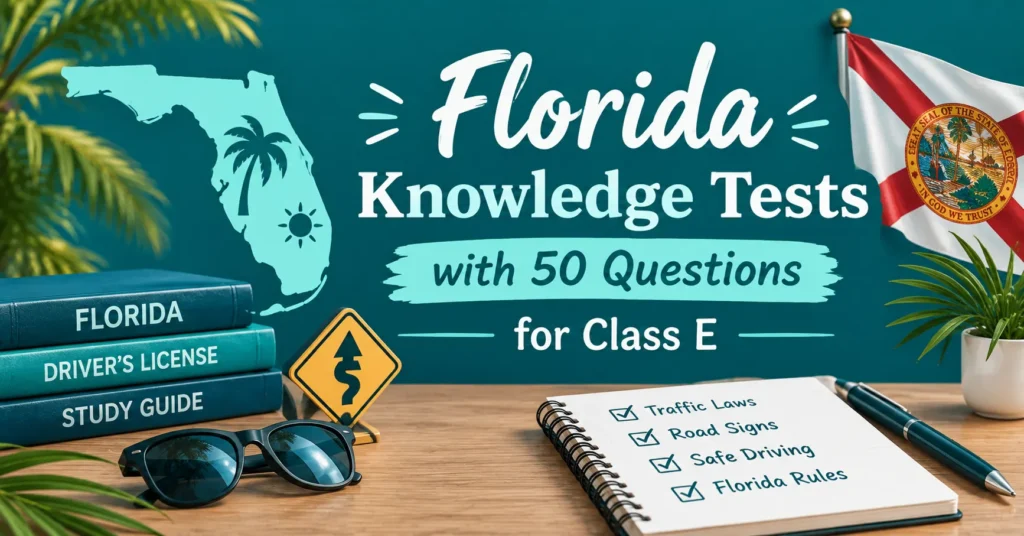
50+ Florida Knowledge Test Questions for Class E: Complete Practice Guide
The Florida Knowledge Test Questions for Class E is the written exam you must pass to earn a learner’s license, and you need 40 correct answers exactly 80 percent to clear it. I’ve walked more than a few nervous fifteen-year-olds and their equally nervous parents through this process, and the same thing trips almost everyone: they study the Florida Driver License Handbook cover to cover but never learn how FLHSMV actually weights the questions. Road signs and traffic laws carry far more of the exam than substance abuse content does.
That gap between studying hard and studying smart is why capable teenagers walk out of a service center having missed eleven questions instead of nine. This guide breaks down the exam structure, the topic-by-topic scoring, the online versus in-person testing options, and the DETS and TLSAE requirements that changed in 2025 the single point most pages still get wrong. Read it once and you’ll know precisely where to spend your study hours.
What Is the Florida Knowledge Test Questions for Class E?
The Class E Knowledge Exam is Florida’s official written test for a learner’s license, built entirely from the Official Florida Driver License Handbook. FLHSMV describes it as 50 multiple-choice questions covering Florida traffic laws, safe driving practices, and identifying traffic controls. Every question traces back to handbook content, so nothing on exam day should feel unfamiliar.
What surprises most first-time applicants is that the knowledge exam is only one gate of several. Before you sit for it you’ll need the required education course, and afterward you’ll face a vision and hearing screening before the Department of Highway Safety and Motor Vehicles issues anything. The written test is the milestone people remember, but it’s genuinely step two of five.
Who Must Take the Exam?
Anyone who has never held a driver license in any state or country must pass this exam before a Florida learner’s license is issued. That includes teens aged 15 to 17, adults applying for the first time, and new residents whose out-of-state license has been expired past the allowable window. Straight renewals don’t require retesting.
Test Format and Scoring on the Florida Class E Knowledge Test
The math is unforgiving in a way that’s worth internalizing early: 50 questions, 40 correct to pass, which means ten wrong answers is your absolute ceiling. Miss eleven and you’re scheduling a retest and paying a retest fee. Knowing the exact margin changes how you approach a question you’re genuinely unsure about.
Class E knowledge examinations are offered in Arabic, Chinese, English, Haitian Creole, Russian, and Spanish, which removes a real barrier for Florida’s multilingual families. When a third-party administrator delivers the exam online, a 60-minute limit typically applies and unanswered questions are scored as incorrect once time expires.
Exam Structure
| Detail | Information |
| Number of questions | 50 multiple-choice |
| Passing score | 80% (40 out of 50) |
| Maximum you can miss | 10 |
| Time limit | 60 minutes via third-party online administration |
| Languages | Arabic, Chinese, English, Haitian Creole, Russian, Spanish |
| Retake allowed | Yes, with a retest fee |
Scoring Breakdown by Topic
Questions are drawn proportionally across five content areas. Half the exam sits in just two of them, which is exactly where your study time should concentrate rather than spreading evenly across the handbook.
| Topic area | Share of test | Approximate questions |
| Road signs and pavement markings | 25% | 12–13 |
| Traffic laws and regulations | 25% | 12–13 |
| Safe driving practices | 20% | 10 |
| Alcohol and drug awareness | 15% | 7–8 |
| Vehicle equipment and inspection | 15% | 7–8 |
Florida Knowledge Test Questions: Quick Facts
If you remember nothing else, remember these numbers. The learner’s license minimum age is 15, the permit holding period before a full Class E driver license is 12 months, and the passing threshold never moves off 80 percent regardless of where or how you test.
One detail that catches families off guard: passing results stay valid for a limited window, so a teen who tests in January and delays the service center visit until the following year may need to sit the exam again. Book the appointment while the score is fresh.
Online vs. In-Person: What’s the Difference for the Class E Knowledge Test?
The split is driven entirely by age. Applicants under 18 can take the Class E Knowledge Exam online through an approved third-party administrator. Adults 18 and over take it in person at a service center or county tax collector’s office. There is no adult at-home option, which is the most common misconception I encounter.
Either route produces the same result in FLHSMV’s records. When you pass through a registered third-party administrator, your exam information is transmitted to the Department automatically and becomes visible at every driver license office statewide no certificate to lose in a backpack.
Online Exam (Available for Teens)
Testing at home removes the waiting room, but it adds paperwork. A Parent Proctoring Form is required, and it must be notarized or signed in the presence of a driver license examiner. Handle that before test day. Sit somewhere quiet, confirm your connection is stable, and read every question fully.
In-Person Exam (Adults 18+)
Arrive early with your TLSAE certificate and REAL ID-compliant documents in hand. You’ll test at a computer station in most offices and receive your result immediately. Bring corrective lenses if you wear them the vision screening happens the same visit, and forgetting glasses stalls the whole application.
Can You Take the Florida Written Driving Test Online?
Yes, if you’re under 18 and testing through an FLHSMV-approved third-party administrator with a notarized Parent Proctoring Form. Many high school driver education classes also administer the exam through the Driver Education Licensing Assistance Program, where a teacher enters results directly into FLHSMV’s test records.
One statutory catch deserves attention. Under Florida Statutes 322.56(3)(b) and (e), anyone who passes the knowledge exam or skills test through an authorized third-party administrator may be randomly selected for a no-fee mandatory re-test without prior notice. Fail that re-test and a re-exam fee applies at your next attempt.
What the Florida Knowledge Test Questions Covers in Detail
Across all five content areas, the exam consistently rewards people who understand why a rule exists rather than those who memorized an answer key. Situational questions who proceeds first at a four-way stop, what a flashing red light requires dominate the traffic law section.
Below is what each area actually tests. Match your study hours to the percentages in the scoring table above, and treat road signs as the highest-leverage category on the entire exam.
Road Signs and Pavement Markings (25%)
Regulatory, warning, and guide signs all appear, along with solid lines, broken lines, double lines, and crosswalk markings. Learn shapes and colors as a system octagon means stop, pentagon means school zone, orange means construction and you can answer correctly even when a sign’s wording is unfamiliar.
Traffic Laws and Regulations (25%)
Right-of-way at intersections, speed limits by road type, passing rules, turning laws including right-on-red, parking regulations, school bus laws, and Move Over Act requirements. Florida’s school bus rules in particular produce more wrong answers than almost any other single topic.
Safe Driving Practices (20%)
Following distance, stopping distance, hazard recognition, night and adverse-weather driving, seat belt law, and Florida’s distracted driving statutes. Expect questions about sharing the road with pedestrians, cyclists, and motorcyclists the handbook treats these as safety obligations, not courtesies.
Alcohol and Drug Awareness (15%)
DUI penalties, the 0.08 percent BAC limit for drivers 21 and over, the 0.02 percent limit under 21, implied consent, and zero tolerance for minors. Prescription and over-the-counter impairment appears here too, which catches people who studied only illegal substances.
Vehicle Equipment and Inspection (15%)
Required headlights, brake lights, turn signals, horn, mirrors, tire condition, windshield wipers, and license plate display. This section overlaps heavily with the vehicle inspection performed before your driving skills test, so learning it once serves you twice.
How to Prepare for the Florida Knowledge Test Questions for Class E
The preparation sequence that works is narrow and repeatable: read the handbook once for coverage, complete your required course, then drill practice questions until your weak areas stop being weak. Most people invert this and take practice tests first, which just measures ignorance repeatedly.
Give yourself two weeks rather than two nights. Retention research and every examiner I’ve spoken with point the same direction spaced review across several sessions beats one long cram, especially for sign recognition, which is essentially visual vocabulary.
Step 1: Study the Florida Driver License Handbook
The Official Florida Driver License Handbook is the sole source of exam content, published by FLHSMV. Read it straight through once for orientation, then return to the road signs and traffic law chapters repeatedly. Those two sections alone account for roughly 25 of your 50 questions.
Step 2: Complete Your DETS or TLSAE Course
This is where most pages are out of date. Effective August 1, 2025, Florida’s six-hour Driver Education Traffic Safety course replaced the four-hour TLSAE for first-time applicants under 18, under Senate Bill 994 and Florida Statute 322.1615. Applicants 18 and over still complete the four-hour TLSAE course.
Step 3: Take Practice Tests
Practice tests are diagnostic instruments, not study material. Take a full 50-question simulation, note every category you missed, return to the handbook for those specific chapters, then retest. Chasing a passing practice score without closing the underlying gaps produces false confidence.
Step 4: Review Road Signs
Drill shapes, colors, and required actions until recognition is automatic. Octagon, triangle, diamond, rectangle, circle, pentagon; red, yellow, orange, green, blue, brown, white. Flashcards genuinely outperform re-reading here, because sign recognition is recall under time pressure, not comprehension.
Test Day Tips for the Class E Knowledge Test
Read every question completely before looking at the answers. Florida’s exam writers use qualifiers always, never, except, at least that flip a question’s meaning entirely. Slowing down by five seconds per item costs you four minutes and saves you several points.
When you’re stuck, eliminate obviously wrong choices first, then choose the most complete answer rather than the merely accurate one. Remember your margin: ten wrong answers is the maximum, so an unsure guess on question eight is worth far less than careful reading on all fifty.
What Happens After You Pass the Class E Knowledge Test
Passing unlocks the administrative half of the process. You’ll submit your passing result to a FLHSMV or tax collector’s office, complete the vision and hearing screening, present REAL ID-compliant documents and parental consent if you’re a minor, pay the permit fee, and have your photo taken.
Your learner’s license then allows you to drive with a licensed driver 21 or older in the front passenger seat. Hold it for a full 12 months or reach age 18 before you can attempt the driving skills test for a full Class E driver license.
Class E Driving Skills Test
The road test is a separate evaluation from the written exam and comes later. FLHSMV assesses a defined set of maneuvers: three-point turn in a 20-to-40-foot space, straight-in parking, parking on a grade, backing 50 feet without using mirrors or a rear-view camera, quick stops, and signaling turns for the last 100 feet.
Your vehicle must pass inspection first. Examiners will refuse the test for an expired tag, inoperable headlights, defective brake lights or signals, cracked glass that hinders visibility, missing driver-side wipers, or a low-speed vehicle topping out at 20 to 25 mph.
Conclusion
Preparing with Florida Knowledge Test Questions for Class E is a practical way to become familiar with the topics you may face on the real exam. Reviewing traffic laws, road signs, safe driving practices, and right-of-way rules can help strengthen both your knowledge and confidence. Practice tests are especially useful because they show which areas you understand well and where you may need more review.
Rather than relying on memorization alone, take time to understand why each answer is correct. With consistent practice and careful study, you can approach the Class E knowledge test feeling more prepared. A little preparation today can make your test day much less stressful and help you build safer driving habits for the future.
FAQs
Author

Hi, I’m Alex, and I enjoy learning through quizzes, trivia, and interactive questions. I love discovering new conversation starters, relationship topics, and educational challenges. This website is my go-to place for fun, practical, and reliable question-based content. I’m always excited to learn something new and share it with others.