
15 Questions to Ask When Touring a Memory Care Facility
If your parent is wandering at night or forgetting how to get home, the questions to ask when touring a memory care facility can feel impossible to organize in your head. You’re standing in a hallway, a director is walking fast, and every answer matters. This guide breaks the visit into the questions that actually predict whether your loved one will be safe, engaged, and treated with dignity not just whether the lobby looks nice.
Families who’ve been through this caregivers, gerontologists, dementia trainers agree on a core set of memory care tour questions that separate a genuinely person-centered community from one that just looks the part. We built this list from what real families ask on real tours, organized so you can walk in prepared instead of overwhelmed.
Determine Your Loved One’s Care Needs Before the Tour
Before you can ask the right memory care tour questions, get clear on what your loved one actually needs day to day. Does your parent need help with activities of daily living like bathing, dressing, or eating? Do they wander, resist care, or need 24-hour supervision? Write these down first they’ll shape every question you ask later.
If your loved one has significant medical needs dialysis, ventilator support, complex wound care a memory care community may not be equipped for that level of skilled nursing. Knowing this upfront saves you a wasted tour and points you toward the right level of care from the start.
What’s the Community’s Philosophy on Resident Well-Being?
This is one of the most revealing questions to ask when touring a memory care facility, because philosophy shapes everything else how staff talk to residents, how decisions get made when no family member is watching, how dignity is protected during difficult moments. A community with a genuine person-centered philosophy will talk about residents as individuals with histories, not as a diagnosis to manage.
Listen for specifics, not slogans. A strong answer references how staff learn a resident’s past preferences and incorporate them into daily routines. A vague answer about “compassionate care” without examples is a signal to dig further with your follow-up questions.
What Dementia-Specific Training Does the Staff Receive?
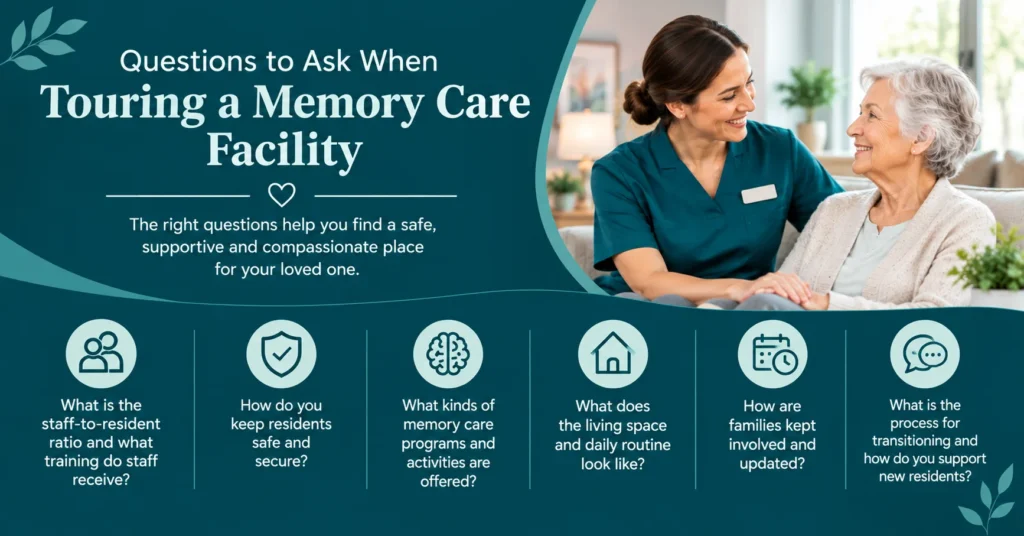
Staff training is the single most repeated theme across memory care guidance, and for good reason dementia caregiving requires skills that general senior-care training doesn’t cover. Ask how staff are trained differently for memory care versus standard assisted living, how often refresher training happens, and whether certifications like Certified Dementia Care Manager credentials are required or encouraged.
Also ask whether all staff not just caregivers, but housekeeping and dining staff receive dementia training. Communities where every employee understands dementia behaviors tend to have calmer environments and lower staff turnover, which directly affects the consistency of care your loved one receives.
What Is the Staff-to-Resident Ratio, Day and Night?
Staffing ratios during a mid-afternoon tour rarely reflect the overnight reality, so ask specifically about ratios at night and during weekends, when staffing often drops. A lower resident-to-caregiver ratio generally means more personalized attention and faster response when a resident needs help.
Ask, too, whether a nurse or licensed medical professional is on-site 24 hours a day, or only on call. For residents with health conditions that can change quickly, the difference between “on-site” and “on-call” can matter enormously in an emergency.
Are Personalized Memory Care Plans and Assessments Available?
Every resident’s dementia progresses differently, so ask whether each person gets an individualized care plan built from a real assessment not a generic template applied to everyone in memory care. Find out who’s involved in building it: nurses, the executive director, and ideally your family.
Then ask how often that plan gets reviewed. Because dementia needs shift, care plans should be reassessed every two to three months, not just once every six months. A community that treats the plan as a living document, not paperwork filed and forgotten, is one worth prioritizing.
What Activities and Memory-Enhancing Therapies Are Offered?
Ask what memory-enhancing therapies are available and how they’re matched to individual residents rather than run as one-size-fits-all group sessions. Music therapy, art therapy, aromatherapy, and reminiscence programs can meaningfully improve mood, sleep, and orientation for people living with dementia but only if they’re offered consistently, not just listed in a brochure.
Ask to see an actual activities calendar, not a sample one. Notice whether activities look passive (residents parked in front of a TV) or genuinely engaging, with real materials like actual gardens, kitchens, or hands-on stations residents can use during unstructured time.
Engagement Areas and Life Skill Stations
Some communities include “life skill stations” a desk with real paperwork, a supervised kitchen, a garden with real plants that let residents replicate familiar tasks from earlier in life. These small, real-object environments can reduce agitation and give residents a sense of purpose that a purely decorative space can’t.
How Does the Facility Handle Safety, Security, and Medical Needs?
Safety questions belong near the top of your list. Ask how the community offers 24-hour supervised care, whether doors and outdoor areas are secured with keypads or alarms, and whether hallways are clearly marked to reduce disorientation. Wandering is common and potentially dangerous in dementia, so ask directly about the community’s wandering-prevention protocols.
On the medical side, ask how the facility coordinates with outside physicians, manages medications, and handles a sudden health decline. A community with a visiting physician or nurse practitioner on a regular schedule offers more continuity than one that only reacts to emergencies as they happen.
What Is the Emergency Response Plan?
Ask specifically about evacuation procedures, staff training for medical emergencies, and how quickly families are notified when something happens. A confident, detailed answer here is a good sign; a vague one is a reason to ask more.
What Is the Staff’s Approach to Behavioral Challenges?
Residents with dementia may show agitation, aggression, or resistance to care, and how a community responds says a lot about its quality. Ask whether staff are trained to see these behaviors as expressions of an unmet need rather than problems to control that mindset shift changes everything about how a resident is treated in a difficult moment.
Ask for real examples: how does staff respond when a resident refuses to bathe, or becomes upset during a transition? Communities that use redirection, sensory calming, and familiarity-based techniques instead of over-medication are generally providing more person-centered dementia care.
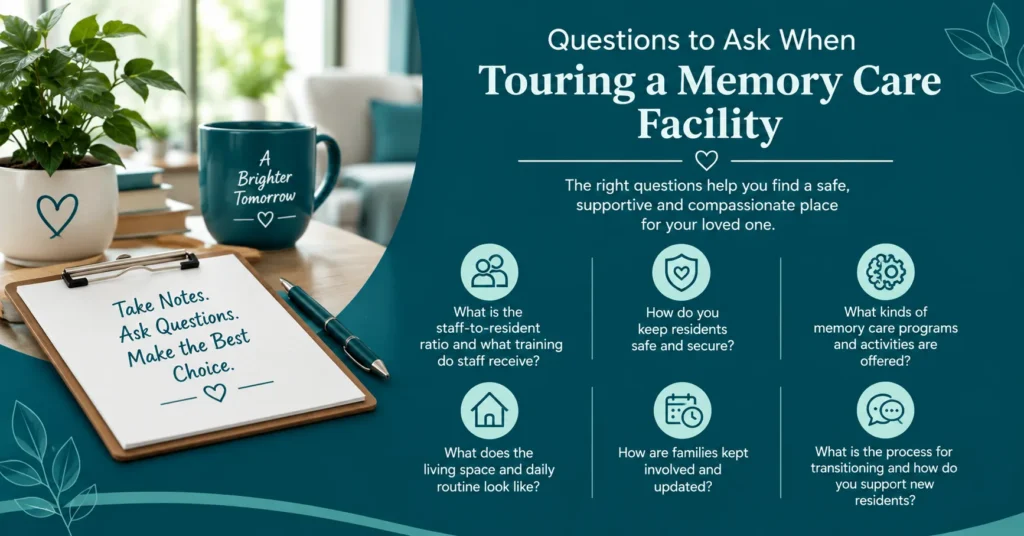
What Amenities, Rooms, and Lifestyle Options Are Available?
Beyond the essentials, ask what lifestyle options fit your loved one’s personality. Do they prefer a private room or would they enjoy a shared living arrangement? Are meals served in a communal dining room, or can residents eat in their rooms if that’s more comfortable for them? Small preferences like these affect day-to-day happiness more than people expect.
Ask what’s included in a standard room versus what residents need to bring themselves, and whether personalization family photos, furniture, a memory box outside the door is encouraged. Familiar objects can reduce confusion and help residents feel more oriented in their new environment.
Are Private Rooms Available?
Private rooms tend to reduce overstimulation and agitation for residents who are easily overwhelmed, and they allow more personal decoration. If privacy matters to your loved one, confirm availability and any cost difference early, since private rooms often carry a premium.
What Does Memory Care Cost, and What Payment Options Exist?
Cost is a major factor, so ask for a full breakdown of the monthly fee what’s included, and what’s billed separately. Some communities include incontinence supplies and transportation to appointments in the base fee; others charge extra for nearly everything beyond room and board.
Also ask whether fees increase annually, what triggers a rate increase if your loved one’s care needs grow, and what payment options exist, including veterans’ benefits or long-term care insurance. Getting these answers during the tour avoids financial surprises down the road.
How Are Families Kept Informed and Supported?
Ask how the community communicates updates through care conferences, a family portal, phone calls, or newsletters and how quickly you’d be notified of a change in your loved one’s condition. Communities that treat families as partners in care, not outsiders, tend to build more trust over time.
Ask, too, what support exists for you as a caregiver: support groups, educational workshops, or referrals to elder law resources. Many families are managing this transition while still working full-time and caring for their own households, so a community that supports the whole family not just the resident is worth extra consideration.
Trust Your Instincts: Questions to Ask Yourself After the Tour
After you’ve asked every question on your list, step back and notice how the community actually felt. Did residents look engaged and comfortable, or disengaged and overlooked? Did staff speak to residents with warmth and patience, or talk around them as if they weren’t in the room?
Ask yourself honestly: would you feel at peace if your loved one lived here? No answer sheet or brochure can replace that gut reaction if something felt off during the tour, it’s worth a second visit, ideally at a different time of day, before you decide.
Memory Care Tour Question Checklist
| Category | Key Question to Ask |
| Staff Training | What dementia-specific training and certifications do caregivers hold? |
| Staffing Levels | What’s the staff-to-resident ratio during the day and overnight? |
| Care Planning | How often is my loved one’s care plan reassessed? |
| Activities | Are therapies and activities individualized or one-size-fits-all? |
| Safety | How is wandering prevented, and what’s the emergency response plan? |
| Behavioral Support | How does staff respond to agitation or resistance to care? |
| Cost | What’s included in the base fee, and what costs extra? |
| Family Involvement | How and how often will I be updated on my loved one’s care? |
Conclusion
A memory care tour is about more than comparing rooms, amenities, or monthly costs. It gives you a chance to understand how the facility supports residents, handles daily needs, communicates with families, and creates a safe, welcoming environment. Asking thoughtful questions can help you uncover details that may not be obvious during a quick visit. Pay attention to how staff interact with residents and whether the atmosphere feels respectful and comfortable.
Take notes, compare your impressions, and discuss any concerns with your family. The right memory care community should provide dependable support while helping residents maintain dignity, connection, and as much independence as possible. A careful tour today can make a difficult decision feel much clearer tomorrow.
FAQs
Author

Hi, I’m Alex, and I enjoy learning through quizzes, trivia, and interactive questions. I love discovering new conversation starters, relationship topics, and educational challenges. This website is my go-to place for fun, practical, and reliable question-based content. I’m always excited to learn something new and share it with others.





2 Comments