
Sobriety Test Questions: What Officers Ask & Your Rights
If you’ve ever seen flashing lights in your rearview mirror, you know the exact moment sobriety test questions start to matter. After years reviewing DUI stops and roadside footage, one pattern holds true: what you say in the first sixty seconds shapes everything that follows. Officers ask a specific set of sobriety test questions designed to gather admissions, test your memory, and observe your speech before a single field sobriety test even begins.
This guide breaks down exactly what to expect the standardized field sobriety tests, the sobriety test questions that precede them, and the legal rights most drivers don’t know they have. You’ll learn how the Horizontal Gaze Nystagmus, Walk-and-Turn, and One-Leg Stand tests are scored, why their results can be challenged, and what happens if you refuse. Understanding this process before you’re standing on the shoulder of a road is the strongest protection you can give yourself.
What Questions Do Officers Ask During a DUI Stop?
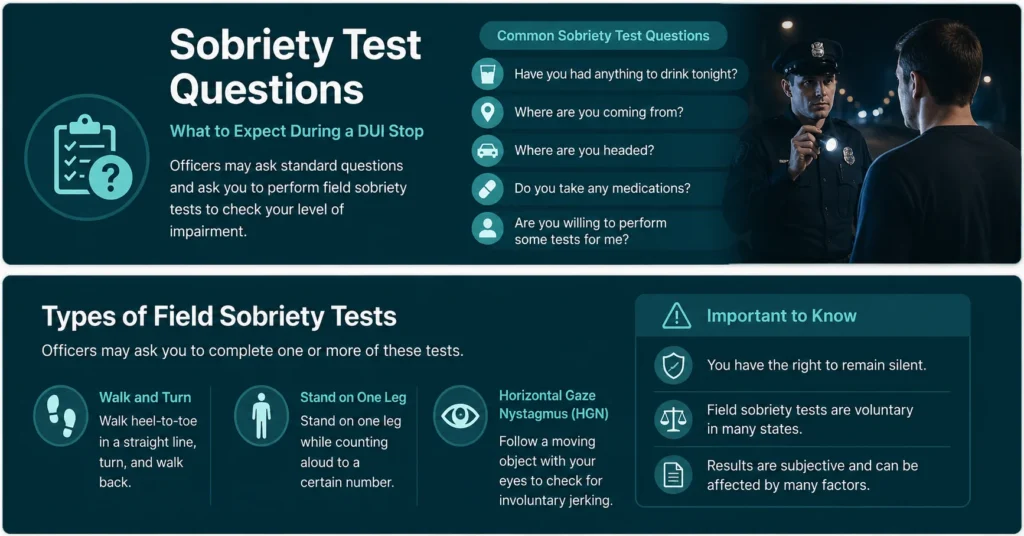
Most sobriety test questions aren’t random small talk they’re an investigative tool. Officers ask where you’re coming from, whether you’ve been drinking, and how much, because each response can become either an admission or a credibility problem later in court. A short, quick answer often reads as consciousness of guilt, while a longer, meandering one reads as confusion or intoxication, so the questioning itself is built to work against you either way.
The pattern repeats at nearly every stop: “Do you know why I stopped you?“, “Where are you coming from?”, and “Have you had anything to drink tonight?” arrive before you’ve even stepped out of the car. These roadside sobriety test questions test attention and consistency as much as they gather facts, and officers are trained to note hesitation, slurred words, or inconsistent details just as closely as the actual content of your answer.
Questions Asked at the Window
The first round is conversational by design, which is exactly what makes it risky. Officers ask about your evening, your destination, and your drinking history while simultaneously watching how you retrieve your license and registration a divided-attention test disguised as small talk. Volunteering extra detail rarely helps; it only expands the material available for the officer’s report.
Common Sobriety Test Questions and How They’re Used
Beyond the opening sobriety test questions, officers ask about medical conditions, medications, and whether you understand their instructions. Answering “yes” to understanding instructions can later be used to frame any test mistake as impairment rather than confusion. The safest approach is providing your license, registration, and insurance, then declining further questions politely and clearly.
What Is the Horizontal Gaze Nystagmus (HGN) Test and How Is It Administered?
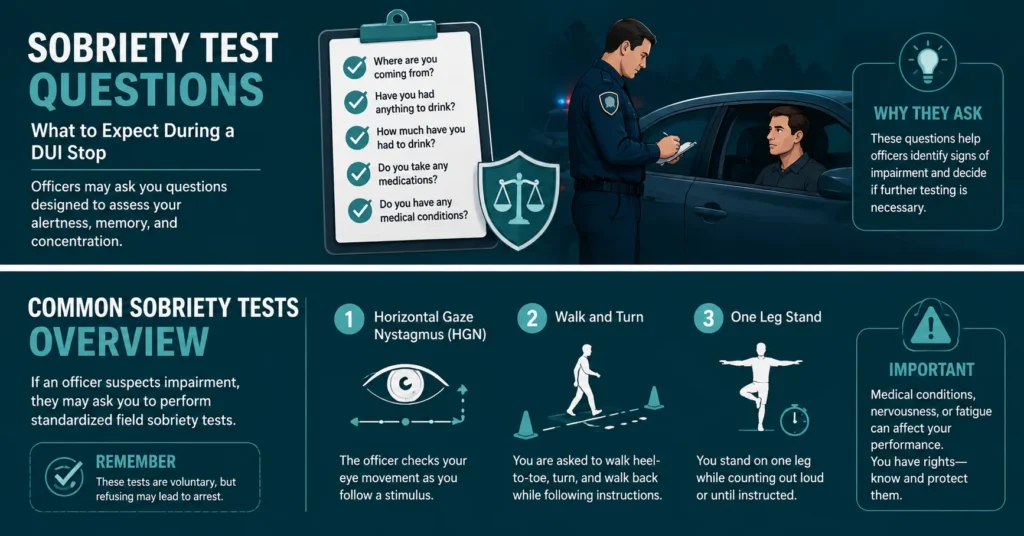
The Horizontal Gaze Nystagmus test is typically the first of the three standardized field sobriety tests, and it isn’t a coordination test at all it’s an observation of involuntary eye movement. The officer holds a pen, finger, or small light roughly a foot from your face and asks you to follow it with only your eyes while keeping your head still, watching for jerking that alcohol is theorized to exaggerate.
The officer scores your eyes for six possible clues: lack of smooth pursuit, sustained jerking at maximum deviation, and onset of nystagmus before a 45-degree angle. This test carries real weight in a DUI investigation, yet it depends heavily on precise technique, proper distance, and correct timing that many officers get wrong under roadside conditions.
How the HGN Test Is Scored
Officers look for three clues in each eye, six total, and NHTSA guidance suggests four or more clues correlates with a BAC of 0.08 or higher. But that threshold assumes flawless administration, consistent lighting, and a cooperative subject conditions rarely present on a dark roadside with passing headlights and adrenaline running high.
Why HGN Test Results Can Be Challenged
Over fifty medical conditions can cause nystagmus independent of alcohol, including inner ear disorders, head injuries, and certain prescription medications. Flashing patrol lights, uneven stimulus speed, and improper positioning of the pen or light are common procedural errors that a defense attorney can use to challenge the reliability of the clues an officer claims to have observed.
How Should the Walk-and-Turn (WAT) Test Be Properly Administered?
The Walk-and-Turn test is a divided-attention exercise: you must listen to multi-step instructions, hold a heel-to-toe stance, then walk nine steps down an imaginary or real line, turn a specific way, and walk nine steps back. Officers are trained to look for eight distinct clues, and observing two or more is treated as an indicator of impairment under NHTSA scoring standards.
Sobriety test questions often surface again during this test, since officers narrate instructions and then ask if you understood them before you begin. The theory behind the WAT test is that alcohol impairs your ability to manage a physical task and a mental task simultaneously, but the test’s difficulty has little to do with sobriety and everything to do with surface, footwear, and nerves.
How the WAT Test Is Scored
The eight clues include starting too soon, stepping off the line, missing heel-to-toe contact, raising arms for balance, and taking the wrong number of steps. Two or more clues is generally recorded as a failing performance, regardless of whether the surrounding conditions made the test unusually difficult to complete.
Why WAT Test Results Can Be Challenged
A cracked or sloped roadside surface, poor lighting, gravel, or an unclear line can make the test nearly impossible even for a sober person. Age, weight, prior leg or back injuries, and improper footwear like heels or loose sandals are common factors attorneys use to argue that a failed WAT result reflects circumstance rather than intoxication.
What Does the One-Leg Stand (OLS) Test Measure and What Are Common Defenses?
The One-Leg Stand test asks you to raise one foot roughly six inches off the ground and count aloud for thirty seconds while an officer watches for four specific clues: swaying, using your arms for balance, hopping, or putting your foot down early. Like the Walk-and-Turn, it’s framed as a divided-attention test combining physical balance with a mental counting task.
This test is widely considered one of the weakest parts of a prosecutor’s case because balance is affected by so many non-alcohol-related factors. Nervousness alone, standing on a road shoulder at night with headlights passing, can produce the same clues an officer associates with intoxication.
How the OLS Test Is Scored
Two or more of the four clues swaying, arm use, hopping, or foot drop is treated as a statistical indicator of a BAC at or above 0.08 under NHTSA scoring. That said, NHTSA’s own validation studies acknowledge meaningful error rates even under ideal lab conditions.
Why OLS Test Results Can Be Challenged
Uneven pavement, a sloped shoulder, wind from passing traffic, and inappropriate footwear can each cause a sober person to fail. Age, physical injuries, and inner ear or neurological conditions are frequently cited defenses, since none of these factors have any connection to alcohol consumption.
What Is the Romberg Balance Test and Why Do Officers Use It?
The Romberg Balance Test, sometimes called the modified Romberg test, is a non-standardized field sobriety exercise some officers use in addition to the three NHTSA-approved tests. You’re asked to stand with feet together, tilt your head back, close your eyes, and silently estimate when thirty seconds has passed, saying “stop” when you believe the time is up.
Because it isn’t part of the official SFST battery, there’s no standardized scoring system, which makes the officer’s interpretation far more subjective than the HGN, WAT, or OLS tests. Body sway, eyelid tremors, and how far off your time estimate is are the primary things officers note.
How the Romberg Test Is Scored
There is no NHTSA-validated scoring threshold for this test. Officers rely on subjective judgment calls about how much sway is “too much,” which opens significant room for inconsistent interpretation between different officers and different stops.
Why Romberg Results Can Be Challenged
Inner ear problems, neuropathy, arthritis, prior injuries, and simple fatigue can all produce sway or tremors unrelated to alcohol. Because the test lacks NHTSA endorsement and any objective measurement standard, courts frequently treat Romberg results as the officer’s opinion rather than scientific evidence.
Which Field Sobriety Tests Should You Refuse?
Field sobriety tests are voluntary in most states, which is a detail few drivers are told at the roadside. Refusing the HGN, Walk-and-Turn, or One-Leg Stand carries no direct license penalty in most jurisdictions, because these tests fall outside implied consent law a very different category from the state-administered chemical test requested after an arrest.
The strategic logic behind refusal is straightforward: these tests are subjective and designed in a way that makes failure common even for sober people. Declining prevents the officer from generating additional “evidence” of impairment, though it doesn’t guarantee you avoid arrest if other observations already support probable cause.
How to Properly Refuse Field Sobriety Tests
State your refusal clearly and once: “Officer, I respectfully decline to perform any field sobriety tests.” Avoid explaining or justifying the refusal, since any reason you offer fatigue, a medical condition can be twisted into an admission later. Remain calm and continue cooperating with lawful requests like providing your license and registration.
Why Refusing FSTs Can Be a Strategic Advantage
Refusal prevents medical conditions, nerves, or bad roadside conditions from generating a “failed” test result that becomes courtroom evidence. It also limits the officer’s stated basis for probable cause to subjective observations alone, such as odor of alcohol or bloodshot eyes, rather than a scored physical performance.
Refusing the State Chemical Test Carries Serious Consequences
This is the critical distinction: refusing a post-arrest, state-administered chemical breath or blood test is governed by implied consent law and typically triggers an automatic license suspension often twelve months for a first offense with no limited driving permit available. Field test refusal and chemical test refusal are not the same decision, and confusing the two is one of the most common and costly mistakes drivers make.
What Is the Scientific Validity of Field Sobriety Tests?
Standardized field sobriety tests are frequently presented as scientifically reliable, but their foundation is narrower than most drivers assume. NHTSA’s original validation studies were conducted decades ago in controlled, lab-like settings using young, healthy volunteers conditions that bear little resemblance to a real stop on a dark highway shoulder.
Even under those ideal laboratory conditions, NHTSA’s own data places test accuracy at roughly 68% to 79%, meaning the tests are wrong close to a quarter of the time even at their theoretical best. That margin of error is central to how defense attorneys challenge SFST evidence in court.
How SFST “Science” Can Be Challenged
Any deviation from standardized protocol incorrect instructions, wrong stimulus distance, an uneven test surface can invalidate results. The original study population also rarely reflects real-world drivers: older individuals, people with medical conditions, and those under genuine roadside stress were largely absent from the research NHTSA relies on.
The Role of Courts in Scrutinizing SFST Evidence
Courts generally allow SFST results as evidence, but not automatically or without scrutiny. Judges increasingly entertain arguments that challenge both the underlying science and whether the officer actually followed protocol, and successfully demonstrating either gap can lead to suppressed evidence or a weakened prosecution case.
7-Point Comparison: Sobriety Test Questions
| Test / Interaction | Reliability | What Officers Look For | Common Defense Angle |
| Horizontal Gaze Nystagmus (HGN) | Moderate in lab conditions; lower roadside | Six eye-movement clues across both eyes | Medical conditions, lighting, improper stimulus technique |
| Walk-and-Turn (WAT) | ~79% accuracy under ideal conditions | Eight clues: balance, steps, turn, timing | Surface conditions, footwear, injuries |
| One-Leg Stand (OLS) | ~68% accuracy under ideal conditions | Four clues: sway, arms, hop, foot-down | Age, balance conditions, environmental factors |
| Romberg Balance Test | Not NHTSA-validated; highly subjective | Body sway, eyelid tremor, time estimation | Lack of scientific standardization |
| Officer Questioning | Low — easily misinterpreted | Content and manner of your answers | Right to remain silent; decline politely |
| Field Test Refusal | N/A — strategic choice | Verbal, clear refusal | No direct license penalty in most states |
| Chemical Test Refusal | N/A — implied consent applies | Post-arrest breath/blood request | Triggers automatic license suspension |
Should I Answer Sobriety Test Questions?
The honest answer, according to experienced DUI defense attorneys, is generally no beyond providing your license, registration, and proof of insurance, you are not required to answer questions about your drinking, your evening, or your health. Officers are trained to use this pre-test interrogation to build an impairment narrative before a single field sobriety test questions is administered.
You have the right to say, calmly and once, that you’re choosing not to answer questions without an attorney present. This isn’t an admission of guilt, and in most states your silence cannot legally be used as evidence of impairment. If you’re facing a DUI stop or have already been arrested, the specific facts of your case the officer’s exact wording, the conditions of the stop, and how any tests were administered are exactly what an experienced DUI attorney reviews to build your defense.
Conclusion
Knowing the right sobriety test questions can make the testing process feel less unfamiliar and help you understand what an officer may ask or assess. These questions are generally designed to observe communication, attention, coordination, and overall behavior rather than simply getting a few answers right or wrong. If you ever face a sobriety evaluation, staying calm, listening carefully, and responding honestly is important.
Remember that sobriety tests are serious matters, and the rules surrounding them can vary by location. Taking the time to understand the process beforehand can help you feel more prepared and informed. Ultimately, responsible decisions and safe choices are always the best way to protect yourself and others on the road.
FAQs
Author

Hi, I’m Alex, and I enjoy learning through quizzes, trivia, and interactive questions. I love discovering new conversation starters, relationship topics, and educational challenges. This website is my go-to place for fun, practical, and reliable question-based content. I’m always excited to learn something new and share it with others.




2 Comments