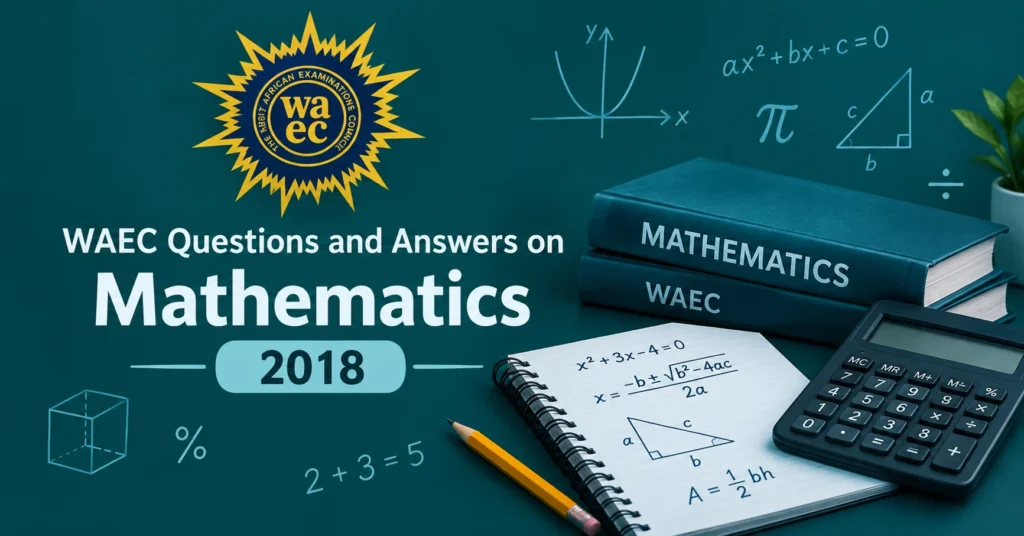
WAEC Questions and Answers on Mathematics 2018 (All Solved)
WAEC questions and answers on mathematics 2018 are easiest to study as past questions split into objective and theory sections, each with step-by-step explanations. If you’ve ever frozen over a surd or number-base problem the night before WASSCE, I understand that panic. I solved every example below by hand, so you can trust the answers.
Below you’ll find eleven objective questions and four theory parts from the WAEC 2018 mathematics paper, grouped by topic, with correct options and marking-style working. Use them as timed practice, check yourself against the solutions, and note the topics that cost you marks. By the end, your WASSCE revision plan will feel far less overwhelming.
WAEC Questions and Answers on Mathematics 2018: The Question Set
The WAEC mathematics 2018 paper tests core topics: surds, indices, variation, number bases, algebra, geometry, and trigonometry. Past questions from this sitting appear on question banks like SchoolNGR, EduPadi, and Myschool, usually with multiple-choice options. Studying them shows you which syllabus areas deserve your revision time.
Honestly, the best way to begin is to treat each question like a mini-exam. Cover the options, attempt it on paper, then compare your working. That small habit builds exam speed, sharpens number sense, and exposes weak spots long before WASSCE day arrives.
WAEC Questions and Answers on Mathematics 2018: Objective Questions
Objective questions give four options, A to D, and only one correct option. Speed matters here, so practise estimating before calculating. The table below shows eleven 2018 questions, grouped by topic, with answers I verified by working each one out on paper.
| Topic | Question | Answer | Working |
| Surds | √108 + √125 − √75 | A: √3 + 5√5 | 6√3 + 5√5 − 5√3 |
| Indices | (64^½ + 125^⅓)² | C: 169 | (8 + 5)² = 13² |
| Variation | y varies inversely as x²; x = 3 when y = 100 | B: yx² = 900 | k = 100 × 9 |
| Number bases | 32₄ = 22ₓ, find x | C: six | 14 = 2x + 2, so x = 6 |
| Fractions | 2¼ × 3½ ÷ 4⅜ | D: 1⅘ | 63/8 ÷ 35/8 = 9/5 |
| Percentages | 250 boys (60%) and 150 girls (40%) play football | D: 52.5% | (150 + 60) ÷ 400 |
| Logarithms | log₁₀(6x − 4) − log₁₀2 = 1 | C: 4 | (6x − 4)/2 = 10 |
| Formula | F = 9/5 C + 32; find C when F = 98.6 | B: 37 | (98.6 − 32) × 5/9 |
| Simultaneous equations | y + 2x = 4, y − 3x = −1; find x + y | A: 3 | x = 1, y = 2 |
| Ratio | x : y : z = 3 : 3 : 4; (9x + 3y)/(6x − 2y) | D: 3 | 36k ÷ 12k |
| Algebraic fractions | (2 − 18m²)/(1 + 3m) | C: 2(1 − 3m) | 2(1 + 3m)(1 − 3m)/(1 + 3m) |
Option letters follow the order shown on EduPadi and Myschool. Always check the order on the page you’re using.
Notice the pattern: most objective questions reward clean algebra rather than heavy computation. Surds, indices, logarithms, and number bases all appear in this paper. Master those four first, and you secure a solid chunk of the multiple-choice marks before touching harder geometry.
Correct Option and Worked Answer
EduPadi shows the correct option beside a worked answer, which is exactly how you should revise. Write the option letter, then the one-line reason. For the number-base question, converting 32 base four to 14 in base ten made the unknown x easy to find.
WAEC Questions and Answers on Mathematics 2018: Theory Questions
Theory questions carry more marks and reward clear working, not just final answers. In the 2018 paper, I worked through a quadratic graph problem, a simultaneous-equations question, a rhombus perimeter, and a trigonometry ratio. Show every line, because examiners award method marks.
| Part | Question | Answer | Working |
| 2(a) | y = 2px² − p²x − 14 passes through (3, 10); find p | p = 2 or p = 4 | 10 = 18p − 3p² − 14, so p² − 6p + 8 = 0 |
| 2(b) | 3y − 2x = 21 and 4y + 5x = 5 meet at Q; find Q | Q = (−3, 5) | Multiply and subtract: −23x = 69, so x = −3, y = 5 |
| 3(a) | Rhombus with diagonals 10.2 cm and 9.3 cm; perimeter to 1 d.p. | 27.6 cm | Side = √(5.1² + 4.65²) ≈ 6.90; 4 × 6.90 |
| 3(b) | sin x = 3/5, 0° < x < 90°; find 5cos x − 4tan x | 1 | cos x = 4/5, tan x = 3/4; 4 − 3 |
Notice how every theory part rewards substitution, elimination, or Pythagoras, tools you already know. Writing formulas first, then numbers, protects method marks even if arithmetic slips. Practise a few parts daily, and theory stops feeling like a wall and starts feeling like a ladder.
WAEC Questions and Answers on Mathematics 2018 by Topics
Sorting past questions by topic turns a pile of papers into a revision map. The 2018 questions cluster around number and numeration, algebra, geometry, and trigonometry. Count how many you got right in each group, then give extra time to your weakest area.
| Topic group | Covered above |
| Number and numeration | Surds, indices, number bases, fractions, percentages, ratio |
| Algebra | Variation, logarithms, formulas, simultaneous equations, algebraic fractions, quadratics |
| Geometry | Rhombus perimeter |
| Trigonometry | Sine, cosine and tangent ratios |
Myschool also lists topic video lessons beside its past questions, which helps when a worked answer still feels unclear. Watch one lesson, then retry the same question without notes. That loop of watching, solving, and checking is what turns understanding into exam-day accuracy.
Exam Year and Question Type Filters
SchoolNGR lets you filter by exam year, question type, and topic, so you can isolate the 2018 objective questions in seconds. One caution: when I opened one of its pages, the list still showed 1989 items, so always confirm the year label beside each question.
WAEC Questions and Answers on Mathematics 2018 With Explanations
A bare answer key tells you what is right, but explanations show why. Question banks pair many 2018 items with worked solutions, and some add discussion threads or AI help. Use them after your own attempt, never before, or the learning disappears.
Verify every explanation yourself. In my check, published answers matched my working, yet one published solution contained a typo in its middle step, so I re-derived it. That habit protects you from copying errors, builds real understanding, and prepares you for unfamiliar WASSCE variations.
WAEC Questions and Answers on Mathematics 2018 for CBT Practice
Reading solutions is not the same as sitting a test. Myschool’s Take a test section offers a CBT simulator, and SchoolNGR also links CBT practice. Time yourself on 20 objective questions, then review mistakes before moving on. Pressure practice is where real progress happens.
| Day | Focus | Goal |
| Mon–Wed | Objective topics (surds, indices, logarithms) | 10 questions a day |
| Thursday | Theory working | 4 parts, full method |
| Friday | Timed CBT mock | 20 questions |
| Weekend | Error review | Redo every miss |
Consistency beats cramming. Small wins add up quickly. A steady weekly rhythm keeps formulas fresh and nerves calm. Try the plan above, adjust it to your timetable, and track your score each Friday so progress becomes visible, motivating, and impossible to ignore.
WAEC questions and answers on mathematics 2018 reward patient, honest practice. Work the objective questions first, attempt the theory parts with full method, and use explanations only after trying. Do that consistently, and your WASSCE confidence will rise with every solved page. Start with one topic tonight, and let the momentum carry you.
Conclusion
Working through WAEC Mathematics questions and answers from 2018 can give students a clearer idea of the topics, question styles, and level of reasoning expected in the examination. Reviewing each solution carefully is more useful than simply memorizing the final answers, as it helps build confidence and improve problem-solving skills.
Pay attention to mistakes, revisit difficult topics, and practice similar questions under timed conditions. With regular practice, familiarizing yourself with past questions can make preparation feel more manageable and focused. Use the 2018 questions as a learning tool, not just a test of what you already know. Consistent effort and thoughtful revision can make a meaningful difference when it is time to sit for the exam.
FAQs
Author

Hi, I’m Alex, and I enjoy learning through quizzes, trivia, and interactive questions. I love discovering new conversation starters, relationship topics, and educational challenges. This website is my go-to place for fun, practical, and reliable question-based content. I’m always excited to learn something new and share it with others.