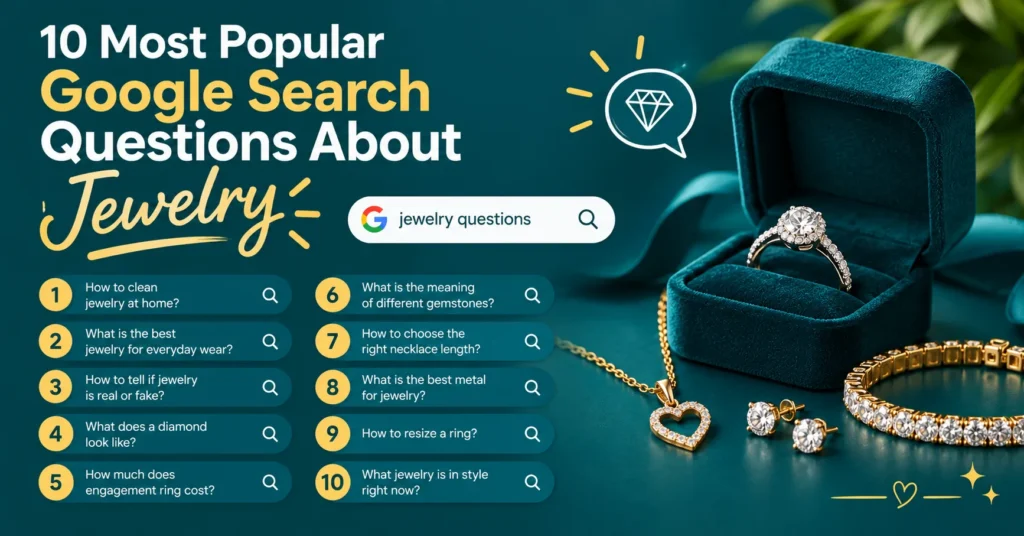
10 Most Popular Google Search Questions About Jewelry
If you’ve ever stood in front of a Google Search Questions About Jewelry case squinting at a tag that says “14K” wondering what it actually means, you’re not alone it’s one of the most Googled jewelry questions there is. Jewelry sits at this strange intersection of sentiment and chemistry: a ring can mean everything to you emotionally while also being a metallurgy and gemology question you never signed up to answer. That gap between “I love this piece” and “I have no idea what I’m buying” is exactly where most search traffic on this topic comes from.
This guide pulls together the ten questions that come up again and again from telling a real diamond from a fake one, to why grandma’s silver keeps turning black, to how much you’re actually supposed to spend on an engagement ring. No fluff, no jargon you have to Google a second time. Just the answers, in plain language, the way a knowledgeable friend at the jewelry counter would give them to you.
1. What’s the Difference Between Karat and Carat?
These two words sound identical but measure completely different things, and mixing them up is one of the most common jewelry-buying mistakes. Karat (with a K) measures gold purity how much actual gold is in an alloy, on a scale up to 24K, which is pure gold. Carat (with a C) measures the weight of a gemstone, most often a diamond, where one carat equals 200 milligrams.
So a “14K gold ring with a 1-carat diamond” is telling you two unrelated things: the ring’s metal is 58.3% pure gold, and the stone weighs 200 milligrams. Higher karat gold is softer and more yellow; higher carat weight simply means a bigger stone, not necessarily a better one. Cut, clarity, and color all matter just as much as carat weight when it comes to how a diamond actually looks on your hand.
2. How Can I Tell If a Diamond Is Real?
Nobody wants to find out the hard way that a “diamond” is actually cubic zirconia, so this question gets searched constantly, especially around estate sales, inherited jewelry, and secondhand purchases. A few simple at-home checks can give you a strong clue, though none of them replace a professional appraisal. The fog test breathing on the stone and seeing how fast the fog clears is popular because real diamonds disperse heat so quickly the fog vanishes almost instantly, while fakes stay foggy longer.
Other quick checks include the water test (real diamonds sink because of their high density) and looking for sharp, defined facet edges under a loupe, since simulants often have slightly rounded edges from softer material. None of these are foolproof on their own. If you’re dealing with a piece of real value an inheritance, an engagement ring, anything insured a certified gemologist with proper equipment is the only way to know for certain.
3. What Metals Are Safest for Sensitive Skin?
If a ring or earrings have ever left your skin red, itchy, or green, you’ve probably searched this. Nickel is the most common culprit in metal allergies, and it hides in a lot of cheaper gold and silver alloys as a hardening agent. The safest bets for sensitive skin are platinum, titanium, and 18K or higher gold, since higher-purity gold contains less of the alloy metals that tend to trigger reactions.
Sterling silver and lower-karat gold (10K, 12K) are more likely to cause irritation because they’re alloyed with a higher percentage of other metals, sometimes including nickel. If you already know you react to costume jewelry, look specifically for pieces labeled nickel-free or hypoallergenic, and consider rhodium-plated white gold, which adds a barrier layer between your skin and the underlying alloy though that plating does wear off over time and needs reapplying.
4. How Do I Find My Correct Ring Size?
Ring sizing questions spike every year around proposal season, and for good reason a ring that’s even slightly off can be uncomfortable or fall off entirely. The most reliable at-home method is wrapping a strip of paper or string around the base of your finger, marking where it overlaps, and measuring that length in millimeters against a printable ring size chart. Time of day and temperature both affect finger size, so measure in the evening when fingers are slightly more swollen, and avoid measuring right after exercise or in cold weather.
For anything expensive or sentimental, a jeweler’s metal ring sizer is far more accurate than the string-and-paper method, and most jewelry stores will size you for free even if you’re not buying that day. Knuckle size matters too if your knuckle is noticeably bigger than the base of your finger, size for comfortable pass-over rather than just the base measurement, or ask about a comfort-fit band.
5. How Do I Clean Jewelry Safely at Home?
Everyday buildup from lotion, sweat, and skincare products dulls jewelry faster than people expect, which is why “how to clean jewelry at home” is such a steady search topic. For most gold and diamond pieces, a few drops of mild dish soap in warm water, a soft-bristled toothbrush, and a gentle scrub along the setting is enough to restore shine without risking damage. Avoid ultrasonic cleaners on pieces with fracture-filled or heavily included stones, since the vibrations can worsen existing cracks.
Pearls, opals, and emeralds need gentler treatment a soft, slightly damp cloth only, never soap soaking or ultrasonic cleaning, because these stones are more porous or structurally delicate than diamonds. As a general rule, if a stone feels soft to a fingernail scratch test or has visible inclusions reaching the surface, treat it as fragile and stick to wiping rather than soaking.
6. Why Does Silver Turn Black?
That dark tarnish on silver jewelry isn’t dirt it’s a chemical reaction. Sterling silver contains copper as part of its alloy, and when that copper reacts with sulfur compounds in the air (from pollution, certain fabrics, even the sulfur naturally in your skin), it forms silver sulfide, which is black. Humidity, perfume, and lotion all speed up the process, which is why silver worn daily near skincare products tends to tarnish faster than silver kept in a drawer.
Storing silver in an airtight bag with an anti-tarnish strip, keeping it away from direct light and humidity, and giving it a gentle polish with a silver cloth every few weeks will keep tarnish from building up. A baking-soda-and-foil bath can reverse light tarnish at home, but for pieces with gemstones or intricate detail, a jeweler’s professional cleaning is the safer route.
7. How Much Should I Budget for an Engagement Ring?
This is one of the most emotionally loaded jewelry questions out there, and the honest answer is: there’s no universal rule, despite what you may have heard about “two months’ salary.” That guideline came from a decades-old diamond industry ad campaign, not any financial standard, and most financial advisors now recommend budgeting based on what you can comfortably afford without debt, not a percentage of income.
A realistic range in the U.S. currently runs anywhere from under $1,000 for a modest setting with a smaller or lab-grown diamond, up to $5,000–$10,000+ for larger natural stones with premium cut and clarity. Lab-grown diamonds have become a major budget lever, typically costing 30–50% less than natural diamonds of the same size and quality, which is part of why searches for “lab-grown vs. natural diamond” have climbed alongside engagement ring budget questions.
8. Do I Need to Insure My Jewelry?
Most standard homeowners’ or renters’ insurance policies only cover a small amount of jewelry loss often as little as $1,000–$2,000 total which is far less than what most engagement rings or fine pieces are worth. That gap is why so many people search this question right after a purchase or an inheritance. A dedicated jewelry rider or a standalone policy through a specialty insurer covers theft, loss, and sometimes even accidental damage like a lost stone, at a cost that typically runs 1–2% of the item’s appraised value per year.
To insure a piece properly, you’ll usually need a recent written appraisal, and it’s worth updating that appraisal every few years since gemstone and metal values shift. If a piece has strong sentimental or financial value an engagement ring, a family heirloom insuring it is generally worth the modest annual cost relative to the risk of losing it uncovered.
9. How Do I Know When Jewelry Needs Repair?
Loose stones, bent prongs, stretched or thinning shanks, and clasps that don’t snap shut firmly are the most common warning signs that a piece needs professional attention before it fails completely. A simple at-home check is gently tapping a ring near your ear if you hear or feel a stone rattling even slightly, that’s a sign a prong has loosened and the stone is at risk of falling out.
Rings worn daily should get a professional prong check about once a year, since prongs wear down from everyday friction even if nothing looks obviously wrong. Catching a loose stone or thinning shank early is almost always a small, inexpensive repair waiting until a stone is actually lost turns it into a much bigger and costlier fix.
10. Is White Gold or Platinum Better?
At a glance, white gold and platinum can look nearly identical, which is exactly why this comparison gets searched so often by engagement ring shoppers. Platinum is naturally white, denser, more resistant to tarnish, and hypoallergenic, but it’s also significantly more expensive and scratches more easily, developing a soft “patina” over time rather than losing metal. White gold is gold alloyed with white metals and typically finished with rhodium plating for its bright white shine it’s more affordable and scratch-resistant initially, but that rhodium layer wears off over months or years and needs periodic replating.
For daily-wear pieces like engagement rings, the real trade-off is upfront cost versus long-term maintenance: platinum costs more initially but needs less intervention, while white gold costs less initially but needs replating every year or two to keep its bright white look. Neither is objectively “better” it comes down to your budget and how much upkeep you’re willing to do.
Conclusion
Google Search Questions About Jewelry is more than something we wear it can reflect personal style, celebrate meaningful moments, and even carry cultural or sentimental value. The most popular Google questions about jewelry show how curious people are about current trends, symbolism, fun facts, and the stories behind different pieces.
Whether you’re choosing a new necklace, learning about gemstones, or simply exploring jewelry trivia, there’s always something interesting to discover. Understanding these common questions can also make it easier to shop thoughtfully and choose pieces that truly suit your taste. Ultimately, the best jewelry is the kind that feels meaningful to you and adds a little extra sparkle to everyday life.
FAQs
Author

Hi, I’m Alex, and I enjoy learning through quizzes, trivia, and interactive questions. I love discovering new conversation starters, relationship topics, and educational challenges. This website is my go-to place for fun, practical, and reliable question-based content. I’m always excited to learn something new and share it with others.