What Is a Testable Question? Definition, Examples & How to Write One
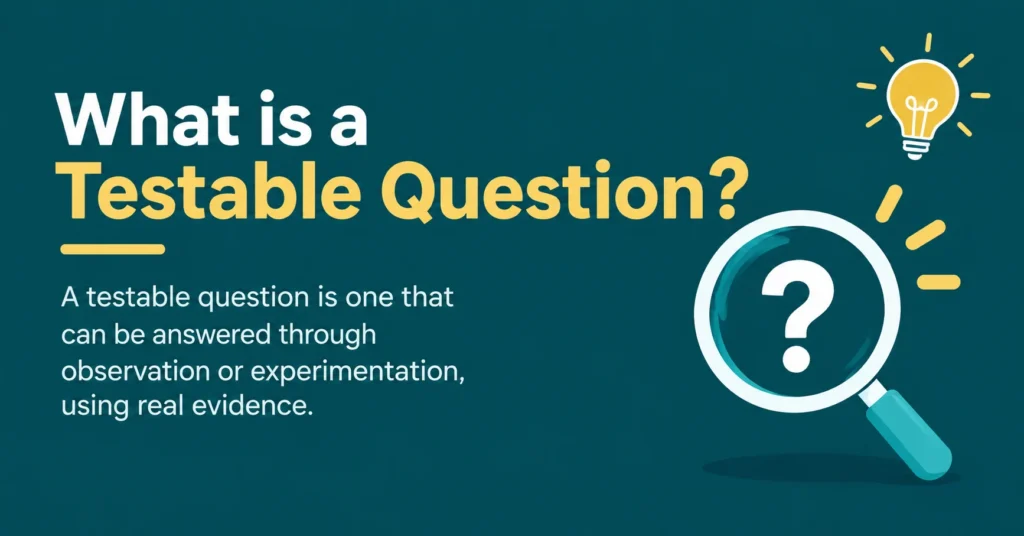
A testable question is a question you can answer by running an experiment, making careful observations, or collecting measurable data not by stating an opinion. If you’ve ever stared at a blank science-fair worksheet wondering why your teacher rejected your question, you’re in the right place.
I’ve watched dozens of students turn a vague idea like “what makes plants grow” into a sharp, testable question in minutes once they understood the pattern. This guide breaks down the definition, the difference between testable and opinion-based questions, and a repeatable formula you can use for any science fair project, classroom investigation, or independent research assignment.
What Is a Testable Question?
At its core, a testable question is one that can be answered through direct observation, experimentation, or measurable data collection not through personal belief. It focuses on cause and effect: you change one variable and measure what happens to another. “Does the amount of sunlight affect how tall a tomato plant grows?” is testable because sunlight can be controlled and plant height can be measured with a ruler.
Good testable questions share a recognizable shape. They’re specific, they name what will be changed, and they name what will be measured which is exactly why they can guide a real investigation instead of a guess. This is also why testable questions sit at the center of the scientific method, connecting observation to hypothesis to experiment.
What Makes a Testable Question Different From Other Scientific Questions?
Not every scientific-sounding question is testable. A “why” question like “why is the sky blue?” often points toward an explanation rather than an experiment you can run yourself, so it needs to be reframed before it becomes testable. Questions that require an opinion, or that different people could reasonably answer differently, also fail the test.
Some legitimate scientific questions aren’t testable through experimentation at all. Certain discoveries in astronomy, geology, or paleontology come from careful, patient observation rather than a controlled experiment which is still valid science, just a different investigative path than a testable question follows.
Testable Questions vs. Opinion Questions
An opinion question asks for a preference: “Which color is the prettiest?” or “Is exercise good for mental health?” These can’t be measured objectively, because different people give different, equally valid answers based on feelings rather than data.
A testable question replaces the vague preference with a measurable variable. Instead of “is exercise good?”, a testable version might be: “Does 30 minutes of daily exercise affect resting heart rate over four weeks?” The subject is the same, but now there’s something to change and something to measure which is the line between opinion and testable science.
Parts of a Testable Question
Every testable question has two essential parts: the thing you will change (the independent variable) and the thing you will measure (the dependent variable). In “Does more water help seeds sprout faster?”, the amount of water is what changes, and sprouting speed is what gets measured.
Writing the testable question down before starting the experiment keeps the investigation focused. Skipping this step is the most common reason student experiments drift off-course without clearly named variables, it’s easy to accidentally test two things at once and end up with results nobody can interpret.
Key Terms and Definitions for a Testable Question
Understanding a testable question also means understanding the vocabulary that surrounds it. A variable is anything in the experiment that can change or be measured. A hypothesis is an educated, testable explanation not just a random guess that predicts what the experiment will show.
A fair test changes only one variable at a time while keeping everything else constant, which is what makes results trustworthy. Evidence is the data collected during the experiment, and the conclusion is what that evidence tells you about whether your original prediction was correct.
Steps to Creating a Testable Scientific Question
Turning a casual observation into a testable question follows three repeatable steps. First, make an observation notice a pattern, like plants in shade growing smaller than plants in sun. Second, brainstorm a possible how or why behind that pattern, such as suspecting sunlight is the cause.
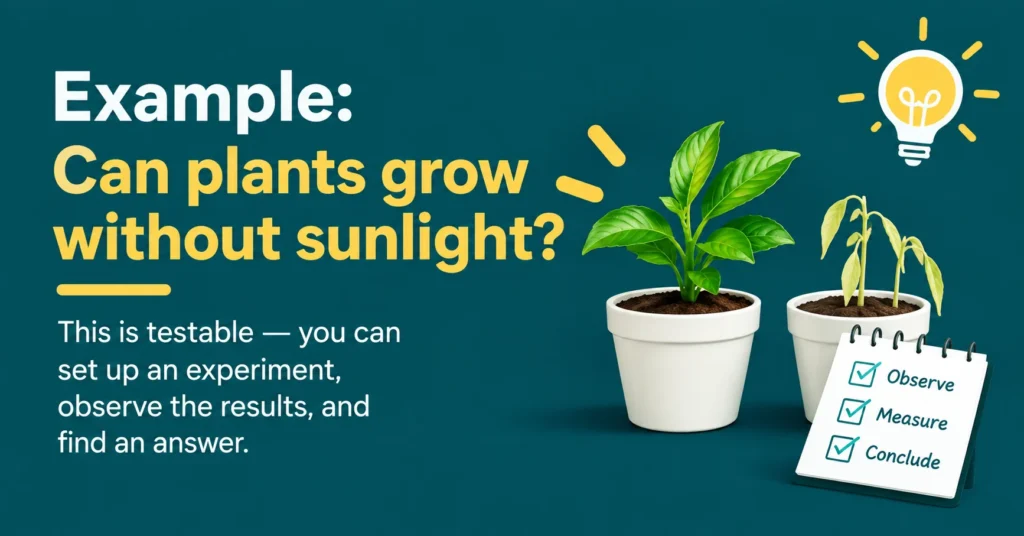
Third, form the question using a testable format: “Does [changing X] affect [Y]?” Using the plant example: “Does the amount of sunlight a plant receives affect its growth?” This three-step process works for nearly any observation, from soccer balls losing air pressure to ice melting at different rates.
Formulas and Definitions for a Testable Scientific Question
The most reliable formula for a testable question is simple: “Does changing ‘X’ affect ‘Y’?” where X is the independent variable and Y is the dependent variable. Question starters like How…?, What…?, If…?, and Does…? almost always signal a testable structure is possible.
Applying the SMART framework sharpens weak questions further: make them Specific (name the exact variable), Measurable (know what data you’ll collect), Attainable (doable with your time and materials), Relevant (worth answering), and Timely (fits your deadline). A question like “How does soil affect plants?” becomes far stronger as “How does soil temperature affect the number of tomato seeds that germinate?”
How to Plan a Fair Test for a Testable Question
A fair test changes only one variable at a time while every other condition stays identical. If you’re testing whether dark paper absorbs more heat than light paper, both pieces need the same size, same sunlight exposure, and same starting temperature color is the only difference.
Skipping this step is why so many “testable” questions produce confusing results. If two variables change at once say, paper color and thickness there’s no way to know which one actually caused the temperature difference, which defeats the purpose of testing in the first place.
Example Problems: Writing a Testable Scientific Question
Example 1: A gardener notices plants in shade are smaller than plants in sun. Observation: plant size differs by light exposure. Possible explanation: more sunlight causes more growth. Testable question: “Does the amount of sunlight a plant gets affect the plant’s growth?”
Example 2: An athlete notices soccer balls with different air pressure travel different distances when kicked with similar force. Observation: ball firmness varies, and so does distance traveled. Testable question: “How does the air pressure in a soccer ball affect how far it travels when kicked?”
| Scenario | Non-Testable Version | Testable Version |
| Plant growth | “What makes plants grow best?” | “How does soil temperature affect the number of seeds that germinate?” |
| Diet & health | “Is exercise good for mental health?” | “Does 30 minutes of daily exercise affect resting heart rate?” |
| Preference | “Which color of crayon is prettiest?” | “Do people identify warm colors faster than cool colors in a timed test?” |
Guided Practice: Is It a Testable Question?
Try sorting these into testable and non-testable categories: (1) “What makes plants grow best?” (2) “How does soil affect the growth of tomato plants?” (3) “How does the duration of light exposure affect the surface area of tomato plant leaves?”
Question 1 fails it’s too broad and has no clear measurement of “best.” Question 2 is close but still too broad, since “soil” could mean nutrients, water, or temperature. Question 3 succeeds: it names a specific variable (light duration), a measurable outcome (leaf surface area), and follows the “how does changing X affect Y” pattern that defines a genuinely testable question.
Conclusion
Understanding what is a testable question is an important first step in planning a meaningful science investigation. A good testable question is clear, specific, and can be answered through observation, measurement, or an experiment. It helps students focus their research and makes it easier to identify the variables they need to study.
Whether you are preparing a science fair project or simply exploring how something works, asking the right question can make the entire investigation more useful and organized. The best questions often begin with curiosity and lead to evidence-based answers. Take time to turn your curiosity into a question you can actually investigate, measure, and learn from.
FAQs
Author

Hi, I’m Alex, and I enjoy learning through quizzes, trivia, and interactive questions. I love discovering new conversation starters, relationship topics, and educational challenges. This website is my go-to place for fun, practical, and reliable question-based content. I’m always excited to learn something new and share it with others.