Knowledge Bowl Questions: Practice Sets & Study Tips (2026)
If you’ve got a Knowledge Bowl meet coming up, you already know the panic: sixty written questions, a buzzer strip you’ve never touched before, and teammates counting on you to know what a “rebound” even means. I’ve coached and competed in enough of these to know the fastest way to calm that panic isn’t more general trivia it’s knowledge bowl questions built around the actual format you’ll face, paired with a study system that fits how the written and oral rounds are really scored.
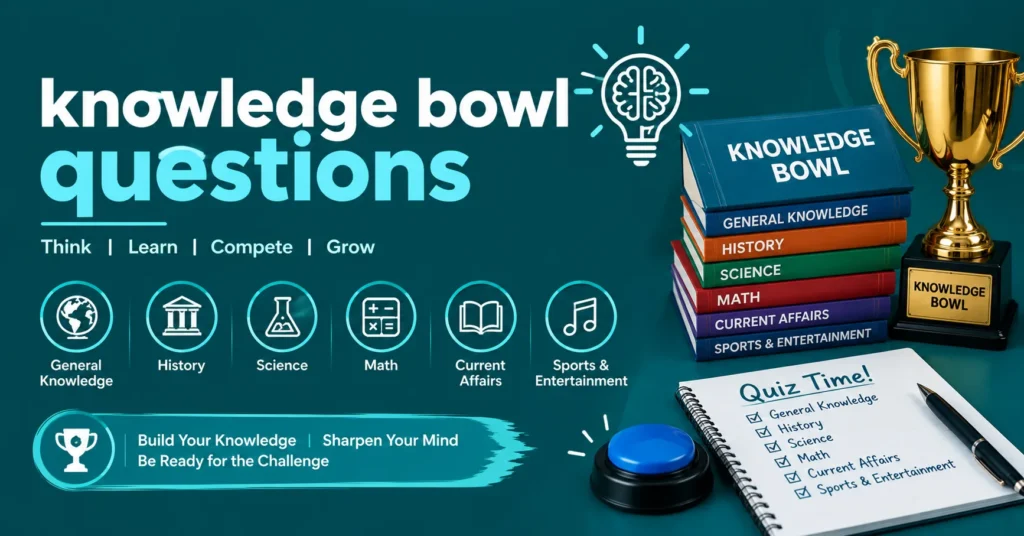
This guide breaks down real knowledge bowl questions by grade level and subject, explains exactly how scoring works so you’re not guessing on meet day, and points you toward the practice resources coaches actually trust. No fluff, no generic trivia just what you need to walk into that room ready.
What Is Knowledge Bowl?
Knowledge Bowl is an academic quiz competition that started in 1976 as a project within the San Juan Board of Cooperative Services in Durango, Colorado, and has since spread to states like Minnesota, Washington, and Tennessee. Teams of four to six students answer knowledge bowl questions across subjects like science, literature, math, and history in both a written round and fast-paced oral rounds.
What sets it apart from generic trivia is the format: a 60-question written round for seeding, followed by oral rounds where three teams share a “buzzer strip” a single piece of pressure-sensitive tape to answer 45 tossup questions. Question sets typically come from Academic Hallmarks or Question Authorities, which shapes the style and difficulty you’ll actually see.
Knowledge Bowl vs. Quiz Bowl: What’s the Difference?
They look similar on the surface, but they’re not the same competition. Quiz bowl (also called scholastic bowl or academic bowl) is a broader national category with pyramidal tossup questions that get easier as they go. Knowledge bowl is a specific regional format, strongest west of the Mississippi, with its own written-round seeding system and buzzer-strip mechanics.
If your school calls it “Knowledge Bowl,” expect that written round to matter as much as the oral rounds it decides which room you’re seeded into. That’s a meaningful strategic difference from generic quiz bowl prep, and it’s why practicing with knowledge bowl questions specifically, not just any trivia set, actually helps.
How Knowledge Bowl Scoring Actually Works
Here’s the part most new competitors get wrong: in oral rounds, a correct tossup answer earns two points plus a bonus question, but team members can’t talk to each other before buzzing you’ve got about 10 seconds to decide alone. Buzz in wrong, and your team loses a point while the question “rebounds” to the next team, who then gets to confer before answering.
Bonus questions work differently again, usually allowing team collaboration once your team has earned the right to attempt one. Understanding this rhythm matters more than raw memorization a lot of knowledge bowl questions are lost not to lack of knowledge, but to teams buzzing too early or hesitating too long under the format’s specific timing rules.
How to Effectively Study for Knowledge Bowl Questions
Cramming random trivia rarely works for Knowledge Bowl because the categories are broad and the written round alone covers everything from geometry to fine arts in one sitting. A better approach starts with building a study guide organized by the same subject categories your meet will use, so you’re reinforcing structure, not just facts.
Practice tests matter more here than in most trivia formats, specifically because of the buzzer timing. Studying with teammates who’ll actually be on your buzzer strip helps you learn each other’s strengths, so you’re not both reaching for the same easy science tossup while a teammate who knows literature cold sits quiet. Review every missed practice question immediately, not at the end of a session.
Middle School Knowledge Bowl Questions
Geography
This island country in the Indian Ocean is known for lemurs and has Antananarivo as its capital. Answer: Madagascar
This mountain range forms a natural border between France and Spain. Answer: The Pyrenees
Mathematics
Solve for x: 3x + 5 = 20. Answer: x = 5
What is a polygon with eight sides called? Answer: Octagon
Science
What process do plants use to make food from sunlight? Answer: Photosynthesis
Which gas makes up most of Earth’s atmosphere? Answer: Nitrogen
History
The Battle of Gettysburg was fought during which war? Answer: The American Civil War
Who was the Norman leader victorious at the Battle of Hastings in 1066? Answer: William the Conqueror
Literature
What type of animal is Charlotte in “Charlotte’s Web”? Answer: A spider
Who wrote the “Percy Jackson” series? Answer: Rick Riordan
Fine Arts
Who painted “The Last Supper,” and in which city can it be found? Answer: Leonardo da Vinci, in Milan, Italy
Which art style, associated with Picasso, uses distorted and exaggerated forms? Answer: Cubism
Mixed
What is the capital of Bhutan? Answer: Thimphu
Who wrote “One Hundred Years of Solitude”? Answer: Gabriel García Márquez
High School Knowledge Bowl Questions
Geography
This country is known for fjords and the Northern Lights, with Oslo as its capital. Answer: Norway
What term describes a narrow strip of land connecting two larger landmasses? Answer: Isthmus
Mathematics
Solve the system: 2x + 3y = 7 and 4x − 2y = 6. Answer: x = 2, y = 1
In trigonometry, what is the reciprocal of the tangent function? Answer: Cotangent
Science
What law states total pressure of a gas mixture equals the sum of partial pressures? Answer: Dalton’s Law
What term describes a substance that speeds a reaction without being consumed? Answer: Catalyst
History
The Magna Carta, signed in 1215, was pivotal in the development of what? Answer: Constitutional law
The Berlin Wall fell in which year? Answer: 1989
Literature
In which novel does Holden Caulfield appear? Answer: “The Catcher in the Rye”
Which Russian author wrote “War and Peace”? Answer: Leo Tolstoy
Fine Arts
Which artist is known as the “father of modern sculpture,” creating “The Thinker”? Answer: Auguste Rodin
Who co-founded Cubism alongside Picasso? Answer: Georges Braque
Mixed
What is the discriminant formula in a quadratic equation? Answer: b² − 4ac
Who developed the theory of general relativity? Answer: Albert Einstein
Most Challenging
What does the Heisenberg Uncertainty Principle state? Answer: That position and momentum of a particle cannot both be known with absolute precision at the same time.
What historical events contributed to the emergence of the Renaissance? Answer: The fall of Constantinople, revival of classical knowledge, and expanded trade and cultural exchange.
Where to Find More Knowledge Bowl Practice Questions
Once you’ve worked through these, the best next step is a resource built specifically for Knowledge Bowl’s format rather than generic trivia. Sites with searchable databases of tens of thousands of real questions let you drill by subject and simulate buzzer timing, which matters more for this format than flashcard memorization alone.
Coaches also recommend mixing in past written-round PDFs from your own state’s circuit, since regional question suppliers have recognizable styles once you’ve seen a few sets. Studying with a partner using a shared buzzer setup, even an improvised one, builds the reflexes that separate a good written-round score from a good oral-round performance.
Conclusion
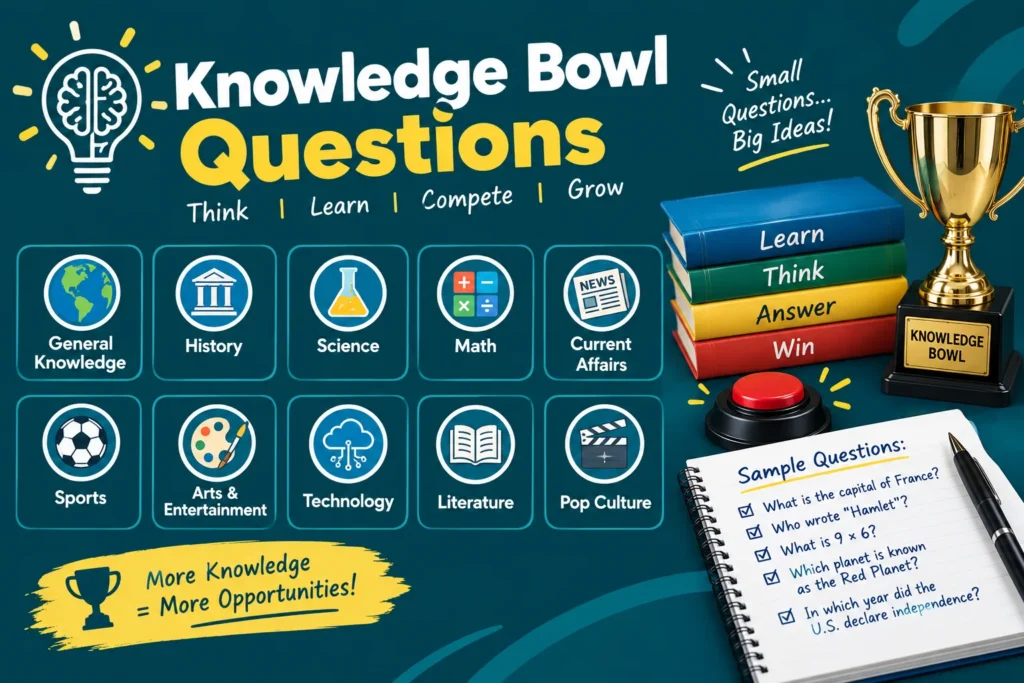
Knowledge Bowl questions are a great way to challenge your memory, build confidence, and explore a wide range of subjects in an engaging format. Whether you are preparing for a competition, practicing with classmates, or simply testing your general knowledge, each question offers an opportunity to learn something new. The best preparation combines regular practice with curiosity, teamwork, and a willingness to learn from mistakes.
As you work through different topics, you may discover strengths you did not know you had and identify areas where you can improve. Keep practicing, stay curious, and treat every question as a chance to sharpen your knowledge and enjoy the learning process.
FAQs
Author

Hi, I’m Alex, and I enjoy learning through quizzes, trivia, and interactive questions. I love discovering new conversation starters, relationship topics, and educational challenges. This website is my go-to place for fun, practical, and reliable question-based content. I’m always excited to learn something new and share it with others.