Level 2 Questions Examples: Costa’s Framework Explained (2026)
Level 2 questions examples ask students to process information rather than just recall it comparing, classifying, inferring, and connecting ideas instead of pointing to a single answer on the page. If you’ve ever written a quiz question and realized every answer was just copied straight from the text, you’ve felt the gap these questions are built to close.
That gap is exactly what Arthur Costa’s Levels of Questioning framework addresses. It’s used across US classrooms from elementary reading groups to AP history seminars to help teachers move students past memorization and into genuine analysis, which is what most standardized assessments and real-world thinking actually demand.
Understanding Costa’s Levels of Questioning
Arthur Costa, an educator and psychologist, built his levels of questioning framework to classify questions by cognitive complexity. It’s often taught using the metaphor of a three-story house: Level 1 on the ground floor (gathering facts), level 2 questions examples on the middle floor (processing those facts), and Level 3 on the top floor (applying and evaluating them). Each level builds on the one below it you can’t easily ask a strong Level 2 question about a topic without some Level 1 information already established.
The framework pairs closely with Bloom’s Taxonomy, another well-known model of cognitive complexity, and both aim at the same target: getting students to do something with information instead of just storing it. Costa also developed the “16 Habits of Mind,” a set of behaviors including gathering data, thinking interdependently, and applying past knowledge to new situations that overlap directly with what Level 2 and Level 3 questions demand of students.
Level 1: Gathering (For Context)
Level 1 questions ask students to locate information that’s explicitly stated in a text or source. The answer can be pointed to directly there’s no inference required, which makes these questions useful for building foundational knowledge before deeper analysis begins.
Common Level 1 power verbs include define, describe, label, identify, list, recall, locate, and match. In practice: “Label the parts of an animal cell” (science) or “Match the monarch to their country” (social studies). These questions matter, but research on cognitive complexity (Brookhart, 2022) shows that recall alone tells you little about whether a student can actually use what they’ve learned.
Level 2 Questions: Processing (Examples by Subject)
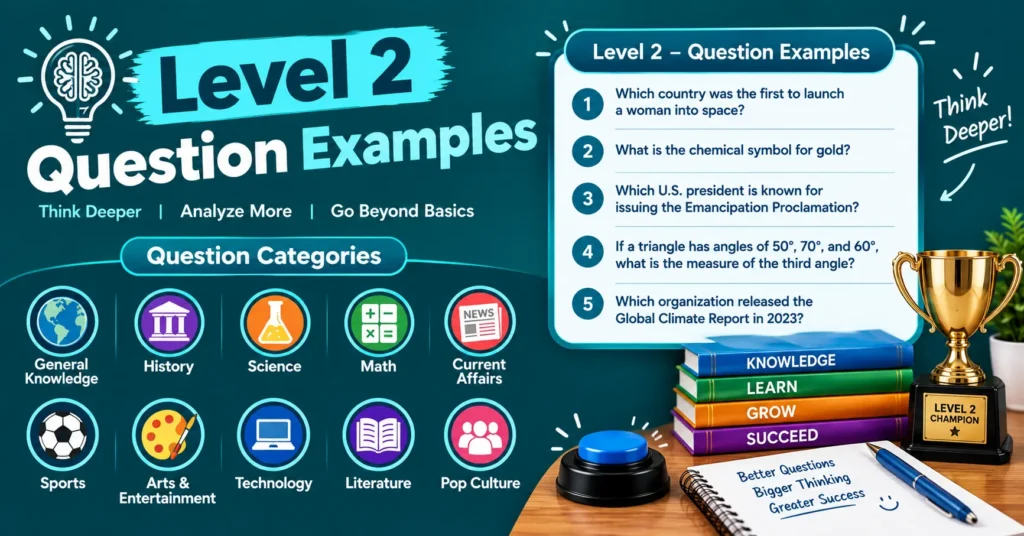
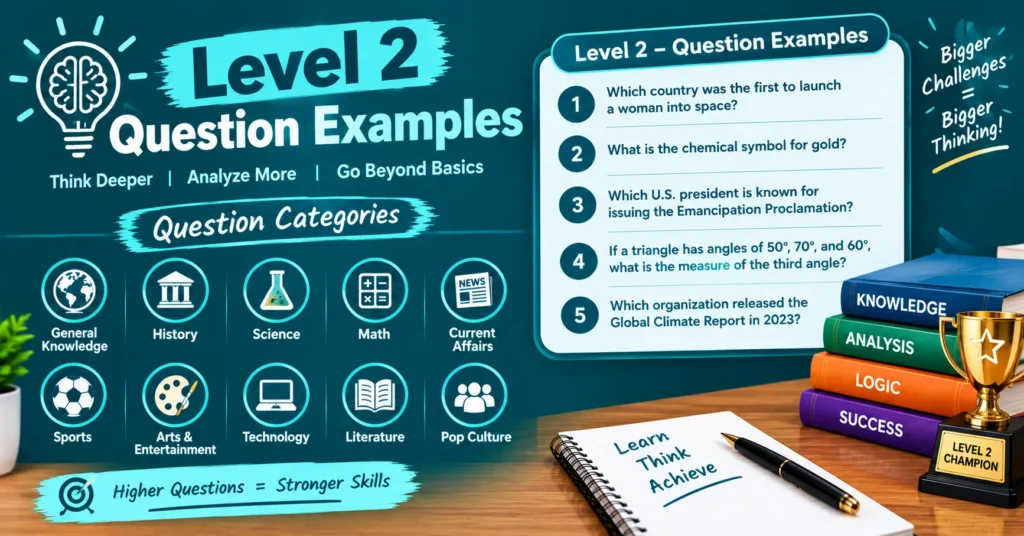
This is the level 2 questions examples most searches for “level 2 questions examples” are actually looking for. Level 2 questions push students to “read between the lines” using literal information from Level 1 but processing it against what they already know to form new connections. Students categorize, compare, contrast, and analyze rather than simply repeat.
Power verbs at this level include compare, contrast, classify, sort, distinguish, infer, analyze, organize, and combine. Here’s how level 2 questions examples look across common subject areas:
| Subject | Level 2 Question Example |
| Science | Compare the processes of mitosis and meiosis. |
| Math | Classify these shapes by their number of sides and angles. |
| Social Studies | Arrange these historical events in order of significance, from most to least. |
| English Language Arts | Analyze how the author’s tone affects the overall meaning of the text. |
| Reading (elementary) | Why do you think the character made that choice, based on what happened earlier? |
Notice the difference from Level 1: instead of locating “the mitochondria is the powerhouse of the cell,” a Level 2 question asks a student to hold two processes in their head at once and find the relationship between them. That’s a meaningfully harder cognitive task, and it’s the level most classroom discussion should actually live in.
Level 3: Applying (For Context)
Level 3 questions ask students to generate an output rather than process an input evaluating, predicting, judging, or creating something new. Power verbs include evaluate, predict, justify, synthesize, hypothesize, and create.
Example: “Based on the last decade of hurricane data in the southeast US, predict how frequency will change over the next ten years” (science), or “Build an argument defending or opposing mandatory employee vaccination policies” (ELA). These questions have no single correct answer success depends on the quality of reasoning behind the response, not just the conclusion reached.
Why Costa’s Levels of Questioning Matter
The framework isn’t just an academic exercise it directly shapes how much students actually retain and can transfer to new situations. Level 2 and 3 questions promote active learning because students have to participate in constructing meaning rather than passively receiving it, which research on deeper learning (National Research Council, 2012) directly links to a student’s ability to apply what they learned in one context to a completely new one.
It also supports differentiation. A teacher working with a struggling reader can lean on Level 1 questions to build confidence and foundational vocabulary, then scaffold up to level 2 questions examples as comprehension solidifies rather than assuming every student is ready for high-inference questions on day one.
Instructional Application
Effective question design should weight Levels 2 and 3 more heavily than Level 1 in day-to-day instruction. A purely factual assessment dates, names, formulas provides limited evidence that a student actually understands the material or could use it somewhere new. Consider the difference: “When did the Civil Rights Act pass?” (Level 1) versus “How did the timing of the Civil Rights Act relate to concurrent social movements?” (Level 2) versus “What structural barriers would similar legislation face today?” (Level 3). Each version tests something genuinely different.
In Practice
Getting this into daily teaching doesn’t require a curriculum overhaul. Plan a mix of all three levels into every lesson rather than defaulting to Level 1 recall questions, which are the easiest to write but the least revealing. Encourage students to generate their own Level 2 and Level 3 questions about a text or topic the act of writing a good “why” or “how” question is itself a higher-order thinking exercise. And post the three levels somewhere visible in the room; several teachers use a simple poster breaking down each level’s power verbs so students internalize the difference between “find the answer” and “build the answer.”
Conclusion
Level 2 questions help learners move beyond simple recall and begin thinking about ideas, relationships, patterns, and meaning. They encourage students to explain their reasoning, make connections, compare information, and use what they already know in new ways. The examples throughout this article show that these questions can be useful across subjects and grade levels, whether in classroom discussions, assignments, or study activities.
Learning to recognize and create Level 2 questions can make learning more active and thoughtful. When students are given opportunities to explore ideas rather than simply remember facts, they develop stronger understanding and more confident thinking skills that can support them well beyond the classroom.
FAQs
Author

Hi, I’m Alex, and I enjoy learning through quizzes, trivia, and interactive questions. I love discovering new conversation starters, relationship topics, and educational challenges. This website is my go-to place for fun, practical, and reliable question-based content. I’m always excited to learn something new and share it with others.