
WH Question Visual Supports: A Complete SLP & Teacher Guide
If you’ve ever watched a child freeze when asked “where does the dog live?” not because they don’t know the answer, but because “where” itself doesn’t register you already understand why a WH question visual matters. These simple picture-based tools turn an abstract question word into something a child can see, point to, and eventually internalize on their own.
For speech-language pathologists, special education teachers, and parents of children with autism spectrum disorder, this isn’t a minor classroom trick. Comprehension of who, what, when, where, why, and how underlies nearly every instructional interaction a child will have and a well-designed visual support is often the fastest bridge to real understanding.
The Need for Good WH Question Visual Comprehension
Question words are deceptively powerful. From early toddlerhood, “who’s that?” and “what’s that?” shape how children learn language, request information, and connect with caregivers. By the time a child reaches school, WH questions are woven into nearly every lesson, story, and social interaction which means a gap in comprehension here doesn’t stay contained to one skill area.
What makes this tricky to catch is that expressive ability can mask a receptive gap. A child might ask a “where” question just fine while still struggling to answer one correctly, especially once sentences get longer or the environment gets noisier. That mismatch is exactly why a visual, rather than an auditory instruction alone, gives struggling learners something concrete to anchor to.
Checking Student Comprehension With a WH Question Visual Test
Research from the Indiana Resource Center for Autism found that WH question comprehension is genuinely hard to predict from age or a teacher’s informal impression alone. In one study of 28 verbal students with autism spectrum disorder, only 8 outperformed a comparison group of typically developing three-year-olds and just 2 students scored a perfect result across all six question categories.
The most telling error pattern researchers found wasn’t wrong answers it was mismatched answers, where a child responded to a “who” question with a place or object instead of a person. Typically developing preschoolers almost never made this mistake. That distinction matters practically: it tells you the issue usually isn’t vocabulary, it’s whether the child has internalized what category of answer each question word demands which is precisely the gap a visual support is built to close.
Using a WH Question Visual Support: One Core Strategy
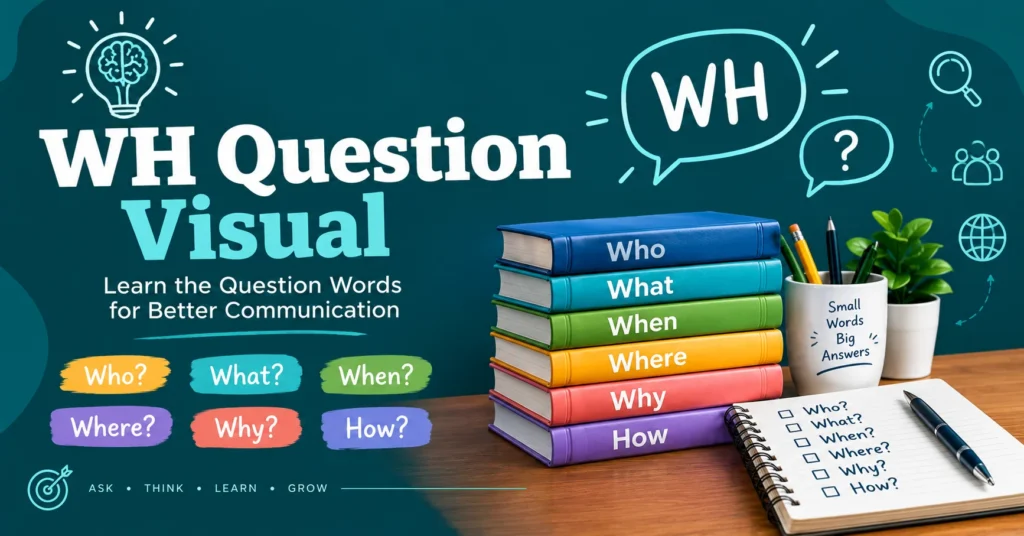
A WH question visual doesn’t have to be complicated. It can be as simple as a poster with a distinct picture cue for each question type (a person icon for “who,” a clock for “when,” a location pin for “where”) that a teacher points to while asking questions aloud to the whole class. Pairing the spoken question with a consistent picture cue gives the child a second channel of information to lean on.
The same support scales down easily. A miniature version taped to an individual student’s desk lets a teacher quietly point to the relevant icon during a lesson, without singling the child out verbally. Over time, as instruction connects the picture to the meaning of the spoken word, the visual becomes a genuinely independent comprehension aid rather than just classroom decoration.
Using WH Question Visual Choices in Speech Therapy
Most practitioners start in the same place: offering a field of two to four visual answer choices for a WH question. It’s an effective, low-effort entry point show a picture of a dog and a sheep, ask “what animal is this?”, and let the child point or select. The strategy works well for building initial response confidence.
Where most people stop, though, is exactly where the ceiling of that approach shows up. Visual answer choices help a child understand the choices, but they don’t necessarily teach the child to understand the question itself. That’s an important distinction if your goal is generalized comprehension rather than a memorized response pattern for one specific activity.
WH Question Visual Supports That Increase Comprehension of the Question
To close that gap, the visual needs to attach to the question, not just the answer. That might mean a single illustration tied directly to the question being asked, a picture-scene the clinician gestures toward, or visuals already built into a child’s AAC device. Because many high-tech AAC systems display icons automatically, simply modeling the question through the device provides visual support and language modeling at the same time with no extra materials needed.
This is also where progress tends to compound. A child who has learned to associate a picture cue with “where” in one context is far more likely to transfer that understanding to a new “where” question in a completely different activity, because the support was attached to the concept of the question rather than to one specific answer set.
Using a WH Question Visual to Teach the Types of Questions
Before mixing question types together, it helps enormously to teach each type in isolation first. Jumping straight into randomized “who/what/where/why” drills without first establishing what each word is asking for tends to produce guessing rather than genuine comprehension a pattern experienced clinicians see often in newer therapists eager to move fast.
A dedicated chart that lays out each WH word alongside its expected answer category gives both the clinician and the student a shared reference point. It’s useful not just for initial teaching, but for ongoing review and for prompting when a student starts to drift toward a mismatched answer.
| WH Word | What It’s Asking For | Example Question | Typical Visual Cue |
| Who | A person | “Who helps put out fires?” | Person/figure icon |
| What | An object or action | “What is the girl doing?” | Object or action picture |
| Where | A location | “Where does the cow live?” | Location/map icon |
| When | A time | “When do you brush your teeth?” | Clock or calendar icon |
| Why | A reason | “Why do you go to the doctor?” | Question mark/reason icon |
| How | A method | “How will you get there?” | Steps/process icon |
WH Question Visual – Free Download Options
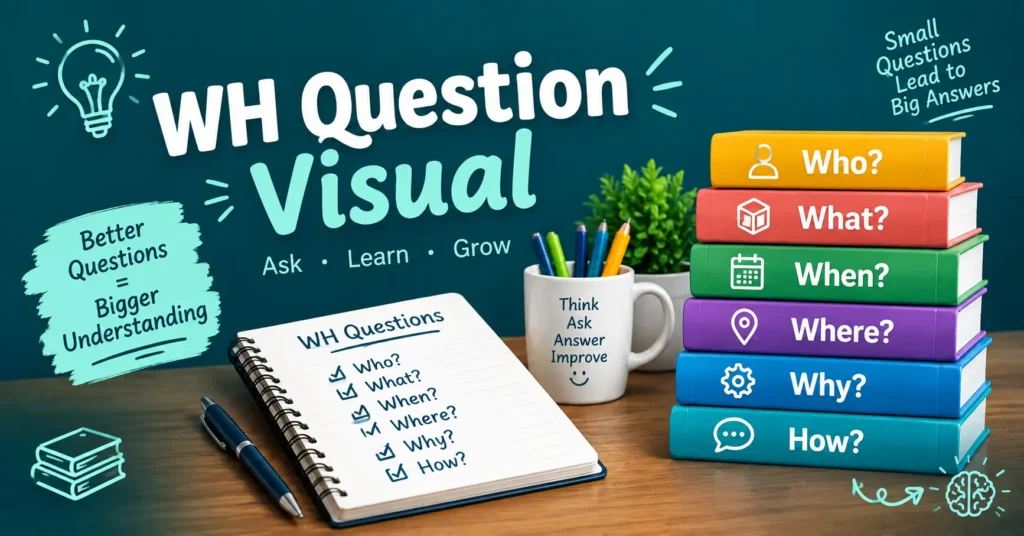
Because this is such a common early goal, free WH question visual charts and picture supports are widely available from SLP-run resource sites and marketplaces like Teachers Pay Teachers. These typically include a poster-style reference chart, individual question-word cue cards, and a black-and-white print-friendly version for classroom or take-home use.
Free versions are genuinely useful as a starting point, and many practitioners layer their own paid materials picture scenes, task cards, or BOOM Cards on top once a student has learned the basic categories. There’s no need to over-invest before confirming a particular format works for a specific student.
Varying the Answer Choices in Your WH Question Visual
Once a question type has been taught in isolation, the next step is to vary the answer field. Start by presenting choices that are all the same category for instance, three different places for a “where” question while pointing to the WH word and its associated icon on the chart. This reinforces the category-matching skill without adding unnecessary difficulty.
Only after that’s solid should you introduce mixed answer types a person, a place, and an object presented together which forces the student to actually attend to the question word itself rather than pattern-matching within a single category. This staged approach mirrors how typically developing children build the same skill, just made explicit and visual.
Don’t Forget to Fade the WH Question Visual
The end goal of any visual support is its own obsolescence. As a student’s independent comprehension strengthens, the visual should be deliberately faded moving from a full-color, prominent chart to a smaller cue, then to an occasional point, and eventually to no visual at all.
Skipping this step is a common oversight. A visual support that never fades risks becoming a permanent crutch rather than a bridge to independent comprehension, so building a fading plan in from the start is just as important as introducing the visual in the first place.
Conclusion
Wh question visuals make it easier to understand and practice important question words such as who, what, when, where, why, and how. By connecting each question with clear pictures and familiar situations, learners can build vocabulary, improve comprehension, and become more confident when communicating. These visual supports can be especially helpful for children, students, and learners who benefit from structured or picture-based activities.
Whether used in the classroom, at home, or as a printable worksheet, they provide a simple way to turn question practice into an engaging learning experience. With regular practice and encouraging guidance, wh question visuals can help learners develop stronger language skills one question at a time.
FAQs
Author

Hi, I’m Alex, and I enjoy learning through quizzes, trivia, and interactive questions. I love discovering new conversation starters, relationship topics, and educational challenges. This website is my go-to place for fun, practical, and reliable question-based content. I’m always excited to learn something new and share it with others.