Free SATs Questions Fractions: Year 6 Practice & Answers
SATs questions fractions in KS2 maths usually ask pupils to compare, order, simplify and calculate with fractions, then apply them in word problems. If a tricky denominator makes your Year 6 child freeze, you’re not alone. This guide covers UK KS2 SATs, not the US SAT. They appear across the arithmetic and reasoning papers.
I reviewed how the arithmetic and reasoning papers present fractions, then wrote original practice questions around those patterns. You’ll find worked answers, equivalent fractions tips and mixed numbers help, so your child can walk into May feeling prepared instead of panicked. Each one echoes the style of the national tests.
What do Year 6 pupils need to know about fractions?
By Year 6, pupils should handle sats questions fractions confidently: comparing unlike denominators, adding and subtracting, multiplying, dividing and simplifying answers. They also link fractions, decimals and percentages. Think of it as a toolkit, not a mountain, built gradually from Year 3 unit fractions to fluent problem solving.
Children who struggle often lack visual understanding rather than ability. Fraction walls, number lines and shaded diagrams make abstract ideas concrete before formal methods begin. When a child can picture three-quarters, a SATs question stops feeling like a puzzle and starts feeling like something familiar.
National Curriculum expectations for fractions in KS2 maths
Fraction learning climbs steadily across Key Stage 2. Year 3 introduces unit and non-unit fractions, Year 4 deepens equivalence and tenths, Year 5 tackles unlike denominators and mixed numbers, and Year 6 combines all four operations with simplifying. The table below shows that progression at a glance.
| Year | Main fraction skills |
| Year 3 | Unit and non-unit fractions, equivalence, comparing, adding and subtracting with the same denominator |
| Year 4 | Stronger equivalence, same-denominator addition and subtraction, counting in tenths and hundredths |
| Year 5 | Unlike denominators, improper fractions and mixed numbers, early multiplication, links to decimals and percentages |
| Year 6 | All four operations, simplifying, converting between fractions, decimals and percentages |
Key Year 6 fractions terminology needed for these questions
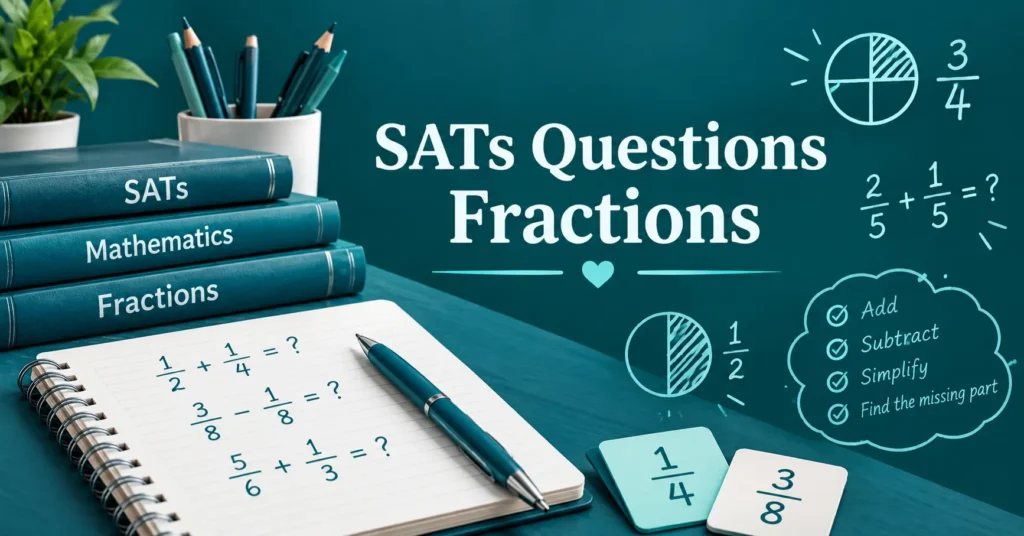
Know the vocabulary and the sats questions fractions get easier. The numerator counts parts chosen; the denominator shows equal parts in the whole. Equivalent fractions share a value, improper fractions exceed one whole, and mixed numbers combine whole numbers with fractions. To simplify, divide top and bottom by their highest common factor.
What fractions questions appear in the KS2 SATs?
The arithmetic paper leans on fluency: quick calculations such as adding, subtracting, multiplying and dividing fractions. The two reasoning papers use word problems, diagrams and explain-your-answer tasks. Difficulty climbs as each paper progresses, so early questions build confidence and later ones stretch problem solving.
Fractions, decimals and percentages together form one of the biggest content areas across both paper types, according to Third Space Learning’s breakdown. In 2023, for example, the arithmetic paper included three adding-fractions questions that moved from sums within one whole to totals above one.
About these KS2 SATs questions
Good practice questions mirror the real tests: they start with fluency, move to reasoning, and carry marks so pupils learn where to show working. Use them as a diagnostic rather than a timed exam, aiming to spot gaps early. A short 20 to 35 minute session works well.
| Paper | Style | Marks | Time |
| Paper 1 | Arithmetic | 40 | 30 minutes |
| Paper 2 | Reasoning | 35 | 40 minutes |
| Paper 3 | Reasoning | 35 | 40 minutes |
Check current figures on GOV.UK, as test details can change.
KS2 SATs fractions, decimals and percentages questions
Pupils often meet fractions alongside decimals and percentages, so fluent conversion matters. Knowing that one-half equals 0.5 equals 50% saves precious time. Practise writing tenths and hundredths as decimals, then percentages, until switching between forms feels as natural as changing a coin for smaller change.
Try ordering mixed forms, because that is where marks slip. Convert everything to hundredths or decimals first, then compare. Finding a percentage of an amount also appears regularly, so 10% and 5% chunking methods are worth rehearsing with everyday money amounts.
| Question | Worked answer |
| Write 0.35 as a fraction in simplest form. | 0.35 = 35/100. Divide both by 5 to get 7/20. |
| Order from smallest to largest: 40%, 3/8, 0.35 | As decimals: 0.4, 0.375, 0.35. Order: 0.35, 3/8, 40%. |
| Find 15% of 80. | 10% = 8 and 5% = 4, so 15% = 12. |
Fraction questions for Year 6: comparing and ordering
Comparing starts with a common denominator. Rewrite each fraction so the bottom numbers match, then the numerators tell the story. For 5/6 and 7/9, eighteenths work neatly, giving 15/18 and 14/18, so five-sixths wins. Showing this working can earn method marks even if arithmetic slips.
Ordering a longer list follows the same idea. Pick one shared denominator, convert every fraction, then line up the numerators from smallest to largest. Finally, write the original fractions in order, not the converted ones, because that detail trips up many careful pupils under pressure.
| Question | Worked answer |
| Which is greater: 5/6 or 7/9? | 15/18 vs 14/18, so 5/6 is greater. |
| Order smallest to largest: 3/4, 2/3, 7/12 | Twelfths: 9/12, 8/12, 7/12. Order: 7/12, 2/3, 3/4. |
| Priya read 3/5 of her book and Leo read 7/10 of his, both the same length. Who read more? | 3/5 = 6/10, which is less than 7/10, so Leo. |
Fraction questions for Year 6: four operations with fractions
Adding and subtracting needs matching denominators, and only the numerators change. Multiplying a fraction by a whole number multiplies the numerator, then converts any improper result to a mixed number. Dividing a fraction by a whole number makes the denominator bigger, which is why each share gets smaller.
Simplify last, every time. Questions sometimes ask for simplest form, and cancelling common factors keeps numbers manageable anyway. A quick habit check: does the answer look sensible? If you add two fractions and the total is smaller than either, something went wrong, and a calm re-read usually reveals it.
| Question | Worked answer |
| 5/9 + 1/3 | 5/9 + 3/9 = 8/9 |
| 7/8 − 1/4 | 7/8 − 2/8 = 5/8 |
| 3/7 × 4 | 12/7 = 1 5/7 |
| 5/6 ÷ 5 | 5/6 × 1/5 = 5/30 = 1/6 |
Fraction questions for Year 6: fraction word problems
Word problems hide simple maths inside a story. Underline the fraction, circle the whole amount, and decide the operation before calculating. Finding three-eighths of 32, for instance, means dividing by eight to get four, then multiplying by three. Breaking tasks into tiny steps keeps panic away.
Picture a Year 6 pupil staring at a question about pocket money, scared of the fractions inside. Once she sketches a bar model, splits it into quarters and thirds, and subtracts step by step, the fear fades. Pictures turn confusion into confidence.
| Question | Worked answer |
| 3/8 of 32 pupils walk to school. How many walk? | 32 ÷ 8 = 4, then 4 × 3 = 12 pupils. |
| Maya has £60. She spends 1/4 on a book and 1/3 on a game. How much is left? | Book £15, game £20, total £35. £60 − £35 = £25. |
| 2/5 of a cup of milk makes 4 pancakes. How much for 12 pancakes? | 12 is 3 times 4, so 3 × 2/5 = 6/5 = 1 1/5 cups. |

Example equivalent fractions Year 6 questions
Equivalent fractions appear everywhere, from diagram shading to missing-number tasks. Multiply or divide the numerator and denominator by the same number and the value stays unchanged. For 3/4 = ?/20, multiply both by five to reach 15/20. Spotting that one scale factor is the entire trick.
Reasoning versions ask pupils to explain. If someone says 6 out of 24 stickers are gold, they can show 6/24 simplifies to 1/4 by dividing top and bottom by six. One clear sentence like that helps secure the explanation mark.
| Question | Worked answer |
| Complete: 3/4 = ?/20 | ×5 on both parts: 15/20 |
| Which two are equivalent: 4/6, 5/9, 6/9, 8/15? | Both simplify to 2/3: 4/6 and 6/9 |
| Simplify 18/24. | Divide by 6: 3/4 |
Other free KS2 SATs questions to practise with
Once these examples feel comfortable, widen your practice. Official past papers from the Standards and Testing Agency give the closest match to real tests, while teacher-created packs from Third Space Learning, Teachwire and similar sites offer topic-by-topic sets with answers for targeted catch-up.
Short, regular sessions beat last-minute cramming. Ten focused minutes of SATs questions fractions practice, three or four times a week, builds fluency without burnout. Celebrate small wins, revisit mistakes calmly, and remember that confidence with fractions grows one question at a time.
Conclusion
Working through SATs questions fractions can make a big difference in building confidence with fractions, decimals, percentages, and related calculations. Regular practice helps students recognise different question styles, choose the right method, and avoid common mistakes under exam pressure. It is also useful to review incorrect answers and understand why a particular step went wrong, rather than simply moving on.
With a mixture of straightforward and challenging questions, pupils can gradually improve both their accuracy and speed. The key is to practise consistently and focus on understanding the maths behind each answer. With patience and steady preparation, fraction questions can become a much more manageable part of SATs revision.
FAQs
Author

Hi, I’m Alex, and I enjoy learning through quizzes, trivia, and interactive questions. I love discovering new conversation starters, relationship topics, and educational challenges. This website is my go-to place for fun, practical, and reliable question-based content. I’m always excited to learn something new and share it with others.