21 Employee Survey Questions About Process Improvement 2026
The best employee survey questions about process improvement ask people to name the exact step where work stalls, breaks, or repeats. After comparing three leading guides, I noticed most surveys collect vague employee feedback instead of pinpointing workflow bottlenecks, handoff delays, and root causes, so process efficiency never moves.
If you’ve ever watched a frustrated team patch the same broken approval for months, you know why this matters. Below are 21 original questions grouped by process area, plus pulse survey timing, analysis, and follow-through steps grounded in Lean thinking, change management research, and process owner accountability, so continuous improvement finally feels real.
Why Traditional Employee Survey Questions About Process Improvement Miss the Mark
Static forms usually stop at a rating or a one-line comment. When someone writes that approvals take too long, nobody asks which stage stalls or who waits. Without that follow-up, survey feedback stays surface-level, and the real root causes of workflow friction never reach the process owner.
Generic questions such as “Is there anything you’d improve?” invite shrugs, while process-specific prompts invite stories. Ask which step consistently slows your week, or where handoffs between teams break down. Specific wording turns vague frustration into usable operational data, and respondents feel the survey actually listens.
| Generic question | Process-focused rewrite |
| Are you happy with our tools? | Which system do you reopen most often to finish one task? |
| Do teams communicate well? | Which handoff leaves you chasing missing details? |
| Any ideas for improvement? | Which single step would you drop first, and why? |
| Is training adequate? | Which step did training skip that you learned the hard way? |
Essential Employee Survey Questions About Process Improvement That Uncover Process Inefficiencies
Strong surveys mix rating scales with open prompts, and they scope everything to one workflow. A single named process, from first request to final output, keeps answers precise. Ratings reveal where friction clusters; open comments explain why, which together guide process mapping and prioritization.
Below are 21 original questions in six process areas. Choose three or four per area, keep at least one open question in each group, and reuse identical wording every cycle so trend lines stay comparable. Short surveys finish faster, respect people’s time, and protect response rates.
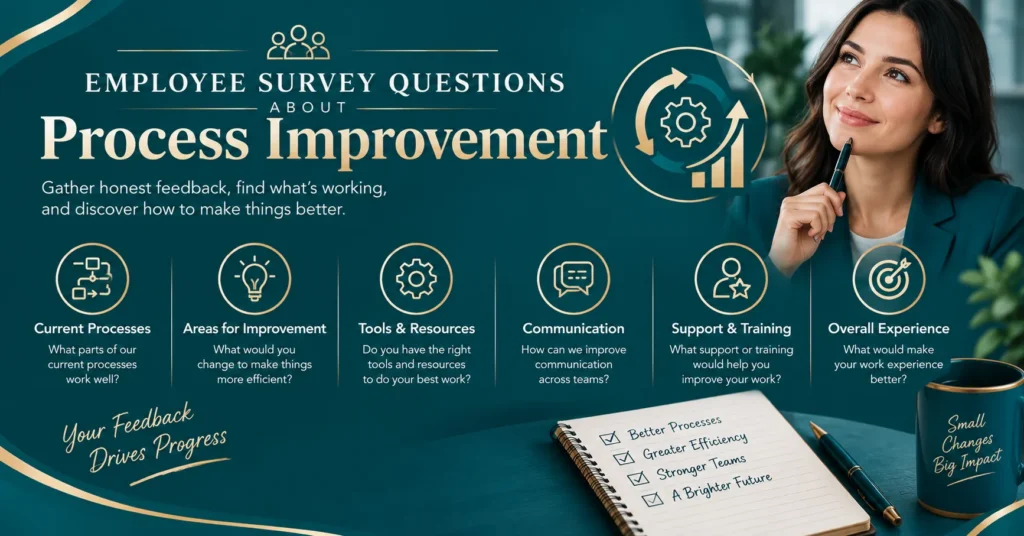
Workflow Efficiency and Bottlenecks Survey Questions
Start here, because bottlenecks decide where everything else should focus. These prompts locate approval queues, duplicate steps, and waiting time that dashboards miss. Answers expose cycle time problems and wasted effort that employees quietly absorb every week, long before managers notice the pattern.
- Which step in your week takes longest to clear, and what is it waiting on?
- How many approvals does a routine request need, and which ones add no value?
- How often do you redo or re-enter work because of an earlier step? (Never to daily)
- If one step disappeared tomorrow, which would you remove first, and why?
Communication and Cross-Functional Handoff Survey Questions
Delays often hide between teams rather than inside them. These questions reveal missing context, unclear ownership, and escalation paths nobody trusts. Review scores by department pair, because cross-functional collaboration problems rarely show up in company-wide averages and often explain recurring rework and customer-facing mistakes.
- When work reaches you from another team, how often does it arrive complete?
- Which handoff leaves you chasing missing information the most?
- Is it clear who owns each step when a task crosses departments?
- What information do you wish you had earlier to finish your work faster?
Tools, Systems, and Resources Process Survey Questions
Tool friction is the easiest finding to cost out. These questions uncover duplicate data entry, manual workarounds, and software that fights the real workflow. Separating tool problems from process design problems matters, because fixing the wrong layer wastes budget and leaves frustrated employees using the same clumsy systems.
- How many systems do you open to finish one routine task?
- Which tool or form costs you the most time each week?
- How often do you copy the same information between systems?
- Which repetitive task would you automate first?
Process Clarity, Documentation, and Training Survey Questions
Unclear processes often masquerade as performance problems. These questions test whether documentation is current, findable, and understood the same way across teams. New hires spot missing instructions quickly, while veterans notice outdated steps, so surveying both groups gives a more honest picture of training gaps.
- How easy is it to find the current version of the instructions you need?
- Which part of this process is most open to interpretation?
- When a process changes, how quickly do you learn the new version?
Quality, Error Reduction, and Compliance Improvement Questions
Rework is hidden capacity. These prompts show where mistakes start, whether quality checks arrive too late, and which compliance steps add friction without adding safety. Recurring errors usually point to process design rather than individual performance, so frame questions around steps instead of people.
- At which step do errors most often begin?
- Do quality checks catch problems early enough, or after the damage is done?
- Can you pause or flag work when you spot a quality issue?
Employee Ownership, Ideas, and Continuous Improvement Questions
Great ideas usually live closest to the work. These questions measure whether employees believe suggestions go anywhere, which predicts future participation. Psychological safety matters here, because people stop sharing improvement ideas once earlier suggestions disappear without a reply, a decision, or a reason.
- What small change would make your work noticeably easier?
- How comfortable are you suggesting a process change when something isn’t working?
- Have you seen any of your earlier suggestions implemented?
When Should You Run Employee Survey Questions About Process Improvement?
Leading guides recommend a baseline survey two to four weeks before a redesign, then repeating the same questions 60 to 90 days after launch. Between those moments, add a few process items to a pulse survey or annual engagement survey so trend lines never go dark.
Event triggers matter too. CultureMonkey’s guidance adds a short check about 30 days after a new system goes live, and another within two weeks of repeated errors. Without a baseline, nobody can prove a redesign helped the people doing the work.
Employee Survey Questions About Process Improvement: How to Run the Survey Step by Step
Name one process and the decision the survey must inform. Pick ten to twenty questions, add one open prompt per area, and set a minimum reporting group, commonly five responses, so anonymity holds. Announce the purpose, owner, and results date before launch.
Keep the window open for one to two weeks and watch participation by team and shift. Then code open comments by the process step they name, and share findings within a month. Visible follow-through lifts the response rate next cycle more than extra reminders ever will.
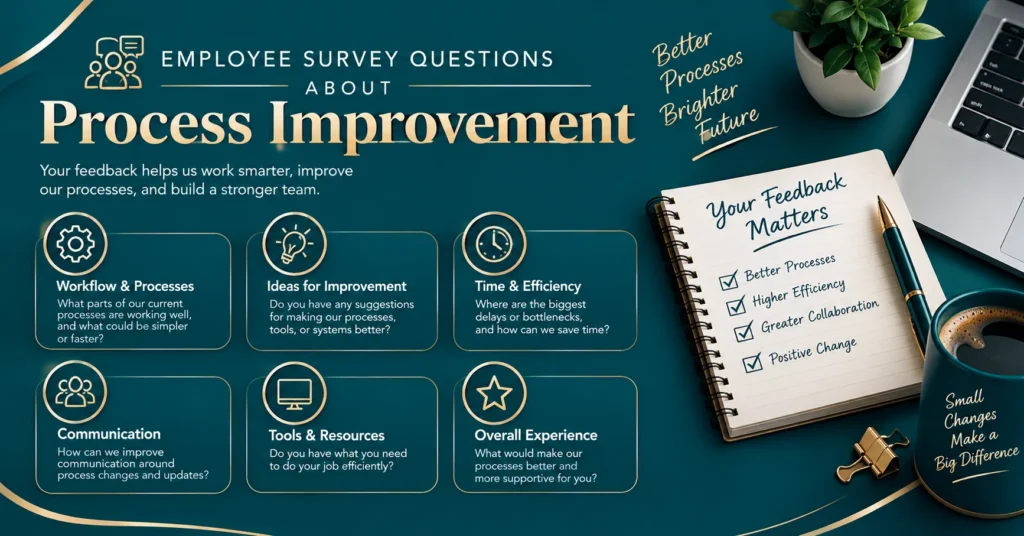
How Do Employee Survey Questions About Process Improvement Compare With a Focus Group or Process Walk?
A survey shows which teams and steps carry the most friction across the whole workforce, anonymously and at scale. A focus group explains why a step fails, while a process walk measures the step where the work happens. Each method fills a different gap.
Use them in sequence. Let the survey pick two or three steps worth examining, invite the people in those steps to a focus group, then observe the process directly. Interview-style follow-ups work best once patterns appear, because they dig into causes instead of guessing.
| Method | Best for | Anonymous? | Scale | Main limitation |
| Survey | Finding where friction clusters | Yes | Whole workforce | Shows where to look, not the full cause |
| Focus group | Explaining why a step fails | No | One group per session | Louder voices can dominate |
| Process walk | Measuring time and waste in one step | No | One process | Misses what people won’t say to an observer |
How Do You Analyze Results From Employee Survey Questions About Process Improvement?
Segment before you average. A healthy company score can hide one warehouse or finance team sitting far lower, so compare results by team, role, location, and shift. Then tag each open comment with the process step it names and count the tags.
Cross-check hot spots against cycle time, error rates, and ticket backlogs, because agreement between opinion and operational data builds a case for change. Rank findings by impact and effort, ship two or three quick wins first, and compare every cycle against the last.
| Engagement driver | Benchmark score (0–10) | Link to eNPS | Best-matched question area |
| Communication | 7.95 | Strong | Handoffs |
| Involvement | 8.04 | Strong | Ideas and continuous improvement |
| Work Environment | 8.14 | Moderate | Tools and systems |
| Innovation | 8.17 | Moderate | Ideas and continuous improvement |
| Autonomy | 8.23 | Moderate | Workflow and bottlenecks |
| Management | 8.23 | Moderate | Clarity and training |
Source: CultureMonkey People Science, Employee Engagement Drivers Benchmarks, Q2 2026. This is vendor data from its own customer base.
Turning Employee Survey Questions About Process Improvement Into Actionable Improvements
Feedback earns its keep only when someone acts on it. Group comments into themes, such as bottlenecks, communication gaps, tool issues, training needs, and quality risks, then assign each fix an owner and a date. Quick wins build credibility for the harder projects.
Close the loop in writing: what employees said, what changes, what doesn’t, and why. A McKinsey case cited by HeySurvey found value-stream mapping exposed unnecessary checks and approvals that stretched development times by nearly 30%. Silence after a survey teaches people to stop answering.
Best Practices for Writing and Using Employee Survey Questions About Process Improvement
Keep questions specific, neutral, and jargon-free, and avoid double-barreled wording that asks two things at once. Mix rating scales with open text, align items with measurable outcomes like cycle time or error rate, and keep the whole survey short enough to finish in five to ten minutes.
Test anonymous formats when feedback touches friction or leadership support, and segment results by role, because managers, analysts, and frontline staff experience the same process very differently. Treat every survey as a tool for better work, never as paperwork that sits in a shared folder.
Dos
Do align each question with a measurable goal, close the feedback loop quickly, and segment by role or function. Keep surveys short, protect anonymity where friction is sensitive, and share what you learned. Employees answer more candidly next time when they see action follow their feedback.
Don’ts
Don’t survey every process at once, lean only on rating scales, or ignore open comments, where root causes usually hide. Avoid jargon, double-barreled items, and promises of anonymity that small teams can’t keep. Never collect ideas without replying, because unanswered suggestions quietly lower participation.
How Should Employee Survey Questions About Process Improvement Change for Frontline, Hybrid and Office Teams?
The questions stay similar, but delivery changes. Frontline and deskless teams need short surveys by SMS, QR code, or kiosk during paid shift time, while hybrid and office teams can handle longer email or chat surveys focused on approvals and handoffs.
Frontline workers in manufacturing, retail, and healthcare often see process failures first yet get asked last. Offer each site’s working languages, cover every shift, and stress safety steps and shift handoffs. A five-to-eight-question version usually respects limited break time and keeps completion rates healthy.
| Team type | Delivery | Typical length | Focus areas |
| Frontline / deskless | SMS, QR code, kiosk | 5–8 questions | Tools, safety steps, shift handoffs |
| Hybrid | Email plus Slack or Teams | 10–15 questions | Handoffs, tools, documentation |
| Office-based | Email plus chat | 10–20 questions | Approvals, handoffs, documentation |
Conclusion
Employee survey questions about process improvement work when they name one process, ask about steps instead of people, and promise a visible reply. Scope tightly, pair ratings with open prompts, and let employees tell you exactly where work waits, breaks, or repeats.
Start small this week: pick one workflow, choose ten questions from the six areas above, and set a results date. When people see their answers turn into fixes, honest feedback becomes a habit, and continuous improvement stops being a slogan.
FAQs
Author

Hi, I’m Alex, and I enjoy learning through quizzes, trivia, and interactive questions. I love discovering new conversation starters, relationship topics, and educational challenges. This website is my go-to place for fun, practical, and reliable question-based content. I’m always excited to learn something new and share it with others.