
Cat Questions Answered: A Vet-Backed Guide to Feline Behavior
Cats communicate constantly through purring, kneading, meowing, and a dozen small habits but most owners never get a straight answer about what any of it means. As a longtime companion animal writer who’s spent years pulling answers straight from practicing veterinarians, I know the frustration of Googling a cat behavior at 11 p.m. and finding ten conflicting takes. This guide clears that up, one real question at a time.
Whether you’re a brand-new kitten parent or you’ve lived with feline family members for decades, these cat questions cover behavior, health, nutrition, and everyday care grounded in what veterinarians actually tell clients, not internet folklore.
Cat Questions: Why Do Cats Purr?
Purring is one of the most-asked cat questions, and the honest answer is nobody fully knows why it happens. It occurs when a cat’s vocal cords vibrate in response to brain stimulation, most often during contentment though sick or injured cats purr too, which is why some vets treat it as a possible self-soothing mechanism.
That dual nature matters practically: a purring cat isn’t automatically a happy cat. If purring shows up alongside hiding, appetite changes, or unusual vocalization, it’s worth a wellness checkup rather than assuming everything’s fine.
Cat Questions: Why Is My Cat Meowing So Much?
Excessive meowing is a common behavioral cat question with several possible causes: hunger, attention-seeking, stress, or discomfort. Senior cats in particular may meow more due to age-related cognitive changes or arthritis pain, making this a behavior worth tracking rather than dismissing.
If the meowing is persistent, sudden, or paired with other changes, it can signal an underlying issue like thyroid disease. A quick veterinary visit rules out the medical causes before you chalk it up to personality.
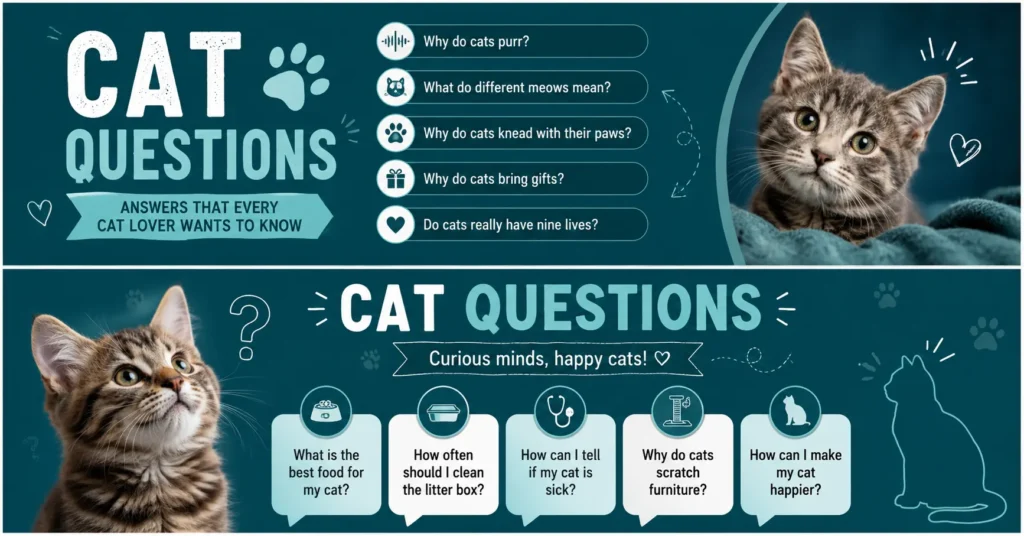
Cat Questions: How Can I Tell if My Cat Is Sick?
Cats are experts at masking illness, which makes “is my cat sick” one of the highest-stakes cat questions owners ask. Watch appetite, water intake, litter box habits, and general behavior subtle shifts often show up before obvious symptoms do.
Red flags include lethargy, vomiting, diarrhea, excessive drinking or urination, labored breathing, coughing, or sudden weight loss. Any of these warrants a same-week evaluation rather than a wait-and-see approach, since feline disease often progresses quietly.
Cat Questions: What Should I Feed My Cat?
Nutrition ranks among the most practical cat questions, and the core fact is simple: cats are obligate carnivores. Look for cat food listing real meat chicken, turkey, or fish as the first ingredient, and favor canned food’s higher moisture and protein ratio over carbohydrate-heavy dry kibble.
Life stage matters too kittens, adults, and senior cats have different nutritional needs. Dietary recommendations should always come up during wellness visits, since a vet can tailor advice to your cat’s age, weight, and any medical conditions.
Cat Questions: Why Do Cats Knead?
Kneading sometimes called “making biscuits” is an instinctive kittenhood behavior that many cats carry into adulthood. Kittens knead their mother’s mammary glands to stimulate milk production, and adult cats repeat the motion as a sign of comfort and contentment.
You’ll usually see kneading when a cat is relaxed, sleepy, or bonding with a favorite person or blanket. It’s considered a compliment in feline body language not a behavior that needs correcting or discouraging.
Cat Questions: How Long Do Cats Live?
Lifespan is a recurring cat question with a wide answer range: cats live an average of 15 years, though this varies with health, diet, and lifestyle. Obesity alone can subtract one to two and a half years from a cat’s life expectancy.
Indoor cats consistently outlive cats allowed to roam outdoors, and consistent wellness care extends that window further some well-cared-for cats reach 20 years or beyond with strong preventive care.
Cat Questions: How Old Is My Cat in Human Years?
There’s no perfectly scientific formula, but the general rule vets use: a cat’s first two years equal roughly 24 human years, and each year after that adds about four more. A 5-year-old cat, by that math, is roughly 36 in human terms.
Breed, health status, and lifestyle can shift this estimate. Annual wellness checkups matter more than the exact number, since they let a veterinarian catch age-related conditions early regardless of your cat’s “human age.”
Cat Questions: How to Stop a Cat from Scratching Furniture?
Scratching is instinctive, not spite but it’s still one of the most frustrating cat questions for owners with nice furniture. Redirect the behavior with scratching posts placed where your cat already scratches, and praise the correct use to reinforce it.
Cat-safe deterrents like double-sided tape, regular nail trims, and protective nail covers can help too. A vet or behaviorist can also discuss pheromone therapy for cats whose scratching is stress-driven rather than purely instinctive.
Cat Questions: What Are the Best Toys for Cats?
Play matters for both mental and physical health, making this a common care-oriented cat question. Interactive toys like feather wands and laser pointers mimic prey movement, while puzzle toys challenge problem-solving instincts.
Catnip toys add extra excitement for cats that respond to it, and simple crinkle balls satisfy the batting instinct. Rotating toy variety keeps engagement high, since most cats lose interest in anything that never changes.
Cat Questions: Why Do Cats Love Boxes?
Few cat questions have a more charming answer. In the wild, cats are ambush predators, and a box mimics the perfect hiding spot to stalk prey from. It also offers safety from the cat’s own predators, like coyotes or foxes.
Add natural curiosity to the mix, and it’s easy to see why an empty box outperforms an expensive cat bed almost every time. It’s instinct, not indifference to your spending.
Cat Questions: What Are the Most Popular Cat Breeds?
Breed-related cat questions come up often among prospective owners. Popular breeds in the United States include the Domestic Shorthair, Maine Coon, Persian, Sphynx, Ragdoll, Abyssinian, Devon Rex, Scottish Fold, Exotic, and British Shorthair.
Each breed carries different grooming needs, activity levels, and health predispositions. A veterinarian can help match breed characteristics to your household before adoption, especially for allergy-prone owners or high-energy homes.
Comparison Table: Popular Cat Breeds at a Glance
| Breed | Coat | Typical Temperament |
| Domestic Shorthair | Short | Adaptable, varied |
| Maine Coon | Long | Gentle, sociable |
| Persian | Long | Calm, low-energy |
| Sphynx | Hairless | Affectionate, attention-seeking |
| Ragdoll | Semi-long | Docile, laid-back |
| British Shorthair | Short/dense | Independent, easygoing |
Conclusion
Exploring cat questions is a fun way to better understand feline behavior, communication, habits, and personalities. From wondering what cats dislike to learning how they show affection, these questions can help cat owners connect with their pets on a deeper level. Whether you are a new cat owner or simply love learning about cats, every question can reveal something interesting about these fascinating animals.
Paying attention to your cat’s body language, sounds, and daily routines can also provide valuable clues about what they need. Keep asking cat questions, stay curious, and take time to understand your feline companion. The more you learn, the easier it becomes to build a happier and more trusting relationship with your cat.
FAQs
Author

Hi, I’m Alex, and I enjoy learning through quizzes, trivia, and interactive questions. I love discovering new conversation starters, relationship topics, and educational challenges. This website is my go-to place for fun, practical, and reliable question-based content. I’m always excited to learn something new and share it with others.