
Book Club Questions for The Frozen River: 25+ Powerful No-Spoiler Questions
The best book club questions for The Frozen River ask what justice meant to Martha Ballard, a midwife in 1789 Hallowell, Maine, whose diary exposed a crime. If you’ve ever closed this novel unsure what to say first, you’re not alone. This guide gives you spoiler-free discussion questions that open the conversation gently.
We built these prompts from a close review of leading reading guides and the historical record behind Ariel Lawhon’s historical fiction. Because the story touches violence against women and courtroom injustice, each section balances personal reflection with literary analysis, so your group can explore themes without pressure, whether you’re hosting for the first time or the fiftieth.
The Synopsis Behind These Book Club Questions for The Frozen River
Set in Hallowell, Maine in 1789, Lawhon’s novel opens when the Kennebec River freezes around a body. Midwife Martha Ballard is summoned to examine it, and her diary of births, deaths, and local crimes soon becomes the key to a murder mystery.
The book is inspired by a real woman. Martha Ballard kept her diary from 1785 to 1812, and historian Laurel Thatcher Ulrich’s Pulitzer Prize-winning A Midwife’s Tale brought it to wide attention. Lawhon blends that record with invention, so expect historical fiction rather than biography.
| Quick fact | Detail |
| Author | Ariel Lawhon |
| Publisher / year | Doubleday, 2023 |
| Setting | Hallowell, Maine, 1789 (Kennebec River) |
| Real-life inspiration | Martha Ballard, midwife and diarist |
| Honors | Good Morning America Book Club pick; NPR Book of the Year |
| Screen news | Film rights optioned by Maven Screen Media (reported January 2026) |
Book Club Questions for The Frozen River
Good discussion starters work best when they move from easy to emotional. Begin with general impressions, then widen into personal reflection, historical context, and craft. This sequence keeps quieter members comfortable, gives your discussion leader natural pivot points, and protects the group’s energy for the book’s weightier justice questions.
A quick note on tone: the novel deals with sexual violence and vengeance. Offer a trigger warning before you begin, invite members to pass on any prompt, and keep the questions below spoiler-free so newcomers and finishers can share one table, one pot of tea, and one honest conversation.
| Question set | Best for | Suggested time |
| General Impressions | Warm-up, mixed groups | 10 minutes |
| Personal Reflection | Building trust | 15 minutes |
| Societal Context | Deeper debate | 20 minutes |
| Literary Analysis | Craft-minded readers | 15 minutes |
| Creative Engagement | Wrapping up with fun | 10 minutes |
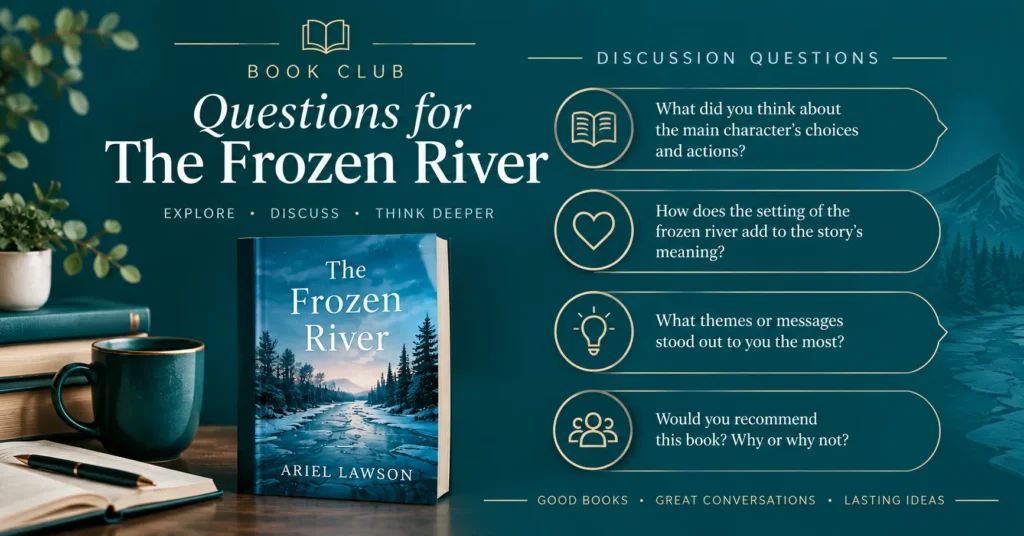
General Impressions
Start broad so everyone can speak. These opening questions on first reactions, historical background, and the book’s emotional pull help book club members warm up before the heavier justice themes arrive, and they work for readers who loved the novel and those who struggled.
- How much did you know about Martha Ballard or colonial Maine before opening the book, and did that background change how you read it?
- What was your overall reaction to the story? What pulled you in, and where did your attention drift?
- Did you read it as a mystery, a historical portrait, or a love story? Which thread mattered most?
- Which scene would you reread first, and why?
- If you had to describe the book to a friend in one sentence, what would you say?
- Did the slow-burn pacing, with daily life in Hallowell woven around the mystery, work for you?
- Martha is a middle-aged protagonist, which is rarer in historical fiction. What did that bring to the story?
Personal Reflection and Connection
The most memorable evenings happen when readers link fiction to real life. These prompts on loyalty, memory, and the pull of home invite personal reflection without demanding that anyone share more than they wish, which keeps the room warm and the talk genuine.
- Martha keeps a diary because written records feel steadier than memory. Do you keep a journal, and what would a stranger learn about you from it?
- Is family loyalty ever absolute? Where would you draw the line if someone you love were suspected of wrongdoing?
- Which character reminded you of someone in your own life?
- Place shapes Martha’s choices. How has the place where you grew up shaped yours?
- Have you or a relative worked with a midwife, and how did that compare with Martha’s care for her neighbors?
- Martha balances work, marriage, and motherhood. What does your own version of that balance look like?
- Martha speaks up when others stay quiet. When have you felt the pull between speaking and silence?
Societal and Cultural Context
Lawhon’s 1789 Maine feels distant until a courtroom scene echoes today’s headlines. These questions on gender, power, and how communities treat survivors connect early American history with modern debates, giving your group room to compare then and now thoughtfully and kindly.
- How does the courtroom treat women who speak up, and what in that process feels uncomfortably familiar today?
- Which rights or protections did Martha’s community lack that we now take for granted?
- What did the silence around pregnancy and assault cost the town?
- Puritan shame culture punished women for what men did too. Where do you still see echoes of that double standard?
- Did the book change how you picture daily life for women in the early Republic?
- The trial plays out in public. What does the book suggest about reputation, spectacle, and who gets believed?
- Which modern institutions, such as courts, hospitals, or newsrooms, echo the gatekeepers of Hallowell?
Literary Analysis
Beyond plot, Lawhon makes deliberate craft choices: a first-person narrator, diary entries, a six-part structure, and recurring symbols. These literary analysis questions help your group weigh whether those narrative techniques deepen the mystery, strengthen the themes, or occasionally slow the story’s momentum.
- How does telling most of the story through Martha’s eyes shape what you trust, and what you can’t see?
- Did the diary entries make the setting feel more authentic, or did they interrupt the pacing?
- The book returns to images like the river, lace, and a silver fox. Which symbol stayed with you, and what did it stand for?
- Which supporting character, such as Dr. Page or Joseph North, felt most fully drawn?
- How does the winter landscape build tension? Would the story work in summer?
- Does Martha ever strike you as an unreliable witness to her own life?
- Without giving anything away, did the final chapters match the promise of the opening image of the frozen river?
Creative Engagement
When the serious talk winds down, play. Creative engagement prompts turn readers into casting directors and playlist curators, and with film rights optioned in early 2026, the question of who should play Martha has never been more timely for fans of the novel.
- If the novel became a series, who would you cast as Martha, Ephraim, and Joseph North, and which scene would open episode one?
- Build a short playlist for the book. Which song belongs on track one?
- Imagine a prequel about Martha’s earlier years. What would you want to see?
- Write a diary entry in Martha’s voice about your own week. What would she notice?
- What would you add to an epilogue?
Book Club Ideas For Food and Beyond to Go With Your Book Club Questions for The Frozen River
Food turns a meeting into a memory. Serve roast chicken and warm, crusty bread, then pour hot mulled cider or wine, an easy nod to winter in Hallowell that keeps conversation flowing long after the last question is asked.
Add a hands-on touch. Make candles or bring knitting, since Martha’s world ran on handwork, and print the questions so members can annotate as they go. Small rituals like these help a book club meeting feel like an event instead of an assignment.
| Category | Idea |
| Eat | Roast chicken, crusty bread |
| Drink | Hot mulled cider or wine |
| Do | Candle-making, knitting, journaling |
Book Club Books to Read Next After the Book Club Questions for The Frozen River
If Martha’s story hooked you, stay in historical fiction with strong women at the center. Lawhon’s other novels and a few bestselling picks continue the themes of courage, justice, and overlooked history, giving your next book club selection an easy, natural bridge.
Choose by mood. Want another Ariel Lawhon mystery with a real heroine, or a sweeping story of women in wartime? Both options below pair well with the same discussion approach, moving from first impressions to personal reflection, then themes and craft.
I Was Anastasia by Ariel Lawhon
Lawhon’s earlier historical fiction explores the mystery of Anastasia Romanov and the woman who claimed her identity, told across two timelines. Fans of Martha’s determination will appreciate another female-driven puzzle where truth, memory, and identity collide, making it a natural follow-up for the same book club.
The Women by Kristin Hannah
Kristin Hannah’s novel follows a young nurse who joins the Army Nurse Corps during the Vietnam War, then faces a divided America at home. It shares The Frozen River’s focus on female courage, unacknowledged service, and the cost of being believed, so discussion flows easily between them.
Whichever route your group takes, these book club questions for The Frozen River should help you move beyond “did you like it?” toward the questions Martha’s diary invites: who gets believed, who gets protected, and what justice costs. Bring the cider, trust the diary, and let the conversation run long.
Conclusion
The Frozen River offers plenty to discuss beyond its central mystery, from its memorable characters and historical setting to the difficult choices that shape the story. These book club questions can help readers look more closely at the novel’s themes, relationships, conflicts, and unexpected moments while encouraging different interpretations.
Whether your group focuses on the investigation, the emotional journeys of the characters, or the historical details, there is plenty of room for meaningful conversation. The best discussions are not always about finding one correct answer; they are about hearing how other readers experienced the story. Bring these questions to your next book club and let the conversation uncover new perspectives.
FAQs
Author

Hi, I’m Alex, and I enjoy learning through quizzes, trivia, and interactive questions. I love discovering new conversation starters, relationship topics, and educational challenges. This website is my go-to place for fun, practical, and reliable question-based content. I’m always excited to learn something new and share it with others.




One Comment