What Questions to Ask When Buying a Used Car: 12 Must-Asks
What questions to ask when buying a used car? Start with the vehicle history report, maintenance records, accident past, title status, and a mechanic’s pre-purchase inspection. Skip them, and a shiny listing can quietly become an expensive regret you’re stuck financing for years.
We reviewed how NerdWallet, Lemonade, and Capital One Auto Navigator tackle used car shopping, then organized their best advice for both dealership and private seller deals. Nervous about asking awkward questions? That’s normal, and sellers expect it. This checklist covers odometer reading, Carfax or AutoCheck reports, warranty terms, and negotiation leverage, so you walk in prepared. Each section shows what a good answer sounds like.
What Questions to Ask When Buying a Used Car: What’s the Vehicle’s History?
A vehicle history report is your first window into the car’s past. It can show reported accidents, title changes, ownership records, and some service entries. Ask the seller for the VIN, then run the numbers before you drive across town.
Remember, reports only capture what gets reported. Carfax tends to run costlier and deeper than AutoCheck, and the NICB’s free VINCheck can flag theft or total-loss records. Use more than one source when the price is high. Treat the report as a starting point, never a guarantee.
Where can I get a vehicle history report?
Dealers often hand over a free report, while private sellers usually don’t, though some buy one to help close the sale. You can purchase one yourself with the VIN. Stick with trusted providers, because fake report sites exist and can waste your money. [Link: how to read a Carfax report]
A clean report is only the opening chapter, so next, learn who actually drove the car.
What Questions to Ask When Buying a Used Car: How Many Previous Owners Has the Car Had?
Ownership history says plenty about care and reliability. A car that changed hands three times in two years deserves extra scrutiny, while one or two long-term owners often points to steadier maintenance. Also ask whether it served as a rental, ride-share vehicle, or fleet unit.
Rental and ride-share cars usually rack up harder miles than a personal commuter. Try searching listings for phrases like original owner, garaged, or service records. Those keywords tend to surface cars with less checkered pasts and more complete documentation, which helps when you’re comparing two similar listings.
Why are you selling the car?
With a private seller, motive matters. Someone upgrading or downsizing is a good sign; someone dodging repeated problems is not. If they dodge the question, glance at their public social posts for breakdown complaints. Honest answers sound simple and consistent.
What Problems Have You Had With the Car?
Almost no used car is perfect, so invite honesty here. Recent major repairs aren’t automatically scary; completed work can save you money later. Follow up by asking about open recalls, then check the NHTSA database using the VIN to confirm.
| What to expect | Dealership | Private seller |
| History report | Often provided, sometimes free | Rarely provided; you may buy one |
| Reconditioning | Commonly performed | Varies; ask what was done |
| Warranty | May offer short-term or CPO coverage | Seldom included |
| Returns | Some offer a short window | Typically final |
Owners shape mileage, so let’s read the odometer next.
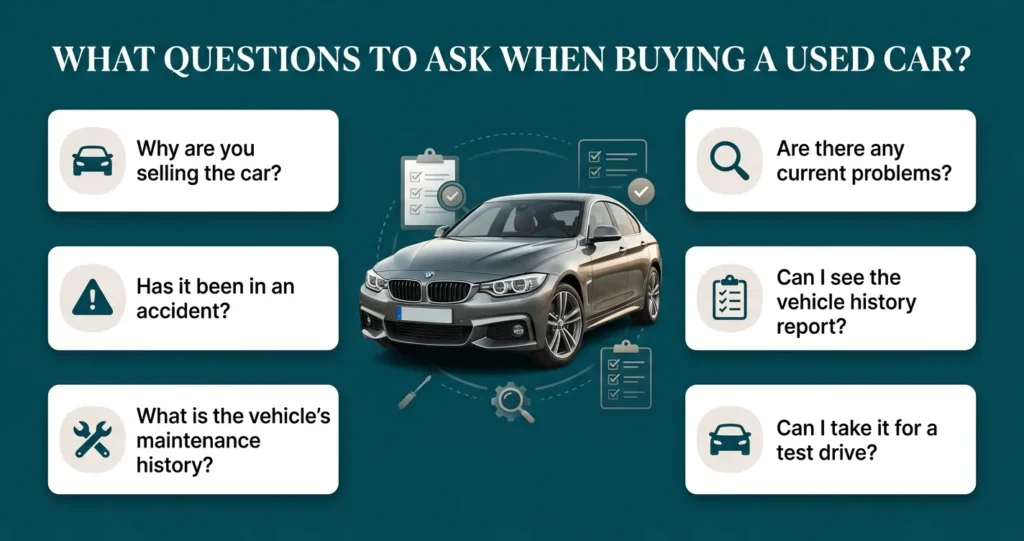
What Questions to Ask When Buying a Used Car: What’s the Current Mileage?
Mileage affects wear, resale value, and remaining lifespan. A common benchmark is an annual average at or below roughly 13,000 to 15,000 miles. Still, a well-serviced highway commuter can outlast a neglected low-mileage car, so pair the odometer reading with maintenance proof.
Be suspicious when mileage looks impossibly low for the age, especially if the interior looks heavily worn. Compare the odometer with the history report and title for mismatches. Past 100,000 miles, ask whether the timing belt, transmission, or brakes were replaced and when.
How old is the car?
Age influences repair frequency, fuel efficiency, and depreciation. Older models may need more frequent fixes, yet a meticulously maintained example can beat a newer, neglected one. Much of the steep depreciation has already happened, which can make slightly aged vehicles a smart value play.
Miles tell one story; collisions tell another.
What Questions to Ask When Buying a Used Car: Has the Car Been in Any Accidents?
A past collision isn’t always a dealbreaker, but you need the full story. Ask how bad the damage was, who repaired it, and which parts were replaced. Request repair paperwork, because a poor fix can create safety problems down the road.
Not every crash reaches a vehicle history report, and listed ones may hide severity. Look for mismatched paint, uneven body panels, and dents. Ask about theft recovery, too, since a stolen-and-recovered car should still carry a clean, non-salvage title. A mechanic can confirm structural repairs later.
After damage, ask how the car was cared for day to day.
What Questions to Ask When Buying a Used Car: Can I See the Maintenance Records?
Service records reveal how the previous owner treated the car. Look for routine oil changes, brake work, tires, and major repairs. A seller who keeps tidy paperwork usually maintained the vehicle regularly, which supports a more confident purchase decision. Receipts beat promises.
Ask who did the work: a dealership, an independent shop, or a backyard mechanic. Some sellers will even share the mechanic’s contact. History reports miss unreported services, so records fill gaps. Missing paperwork doesn’t kill a deal, but it justifies a stricter inspection.
What Service Did You Perform to Prepare the Car for Sale?
Dealers usually recondition trade-ins, and good private sellers do too. Fresh tires, new brake pads, or an oil change save you money and show care. Bigger jobs can be worth thousands. Ask for documentation, then factor completed work into the price you’re willing to pay.
Paperwork matters beyond service receipts, so check ownership proof next.
What Questions to Ask When Buying a Used Car: Does the Seller Have the Car Title Readily Available?
The title proves ownership, so never hand over money without seeing it. A missing title may signal theft or an unpaid loan where the lender still holds paperwork. Buying a car with a lien is possible, but it’s more complicated.
Check the title for a salvage brand, meaning an insurer declared the car a total loss. In most states you can’t legally drive one until it’s repaired, inspected, and reissued with a rebuilt title. Insurance and financing are usually tough until then.
Clear title in hand? Now see what protection comes with the car.
What Questions to Ask When Buying a Used Car: Is There a Warranty?
A used car might carry leftover factory coverage, a certified pre-owned warranty, or a short dealership plan, often three or six months. Ask exactly what’s covered and for how long. Verify any factory coverage with the manufacturer, and request details in writing.
Ask whether coverage transfers to you as the new owner. Be cautious with pricey extended warranties that may cost more than typical repairs, and read the fine print on any free coverage. Even a limited plan can add peace of mind.
| Warranty type | Typical coverage | What to verify |
| Remaining factory | Manufacturer coverage on newer used cars | Call the manufacturer for time left |
| Certified pre-owned | Up to about two years, depending on brand | Inspection report and covered parts |
| Dealership plan | Often three or six months | Fine print and exclusions |
Can I Return the Car if I Don’t Like It?
Some dealerships allow returns within a few days or a few hundred miles, so ask before signing. If there’s no return window, request an extended overnight test drive. Don’t expect private sellers to accept returns; those sales are typically final.
Coverage on paper is nice; now feel the car on the road.
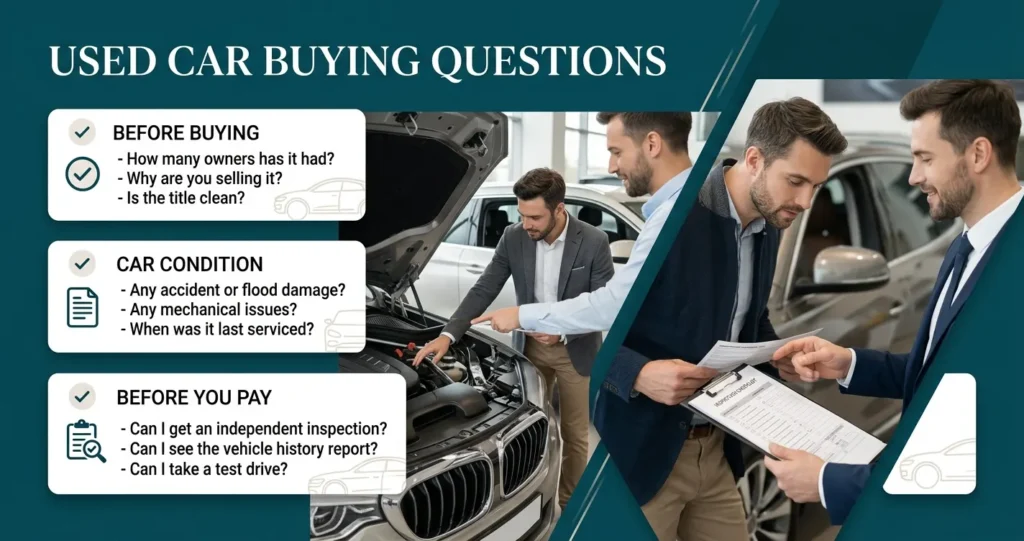
What Questions to Ask When Buying a Used Car: Can I Take the Car for a Test Drive?
A test drive reveals what listings hide. Notice acceleration, braking, steering feel, vibrations, and odd noises on city streets and highways. Trust your senses: unusual smells, like rotten eggs, can point to catalytic converter or fuel system trouble that needs attention.
Test the radio, charging ports, seat adjusters, climate control, and smartphone connectivity too. Small annoyances add up, and a dead infotainment screen can be pricey. Bring a friend, drive a familiar route, and don’t let the seller rush you. Take notes afterward.
Can I inspect the interior and exterior of the car?
Walk around the car in daylight. Look for dents, rust, mismatched paint, uneven panel gaps, and uneven tire wear. Lift floor mats to check for water damage, and open every door, the hood, and the trunk. Weak air conditioning or dead speakers are expensive surprises. [Link: used car inspection checklist]
Your test drive spots symptoms; a mechanic finds causes.
What Questions to Ask When Buying a Used Car: Can I Have the Car Inspected by a Mechanic?
A pre-purchase inspection by an independent mechanic can expose hidden water damage, undisclosed accidents, frame repairs, and odometer tampering you’d never spot yourself. Ask the mechanic to focus on any previous collision areas and to evaluate the engine, since some designs demand extra care.
Picture a spotless crossover priced just below market. The report looked clean, yet a mechanic spotted a poorly repaired frame. That inspection, costing several hundred dollars, saved thousands. A transparent seller should welcome it; resistance is a red flag. Schedule it after your test drive.
With condition verified, you can talk money from a position of strength.
What Questions to Ask When Buying a Used Car: Is the Car’s Price Fair or Negotiable?
Check the asking price against Kelley Blue Book or Edmunds values, factoring in mileage, condition, and trim. An overpriced listing isn’t an automatic no; ask whether there’s flexibility. Use your history report, inspection findings, and repair estimates as negotiation leverage.
Remember the monthly payment and interest rate, not just the sticker. At dealerships, ask for the full out-the-door cost including taxes and fees. A slightly pricier but more reliable car can cost less over the long haul. Run the numbers before you fall in love.
Are There Any Current Problems?
Small issues are negotiation fuel. If tires, brakes, or other wear items need replacing soon, research the cost beforehand and ask for a lower price. Better yet, request disclosure before you visit, so you aren’t surprised and can plan the repair budget.
What Else Is Included With the Car?
A well-kept used car should include two keys or fobs and the owner’s manual. Modern keys can cost upward of $500 to replace. Ask about floor mats, winter tires, roof rack bars, and the original window sticker listing factory options.
Price isn’t the only monthly cost, so don’t forget insurance.
What Questions to Ask When Buying a Used Car: How Will This Car Affect My Insurance Premiums?
Insurance costs vary by model, age, safety features, and your driving record, so a cheap car can still carry a pricey premium. Get quotes for the exact vehicle before committing. That number belongs in your total ownership budget alongside fuel and repairs.
Don’t wait until after the handshake. Many states require proof of coverage to register a vehicle, and your insurer needs the VIN to quote accurately. Comparing two or three finalists by insurance cost can quickly break a tie. Ask about bundling discounts too.
Here’s the short version.
Before We Go: What Questions to Ask When Buying a Used Car
So, what questions to ask when buying a used car? Ask about vehicle history, owners, mileage, accidents, maintenance, title, warranty, price, and insurance, then verify everything with a test drive and a mechanic’s inspection. Written proof beats verbal promises every single time.
Used inventory has felt tight in recent years, but patience pays off. If a seller dodges questions, walk away; another car is always out there. Print this checklist, take notes, and trust your gut. A confident buyer asks, listens, and drives home happy.
Conclusion
Buying a used car is easier when you know what to ask before making a decision. Asking about the vehicle’s history, maintenance records, accident history, mileage, ownership, title, and reason for selling can help you spot potential problems early. It is also important to ask about current mechanical issues, recent repairs, and whether you can take the car for an independent inspection and test drive.
A seller who is open and willing to provide documentation can make the process much more comfortable. Take your time, compare your options, and avoid feeling pressured to buy. The right questions can help you choose a used car with greater confidence and fewer surprises later.
FAQs
Author

Hi, I’m Alex, and I enjoy learning through quizzes, trivia, and interactive questions. I love discovering new conversation starters, relationship topics, and educational challenges. This website is my go-to place for fun, practical, and reliable question-based content. I’m always excited to learn something new and share it with others.