
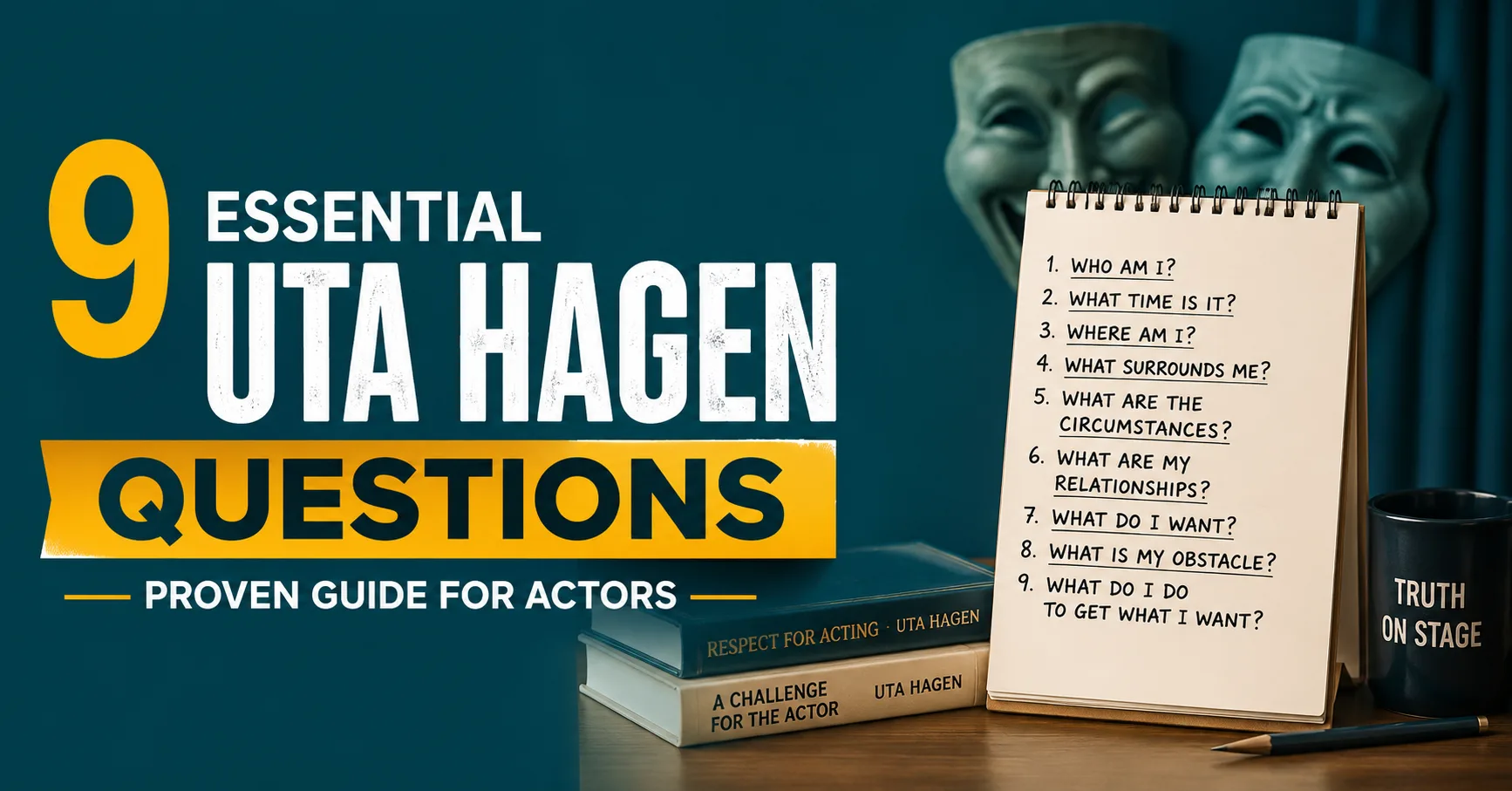
9 Essential Uta Hagen Questions: Proven Guide for Actors
Ever had a character who looks clear on the page but feels strangely difficult to play? You know the lines, understand the plot, and still find yourself wondering what the character actually wants, fears, or believes. That’s where9 Essential Uta Hagen Questions can give actors a much stronger starting point. Developed as part of Hagen’s approach to realistic character work, these questions encourage you to look beyond memorizing lines and start thinking from the character’s point of view.
They can help you explore where the character is, what they want, what stands in their way, and what makes the moment matter. In this guide, we’ll walk through the nine questions, explain what each one means, and show how actors can use them to build more believable characters.
Uta Hagen 9 Questions
Developing a believable character takes more than learning lines and deciding how you want to perform them. Actors need to understand the person behind those words. What does this character want right now? Where have they come from? What are they trying to accomplish? What makes this particular moment important?
This is where Uta Hagen’s 9 questions become useful. Hagen’s approach gives actors a practical framework for exploring a character’s circumstances, relationships, needs, and actions before stepping fully into the role.
Rather than telling you exactly how a character should behave, the questions encourage you to investigate the circumstances and make your own discoveries. That makes them especially useful for beginners and students who sometimes struggle to turn a script into a living, believable person.
What Are Uta Hagen’s 9 Questions?
Uta Hagen’s 9 questions are a character-development exercise designed to help actors understand a character and their circumstances. The questions guide you through the basic facts of the scene and gradually move toward deeper questions about motivation, relationships, obstacles, and action.
The commonly used questions ask:
- Who am I?
- What are the circumstances?
- What are my relationships?
- What do I want?
- What is my obstacle?
- What do I do to get what I want?
- What is the time and place?
- What surrounds me?
- What are the given circumstances affecting me?
Different acting teachers and resources may phrase or organize Hagen’s questions somewhat differently, but the underlying purpose remains the same: to help actors investigate the character rather than simply imitate a performance.

1. Who Am I?
Start with the character themselves.
Ask questions that help you understand who this person is beyond the basic information in the script. What is their name? Age? Background? Occupation? What do they value? What experiences have shaped them?
You don’t need to invent an elaborate biography just for the sake of it. Focus on details that can actually influence how the character behaves.
For example, if your character is meeting someone they haven’t seen in years, their history with that person may matter far more than an unrelated childhood detail.
2. What Are the Circumstances?
Now look closely at what is happening around the character.
What has happened before the scene begins? What is happening during the scene? What does the character know, and what don’t they know?
This question keeps your performance connected to the script.
Imagine a character calmly entering a room. On the surface, the action seems simple. But if they have just received upsetting news, their reason for entering the room changes everything.
The circumstances give the action meaning.
3. What Are My Relationships?
Characters rarely exist in isolation.
Think carefully about the people around your character. Who are they talking to? How do they feel about that person? What history exists between them?
A character might speak politely to a coworker while secretly distrusting them. They might joke with a sibling because that is how they normally hide discomfort.
Relationships influence behavior, tone, choices, and even silence.
When working through this question, don’t only ask, “Who is this person to me?” Also ask, “What do I need from this relationship?”
4. What Do I Want?
This is one of the most important questions an actor can ask.
What does your character want in the scene?
The answer should be specific enough to influence your actions. Instead of saying, “I want to be happy,” consider something more playable, such as “I want my friend to forgive me” or “I want to convince my parents to let me leave.”
A clear objective gives the scene direction.
Your character should be trying to achieve something, even if they never say it directly.
5. What Is My Obstacle?
Once you know what the character wants, identify what is stopping them.
Maybe another character refuses to cooperate. Perhaps the character lacks information, confidence, time, money, or authority. Sometimes the obstacle is internal, such as fear, guilt, pride, or uncertainty.
A scene becomes interesting when the character cannot simply get what they want.
For example, if a character wants someone to tell the truth but knows that asking directly will make that person defensive, the character has a problem to solve.
That problem creates playable behavior.
6. What Do I Do to Get What I Want?
Knowing your character’s goal isn’t enough. You also need to consider how they pursue it.
Do they persuade? Threaten? Joke? Avoid? Apologize? Negotiate? Stay silent?
Actors often discover that two characters can want the same thing but pursue it completely differently.
Suppose two characters both want forgiveness. One might openly apologize. The other might make jokes and avoid discussing the problem.
The objective is similar, but the actions are different.
This question helps you focus on what the character does, rather than simply trying to display an emotion.
7. What Is the Time and Place?
Where and when does the scene happen?
Consider the physical location, time period, season, time of day, and circumstances surrounding the setting.
A conversation at a crowded restaurant feels different from the same conversation happening late at night in an empty house.
The setting can affect your character’s behavior, expectations, energy, and available choices.
For actors, these details are not just background information. They can become part of the character’s reality.
8. What Surrounds Me?
Look beyond the other characters.
What objects, sounds, people, furniture, weather, or physical conditions surround your character?
If the script places you in a kitchen, what is on the counter? If you’re waiting at a bus stop, what can you see and hear? If you’re in an unfamiliar room, how might that affect your attention?
These details can make a performance feel grounded.
Instead of pretending that the set is simply a stage, the actor begins treating the environment as part of the character’s world.
9. What Are the Given Circumstances Affecting Me?
The final question brings the different pieces together.
Think about everything the script has established that affects your character’s choices. This can include relationships, location, time, recent events, social circumstances, personal history, and immediate problems.
The key is to stay connected to what the script actually gives you.
You can make thoughtful choices as an actor, but those choices should still belong to the world of the character.
How to Use the Uta Hagen Questions as a Worksheet
One of the easiest ways to practice this method is to turn the nine questions into a character-development worksheet.
For each question, write a few specific answers.
| Question | What to Explore |
| Who am I? | Identity, background, values |
| What are the circumstances? | What happened before and during the scene |
| What are my relationships? | History and feelings toward others |
| What do I want? | Immediate objective |
| What is my obstacle? | What prevents the objective |
| What do I do? | Actions and tactics |
| What is the time and place? | Setting and timing |
| What surrounds me? | Physical environment |
| What affects me? | Given circumstances |
Try not to write what you think would sound impressive. Write what helps you make a stronger acting choice.
Why These Questions Help Actors
The real value of Hagen’s questions is that they move actors away from simply asking, “How should I act this scene?”
That question can sometimes lead to forced emotions or predictable gestures.
A more useful approach is to ask, “What is happening to me, and what am I trying to do about it?”
That shift can make your choices feel more natural.
For beginners, the questions also provide a practical way to break down a complicated script. Instead of trying to understand everything at once, you can investigate one piece at a time.
Uta Hagen Character Development in Practice
Imagine you’re playing a student who needs to ask a teacher for an extension on an important assignment.
Your objective might be to convince the teacher to give you more time. Your obstacle could be that the teacher has already warned the class about deadlines.
Now consider the character’s relationship with the teacher. Are they comfortable asking for help, or are they nervous around authority figures?
Suddenly, the scene has something to play.
You aren’t simply trying to “look nervous.” You’re trying to accomplish something while dealing with a specific obstacle.
That’s the practical strength of character development through Hagen’s questions.
Tips for Getting More From the Nine Questions
Don’t rush through the worksheet just to complete it.
Be specific. “I’m nervous” tells you less than “I’m worried she’ll say no because she already rejected my request.”
Use the script. Separate what the playwright gives you from what you are imagining.
Look for actions. Instead of focusing only on emotions, consider what your character is trying to do.
Revisit your answers. Your understanding of a character can change as you rehearse and learn more about the scene.
Avoid overexplaining. You don’t need a ten-page biography for every role. Choose details that actually affect your performance.
Most importantly, let your answers create questions rather than forcing every detail into a fixed interpretation.
Uta Hagen Questions for Actors
The nine questions can become a useful part of an actor’s regular preparation routine. Whether you’re preparing for a classroom exercise, audition, rehearsal, or full production, they give you a practical way to investigate the role.
They also remind you that character development isn’t about finding one “correct” way to perform a character.
It’s about understanding the circumstances well enough that your choices have a reason behind them.
When you know who you are, what you want, what stands in your way, and what you’re doing to overcome it, the scene has somewhere to go.
Conclusion
The Uta Hagen 9 questions give actors a practical way to move from reading a script to genuinely understanding a character. Instead of guessing how a character should feel, you examine their circumstances, relationships, objectives, obstacles, and actions. That process can make even a short scene easier to approach and more believable to perform.
For beginners, the questions are especially helpful because they turn character development into something concrete rather than mysterious. You can use them as a worksheet, revisit your answers during rehearsal, and adjust your choices as the character becomes clearer. The goal isn’t to create a perfect character on paper. It’s to understand the character well enough that your choices on stage feel honest, purposeful, and alive.
FAQs
Author

Hi, I’m Alex, and I enjoy learning through quizzes, trivia, and interactive questions. I love discovering new conversation starters, relationship topics, and educational challenges. This website is my go-to place for fun, practical, and reliable question-based content. I’m always excited to learn something new and share it with others.