

How to Play 20 Questions: Rules, Tips & Examples
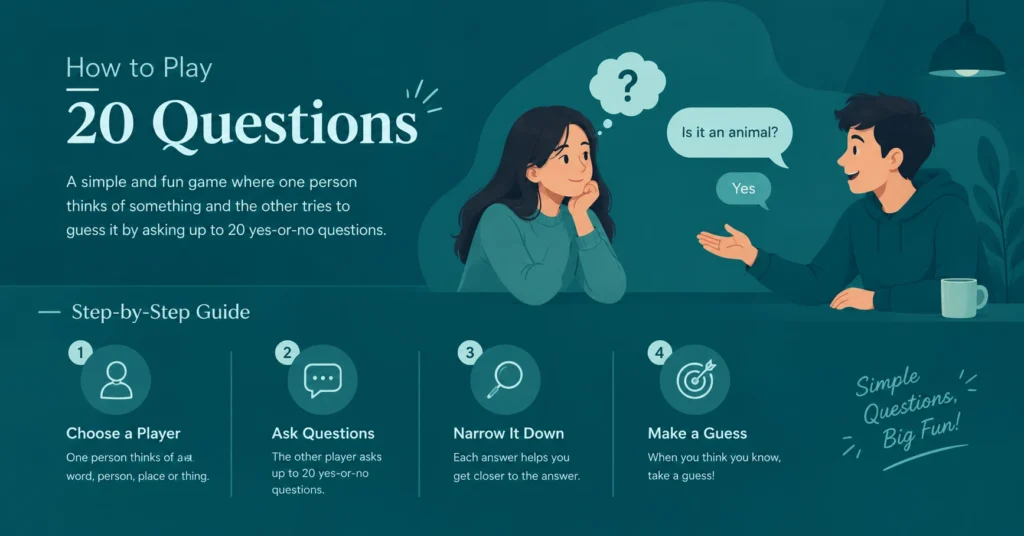
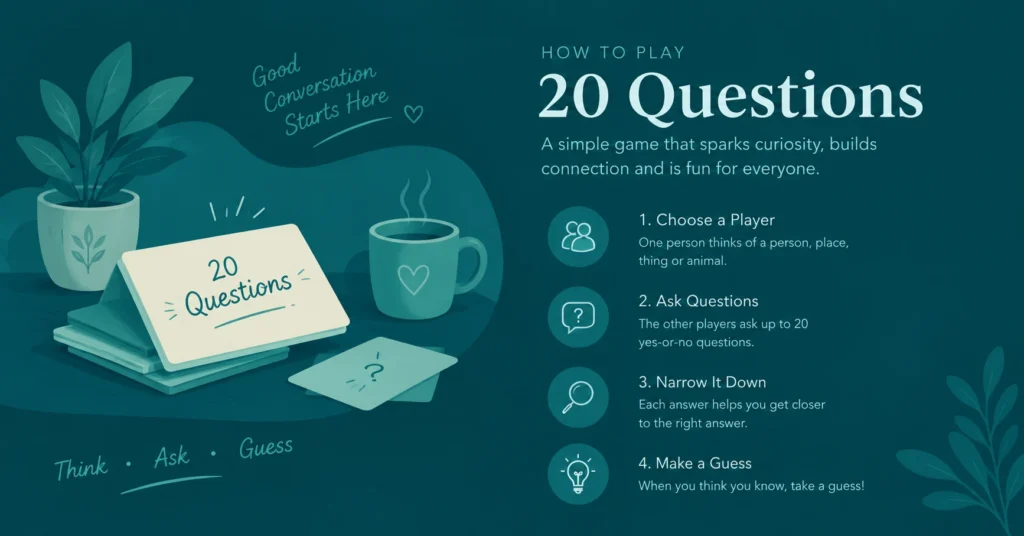
The easiest way how to play 20 Questions is to have one person secretly choose a person, place, animal, or object while everyone else asks up to 20 yes-or-no questions to identify it. If someone guesses correctly before the questions run out, the guessers win; otherwise, the person holding the secret wins the round.
Whether you’re playing with friends on a road trip, entertaining family at home, or looking for a simple party game, Twenty Questions needs no special equipment. The fun comes from choosing useful questions, spotting clues in each answer, and narrowing down the possibilities. Once you understand the rules and agree on a few house rules, you can start playing in minutes.
How to play 20 questions
The classic game has two roles: the answerer, who chooses the secret, and the guessers, who work together to identify it. The answerer keeps the choice hidden, while the other players take turns asking questions that can be answered with yes or no. Everyone shares the same limit of 20 questions.
Start with a broad question such as “Is it alive?” or “Is it a person?” Each answer helps eliminate possibilities. As the options become narrower, ask about size, location, purpose, or recognizable features. A direct guess also counts as a question under the common rules, so it’s usually better to narrow the choices before naming an exact answer.
House rules worth agreeing first
Before the first round, decide whether guesses count toward the 20-question limit, whether answers such as “sometimes” are allowed, and who asks first. Many groups count every direct guess as one question and require the answerer to respond honestly. Agreeing on these details prevents arguments when a round gets close.
Quick rules
You can remember the game with five simple rules:
- Choose a secret: One player thinks of a person, place, animal, or object without revealing it.
- Give a category: The answerer can announce a broad category to make the round fairer.
- Ask yes-or-no questions: The other players take turns asking questions that narrow the options.
- Track the limit: Count every question, including direct guesses, according to your agreed rules.
- Reveal the answer: If someone guesses correctly, the guessers win. If all 20 questions are used without a correct guess, the answerer wins.
The game works best when the answerer chooses something the group could reasonably identify. An extremely obscure person or an object known only to the answerer makes the challenge frustrating rather than fun.
Set up
Choose one person to be the first answerer. They should think of a secret that fits the agreed category and keep it to themselves. Everyone else becomes a guesser. If you’re playing with a larger group, have players ask in a clockwise order so everyone gets a fair turn.
Next, decide who will count the questions. You can count aloud, use fingers, or keep a simple tally on paper or a phone. No game board, cards, or special equipment is required. Once everyone understands the rules, the answerer announces the category and the first player asks a question.
What you need
Nothing is essential except at least two players and a secret answer. A timer or question counter can be helpful for a large group, but it is optional. For younger players, use familiar categories such as animals, food, toys, and household objects. For experienced players, try famous people, landmarks, fictional characters, or less obvious everyday items.
Example round
Imagine that the answerer secretly chooses a lighthouse and tells the group the category is “a thing.” The other players now have up to 20 questions to figure it out.
| Question | Answer | What players learn |
| Is it alive? | No | It is not a living thing. |
| Is it made by people? | Yes | It is human-made. |
| Can you find it outdoors? | Yes | It is not usually an indoor object. |
| Is it bigger than a car? | Yes | It is a large structure. |
| Is it often near water? | Yes | The location provides a useful clue. |
| Does it help boats? | Yes | Its purpose becomes clearer. |
| Does it shine a light? | Yes | The possibilities narrow further. |
| Is it a lighthouse? | Yes | The guessers identify the answer. |
This example shows why listening matters. A good question uses information from previous answers instead of repeating what the group already knows. The round also ends as soon as someone guesses correctly, so the players don’t need to use all 20 questions.
20 good questions for 20 questions, in the order to ask them
The strongest questions eliminate many possibilities at once. Instead of immediately asking “Is it a dog?” begin with questions that separate broad categories. Once you know whether the secret is alive, human-made, or a place, you can focus on its features.
Here are useful questions to try:
- Is it alive?
- Is it a person?
- Is it an animal?
- Is it a place?
- Is it made by humans?
- Is it something found indoors?
- Can you hold it in one hand?
- Is it bigger than a car?
- Can you find it in a typical home?
- Is it something people use every day?
- Is it connected to food?
- Is it used for transportation?
- Can it move on its own?
- Is it found in nature?
- Is it associated with entertainment?
- Is it famous?
- Is it commonly found in the United States?
- Does it have a distinctive shape?
- Is it something most people would recognize?
- Is it a [specific guess]?
These are examples, not a fixed script. The right question depends on what you already know. If the answerer says the secret is not alive, for instance, questions about animals no longer help. Adapt each question to the clues you have collected.
120 things to guess in twenty questions
Choosing the right secret is just as important as asking good questions. It should be familiar enough for the group to recognize but not so obvious that the answer becomes clear immediately. Start with common subjects before introducing harder categories.
Animals
- Dog
- Cat
- Dolphin
- Penguin
- Giraffe
- Octopus
Food
- Pizza
- Apple
- Pancake
- Hamburger
- Popcorn
- Ice cream
Household objects
- Toothbrush
- Umbrella
- Pillow
- Refrigerator
- Flashlight
- Remote control
Places
- Library
- Airport
- Beach
- School
- Grand Canyon
- Eiffel Tower
Famous people
- Taylor Swift
- Albert Einstein
- Serena Williams
- Abraham Lincoln
- Beyoncé
- William Shakespeare
Fictional characters
- Sherlock Holmes
- Spider-Man
- Cinderella
- SpongeBob SquarePants
- Harry Potter
- Mickey Mouse
You can expand each category with more choices as the group gets comfortable with the game. For a family gathering, everyday objects and familiar characters are good starting points. For a group that enjoys a challenge, use historical figures, unusual animals, or recognizable landmarks.
A useful rule is to avoid answers that depend on private knowledge. The secret should be something the other players could plausibly work out from general knowledge and the answers to their questions.
Strategy: how to guess in fewer questions
Winning is less about asking questions quickly and more about choosing questions that divide the remaining possibilities. If you know the secret is an object, for example, asking whether it is normally found in a kitchen may eliminate more choices than immediately guessing “Is it a toaster?”
Try this three-stage approach:
Stage 1: Identify the broad category. Find out whether the answer is alive, human-made, a place, or a person. Use the answer to eliminate entire groups of possibilities.
Stage 2: Narrow down the possibilities. Ask about size, location, purpose, and recognizable features. Build on previous answers instead of asking unrelated questions.
Stage 3: Make a focused guess. When only a few plausible options remain, use a direct guess. Remember that under the common rules, a wrong guess uses one of your remaining questions.
It also helps to listen to the other players. Their questions and the answerer’s responses give everyone useful information. If someone has already established that the secret is a small household object, there’s little value in asking whether it is a building.
5 ways to play the twenty questions game with a team
The traditional version works well with a small group, but a few variations make it suitable for parties, classrooms, and larger gatherings.
1. Team against team: Divide players into two teams. Both teams work toward identifying the same secret, and you can award a point to the team that solves it first. Agree on how questions alternate before starting.
2. Reverse 20 Questions: One player becomes the guesser while the rest of the group chooses a secret together. The guesser asks questions, and the group answers consistently. This version works well when everyone wants to collaborate.
3. Themed round: Choose one category for the entire game, such as animals, foods, movies, or objects in the room. A narrower theme can make the game easier for beginners.
4. Quick round: Reduce the limit to 10 questions and use familiar objects. This is useful when you have only a few minutes to fill.
5. Classroom version: Let students choose age-appropriate vocabulary words, animals, historical figures, or geographical locations. The game can encourage careful questioning and help students practice categorization and vocabulary.
Whichever version you choose, explain any special rules before the round begins. That way, the challenge comes from figuring out the secret rather than trying to work out how the game is being scored.
How to play the 20 questions game online
You can play Twenty Questions over a video call, in a group chat, or through a shared online game. The basic rules stay the same: one person chooses a secret, the others ask yes-or-no questions, and the group tracks the remaining attempts.
For a video call, the answerer can write the secret privately or use a random idea generator without sharing the answer on screen. Players can ask questions in turn, while one person keeps a tally in the chat. In a text-based game, have each player post one question at a time so the order and answers remain clear.
Online play works best when everyone agrees on the category and the question limit in advance. If players are in different locations, choose subjects familiar to the whole group rather than relying on local knowledge. You don’t need a dedicated app, although an online question counter can make larger games easier to manage.
Conclusion
Learning how to play 20 Questions is a simple way to turn an ordinary conversation into an enjoyable guessing game. Whether you’re playing with friends, family, or someone new, the game encourages creativity, curiosity, and thoughtful questions.
All you need is a secret person, place, object, or idea, along with a little patience and a strategy for narrowing down the possibilities. You can make each round more exciting by choosing different categories, setting fun challenges, or adjusting the difficulty to suit your group. The best part is that no special equipment is required. Gather your favorite people, pick a mystery, and see if you can solve it in just 20 questions!
FAQs
Author

Hi, I’m Alex, and I enjoy learning through quizzes, trivia, and interactive questions. I love discovering new conversation starters, relationship topics, and educational challenges. This website is my go-to place for fun, practical, and reliable question-based content. I’m always excited to learn something new and share it with others.





One Comment