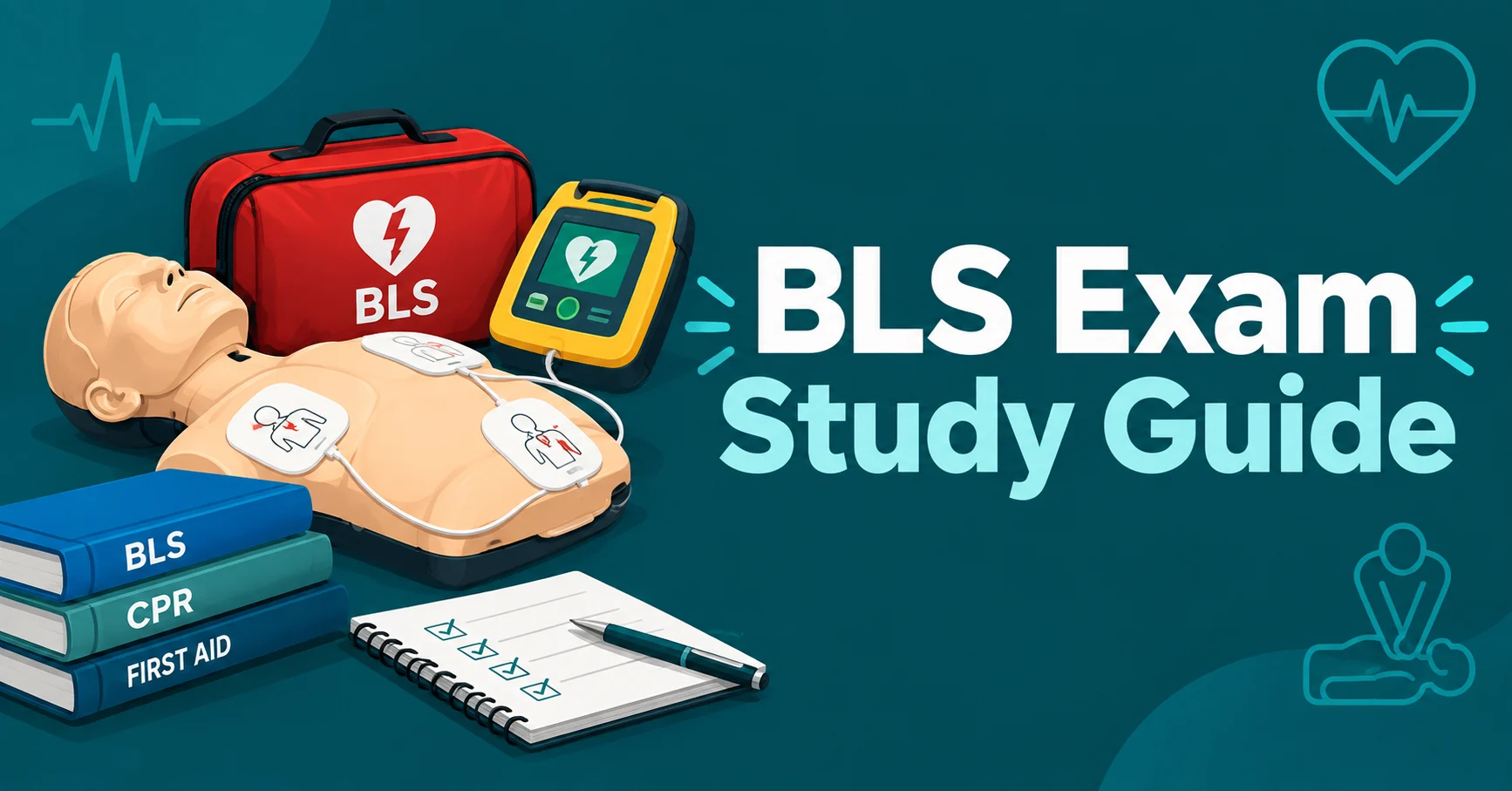
BLS Exam Study Guide 2026: 25 Practice Questions Explained
You want a straight answer, so here it is: the BLS Exam Study Guide certification exam usually contains 25 multiple-choice questions, and you need 84% or higher to pass meaning you can only miss a handful. If that number just made your stomach drop a little, you’re not alone. Most people walking into a Basic Life Support class aren’t nervous about the CPR mannequin; they’re nervous about the written test waiting at the end of it.
That nervousness makes sense, because this isn’t a throwaway certification. The compression rate, the AED sequence, the Chain of Survival order these aren’t just exam trivia, they’re the exact steps that decide whether someone survives a cardiac arrest in front of you. This guide walks through who needs this preparation, what the exam actually measures, and 25 realistic practice questions with the reasoning behind each answer, so you’re not just memorizing you actually understand why.
Who Should Use a BLS Study Guide
Nurses, EMTs, physicians, dental staff, lifeguards, and other healthcare professionals are the core audience for BLS certification, but plenty of non-clinical roles require it too teachers, coaches, and workplace safety officers among them. Reviewing a study guide before class matters because it reinforces the compression ratios, ventilation timing, and AED protocols you’ll be tested on, rather than hearing them for the first time in the classroom.
The people who struggle most on exam day are usually the ones who treated the written test as an afterthought. High-quality chest compressions, early defibrillation, and correct team roles come up again and again in the scoring, so spending twenty focused minutes with a guide beforehand tends to be the difference between a confident first pass and a frustrating retake.
The Passing Score for the BLS Certification Exam
Most BLS written exams contain 25 to 30 multiple-choice questions pulled from the current AHA/ECC guidelines, and a passing score typically requires 84% or higher. On a 25-question version, that means missing more than 4 questions puts your certification at risk a tighter margin than a lot of test-takers expect going in.
The good news is that the exam isn’t designed to trick you. It’s scenario-based, testing whether you can apply BLS steps correctly under pressure recognizing an unresponsive adult, calling for the AED, adjusting compressions for a child versus an infant. Once you understand the underlying logic instead of just memorizing numbers, most of the “tricky” questions stop feeling tricky at all.
Most Critical BLS Skills
High-quality chest compressions, early AED use, proper ventilation, and rapid scene assessment sit at the center of almost every BLS exam, because they’re also the skills most directly tied to patient survival. Team communication and clearly assigned roles get tested too, since real resuscitations almost never happen with a single rescuer working alone.
If you master four things compression rate and depth, the compression-to-ventilation ratio, AED timing, and rescuer rotation you’ve covered the material that shows up most often on the written test. Everything else in the guidelines tends to build outward from those core numbers, so they’re worth memorizing cold before you touch a single practice question.
Free BLS Practice Test 25 Questions with Explanations
Instead of just checking whether you got a question right, take a moment with each one to understand why the correct answer is correct that’s what actually sticks on exam day. These 25 questions mirror the structure and difficulty of the real AHA BLS written exam.
1. What is the correct order of the Adult Chain of Survival? Answer: Recognition and activation → Early CPR → Rapid defibrillation → Advanced life support → Post-cardiac arrest care. Why: Recognition has to come first, because nothing else starts until someone identifies the emergency and activates emergency response.
2. What is the recommended chest compression rate for adult CPR? Answer: 100–120 compressions per minute. Why: This rate maximizes blood flow without causing rescuer fatigue that degrades compression quality.
3. How deep should adult chest compressions be? Answer: At least 2 inches (5 cm), but no more than 2.4 inches (6 cm). Why: Too shallow fails to circulate blood; too deep increases injury risk.
4. What is the compression-to-ventilation ratio for single-rescuer adult CPR? Answer: 30:2. Why: This ratio balances circulation from compressions with adequate oxygenation from breaths.
5. How often should rescuers switch during two-rescuer CPR? Answer: Every 2 minutes, or sooner if fatigued. Why: Compression quality drops measurably after about 2 minutes, even in trained rescuers.
6. What is the first step when you find an unresponsive adult? Answer: Check for responsiveness and shout for help. Why: You need to confirm the emergency and activate the response system before starting interventions.
7. When should you use an AED on a cardiac arrest patient? Answer: As soon as it’s available. Why: Early defibrillation is one of the strongest predictors of survival in sudden cardiac arrest.
8. What should you do if the AED advises “no shock”? Answer: Immediately resume CPR, starting with compressions. Why: A “no shock” reading doesn’t mean the patient is fine CPR must continue without delay.
9. What is the correct hand placement for adult chest compressions? Answer: Center of the chest, on the lower half of the sternum. Why: This placement compresses the heart most effectively between the sternum and spine.
10. What compression-to-ventilation ratio is used for two-rescuer child or infant CPR? Answer: 15:2. Why: Pediatric patients benefit from more frequent ventilations relative to compressions during two-rescuer care.
11. How should chest compressions be performed on an infant? Answer: Using two fingers (single rescuer) or two thumb-encircling hands (two rescuers), at least one-third the depth of the chest. Why: An infant’s smaller chest requires a different technique to avoid injury while still generating adequate blood flow.
12. What should you do first if an adult is choking and cannot cough, speak, or breathe? Answer: Perform abdominal thrusts (Heimlich maneuver). Why: Complete airway obstruction requires immediate mechanical intervention, not back blows alone in adults.
13. What changes if a choking victim becomes unresponsive? Answer: Begin CPR, starting with chest compressions, and check the mouth for a visible object before giving breaths. Why: Compressions can help dislodge the obstruction while also providing circulatory support.
14. What is the correct rescue breathing rate for a patient with a pulse who isn’t breathing normally? Answer: One breath every 6 seconds (about 10 breaths per minute). Why: This rate maintains oxygenation without causing gastric inflation from over-ventilation.
15. What should you check before giving rescue breaths? Answer: That the airway is open using a head-tilt, chin-lift maneuver. Why: An improperly positioned airway can block airflow even when breaths are delivered correctly.
16. Who is typically the team leader in high-performance team CPR? Answer: The most experienced or designated provider, who assigns roles and monitors overall performance. Why: Clear leadership prevents duplicated effort and gaps in coverage during a resuscitation.
17. What is a key benefit of closed-loop communication during a resuscitation? Answer: It confirms that instructions were heard and understood correctly. Why: Miscommunication during a code can directly delay life-saving interventions.
18. How should compressions be adjusted for a pregnant patient in cardiac arrest? Answer: Perform standard high-quality compressions, and consider manual left uterine displacement if late in pregnancy. Why: Displacing the uterus relieves pressure on major blood vessels, improving compression effectiveness.
19. What special consideration applies to CPR on a patient with a suspected spinal injury? Answer: Use a jaw-thrust maneuver instead of head-tilt, chin-lift when opening the airway, if trained to do so. Why: This technique opens the airway while minimizing movement of the cervical spine.
20. What should you do if you’re alone and witness an adult collapse suddenly? Answer: Call emergency services and get an AED before starting CPR, if one is readily available. Why: In witnessed sudden collapse, rapid defibrillation access is prioritized alongside starting compressions.
21. What is the correct response if you’re unsure whether a patient is breathing normally? Answer: Treat it as not breathing normally and begin CPR. Why: Hesitation costs critical time; the guidelines favor erring toward starting compressions.
22. How many rescue breaths should you give during infant CPR after 30 compressions (single rescuer)? Answer: 2 breaths, using gentle puffs appropriate to infant lung volume. Why: Infant lungs require significantly less volume than an adult’s to avoid injury.
23. What is the primary purpose of the Chain of Survival concept? Answer: To outline the sequence of actions that most improve survival after cardiac arrest. Why: Each link depends on the one before it skipping or delaying a step weakens the whole chain.
24. When should team members rotate compressor roles during a resuscitation? Answer: Every 2 minutes, during a pulse/rhythm check to minimize interruption. Why: Timing the switch to a scheduled check avoids adding extra pauses in compressions.
25. What does “high-quality CPR” primarily refer to? Answer: Adequate rate, adequate depth, full chest recoil, minimal interruptions, and avoiding excessive ventilation. Why: These five factors are the measurable components AHA uses to define compression quality.
Team Dynamics and Communication
Effective team dynamics and communication are crucial for successful resuscitation efforts, and the AHA treats them as core BLS Exam Study Guide competencies rather than a soft-skills afterthought. Clear roles, closed-loop communication, and a defined team leader consistently appear on certification exams because uncoordinated teams lose critical seconds during a code.
In practice, this looks like naming who’s compressing, who’s managing the airway, and who’s running the AED before things get chaotic not figuring it out mid-resuscitation. Exam questions in this category test whether you recognize good communication habits, like confirming instructions out loud, over vague or assumed understanding between team members.
Special Circumstances
Real-world emergencies don’t always occur in ideal conditions, and the BLS Exam Study Guide includes questions that test your ability to adapt standard technique pregnancy, suspected spinal injury, opioid-related emergencies, and drowning are common variations. Understanding how to adjust BLS steps for these situations is just as important for certification as knowing the standard adult sequence.
These questions tend to trip up test-takers who only memorized the “default” scenario, because the correct adjustment like uterine displacement or a jaw-thrust airway maneuver isn’t something you can guess intuitively. Reviewing special circumstances specifically, rather than assuming standard CPR always applies unmodified, closes a common gap before exam day.
Conclusion
Preparing for a BLS Exam Study Guide exam becomes much easier when you understand the reasoning behind each answer instead of simply memorizing facts. These 25 questions provide a useful review of essential BLS concepts, including recognizing emergencies, starting CPR, using an AED, and responding effectively when someone needs immediate help. Use them to check your knowledge, identify areas that need more practice, and build confidence before the exam.
Remember that real-life emergencies require calm decision-making and hands-on skills, so studying should go alongside proper BLS Exam Study Guide training whenever possible. A strong understanding of these fundamentals can help you feel more prepared for the exam and more confident when responding to an emergency.
FAQs
Author

Hi, I’m Alex, and I enjoy learning through quizzes, trivia, and interactive questions. I love discovering new conversation starters, relationship topics, and educational challenges. This website is my go-to place for fun, practical, and reliable question-based content. I’m always excited to learn something new and share it with others.