

Nominal Questions in a Survey: Definitions, Examples & Guide
Nominal questions in a survey are closed-ended questions that sort respondents into distinct, unordered categories like gender, brand preference, or job title with no ranking implied between the options. If you’ve ever built a survey and wondered why your “favorite brand” question can’t be averaged into a neat score, you’ve already bumped into this exact problem.
That mismatch between what a question looks like it’s measuring and what its data actually supports trips up even experienced researchers, and it quietly wrecks downstream analysis. This guide walks through clear examples, how nominal data differs from ordinal data, and the right way to analyze each one so your next survey design holds up under scrutiny.
What Are Nominal Questions in a Survey?
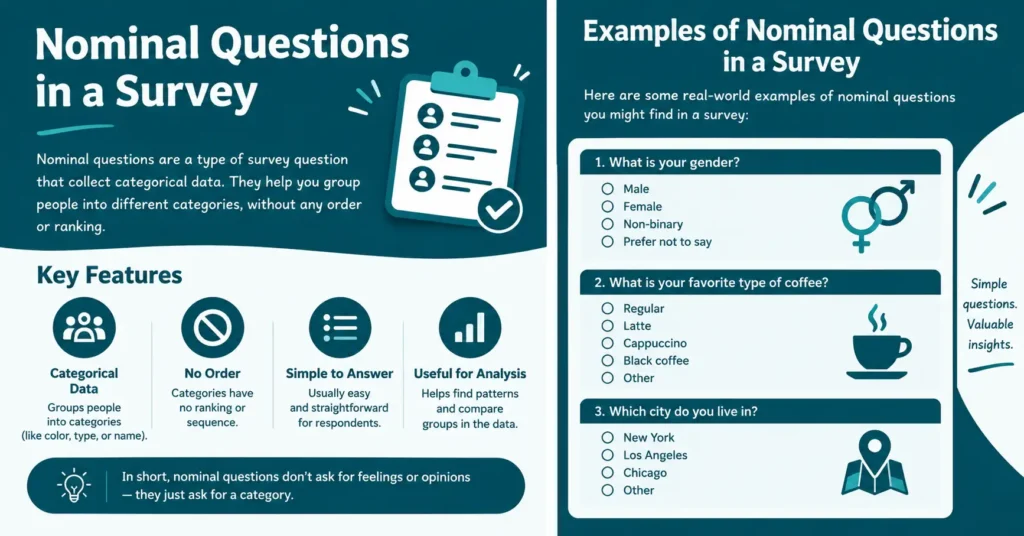
A nominal question is a closed-ended survey question whose response options are non-numerical categories that don’t overlap and imply no order or hierarchy. It’s the simplest level of measurement in survey data, used to sort respondents into mutually exclusive groups gender, brand, location for segmentation rather than ranking.
Even when nominal answers are coded as numbers for a database, those numbers are just labels. Coding “1” for Coca-Cola and “2” for Pepsi doesn’t mean Pepsi outranks Coca-Cola it’s a convenience for data entry, not a measurement of intensity or preference between the two brands.
Examples of Nominal Questions in a Survey
Across demographics, product usage, geography, and preference, nominal questions in a survey share one trait: every answer choice is a category, not a point on a scale. Below are the most common formats researchers reach for, grouped by use case, pulled from patterns that repeat across major survey-question guides.
Respondents typically pick one option (single-select) or several (checkbox/multi-select), and the response set should be exhaustive enough that “Other” rarely gets overused. Well-built nominal questions in a survey are quick to answer, which keeps completion rates high and respondent fatigue low.
Demographic Examples
Demographic nominal questions categorize respondents for segmentation and audience profiling asking, for instance, “Which of the following best describes your employment status?” with options like employed full-time, self-employed, or student. These answers group people, they don’t rank them, and they’re a staple of nearly every intake survey.
Product & Brand Usage Examples
Product-usage nominal questions identify preference or usage patterns without implying that one brand or feature beats another “Which brand of smartphone do you currently use?” (Apple, Samsung, Google, Other) is a textbook case. Contentsquare’s version of this same pattern asks what a respondent uses a product for (business, personal, other), which segments intent rather than ranks it.
Geographic Examples
Geographic nominal questions help businesses understand regional distribution “In which region do you live?” with North, South, East, West as options is a common format. There’s no inherent order to these regions; the data is purely categorical and useful for spotting distribution patterns across a customer base.
Preference Examples
Preference-based nominal questions reveal patterns in taste or lifestyle without ranking one choice above another “What is your favorite type of cuisine?” (Italian, Indian, Japanese, Mexican) captures a category, not an intensity. These are common in market research where the goal is simply to see which group is largest.
When to Ask Nominal Questions in a Survey
Nominal questions in a survey work best early in a research relationship, when you need to bucket respondents into groups before you can meaningfully analyze anything else demographic and segmentation questions almost always come first. They’re also a low-effort way to open a survey, since categorical choices require far less thought than open text.
Because nominal data is easy to turn into counts, percentages, and simple charts, it’s ideal whenever your goal is an overview of behaviors and attitudes across different audience segments, rather than measuring how strongly someone feels. Save the intensity-measuring questions satisfaction, agreement, likelihood for later in the survey.
Nominal vs. Ordinal: What’s the Difference?
An ordinal scale ranks responses in a meaningful sequence, unlike a nominal scale, which only sorts responses into unranked categories that’s the entire distinction in one sentence. Where nominal data answers “which group,” ordinal data answers “how much, relatively,” even though the exact size of the gap between ranks stays unknown.
A satisfaction question with options from “very dissatisfied” to “very satisfied” is ordinal: we know satisfied outranks neutral, but we can’t assume the emotional distance between those two options equals the distance between neutral and dissatisfied. That’s the key limitation that separates ordinal data from true interval or ratio measurement.
Examples of Ordinal Survey Questions
Ordinal questions capture direction and intensity rather than pure category satisfaction scales, Likert agreement scales, and frequency questions (“Never / Rarely / Sometimes / Often / Always”) are the three most common formats. Each ranks responses along a spectrum, which is exactly what separates them from nominal data.
Nominal vs. Ordinal Survey Questions: Key Differences and When to Use Each
Choosing between nominal and ordinal ultimately comes down to your research goal: use nominal scales to label categories without implying order, and ordinal scales when the order matters but the exact gap between choices can’t be measured. Most strong surveys use both nominal to understand who respondents are, ordinal to understand how they feel.
The clearest way to see the split is side by side, since the aspects that matter for analysis purpose, order, equal intervals, and appropriate statistical tests diverge sharply between the two scale types once you line them up directly.
Comparison Table
| Aspect | Nominal Scale | Ordinal Scale |
| Purpose | Classify responses into categories | Rank responses by order or preference |
| Order implied | None | Yes |
| Equal intervals | Not applicable | Not guaranteed |
| Measurement level | Categorical | Ranked categorical |
| Typical examples | Gender, brand, region, product type | Satisfaction, agreement, frequency |
| Appropriate central-tendency measure | Mode only | Median, percentiles |
| Common statistical tests | Chi-square test, cross-tabulation | Spearman’s rank correlation, Mann-Whitney U test |

How Data Type Affects Analysis
Because nominal variables have no inherent order, the mode the most frequently chosen response is the only meaningful way to describe an “average” answer, and tests like the chi-square test check whether two categorical variables are related. Ordinal data, by contrast, supports median and percentile analysis and non-parametric tests like Mann-Whitney U, which compare groups while preserving rank order.
Best Practices for Writing Nominal Questions in a Survey
Well-designed nominal questions in a survey are clear, use simple language, and keep response categories mutually exclusive and exhaustive so every respondent finds a fitting option. Avoid leading phrasing “Don’t you agree our product is the best?” and instead ask neutrally, letting respondents categorize themselves without being nudged toward an answer.
Keep each question focused on a single idea rather than bundling two questions into one (a “double-barreled” question), and never assume respondents already know industry jargon. A well-piloted nominal question, tested on a small group before full launch, catches ambiguity before it corrupts your entire dataset.
How to Analyze Nominal Questions in a Survey (and Ordinal Data)
Analyzing nominal questions in a survey starts with frequency counts and cross-tabulation simply tallying how many respondents chose each category, then comparing categorical variables against each other to spot patterns. This is deliberately simple analysis, because nominal data was never designed to support anything more granular than counting and grouping.
Ordinal data opens the door to more nuanced techniques once ranking is involved, since the order of responses (even without equal spacing) allows for real statistical comparison between groups.
Analyzing Nominal Data
Frequency analysis counts how many respondents selected each category, cross-tabulation compares two categorical variables to find relationships, and the chi-square test determines whether an observed association between them is statistically significant. These three techniques cover the vast majority of real-world nominal analysis needs.
Analyzing Ordinal Data
Spearman’s rank correlation assesses relationships between ranked variables, the Mann-Whitney U test compares two independent groups without assuming equal intervals, and ordinal regression models an ordinal outcome against one or more predictors. None of these techniques should be used to calculate a true average, since the gaps between ranks aren’t guaranteed to be equal.
Conclusion
Nominal questions can make surveys much easier to organize, answer, and analyze. By giving respondents clear categories such as age group, location, favorite choice, or yes/no options, these questions collect straightforward information without asking people to rank or measure their answers. They are especially useful when the goal is to understand who respondents are or which category best describes their response.
When writing nominal questions, keep the choices simple, relevant, and easy to understand. Avoid overlapping or confusing options that could make answers difficult to interpret. A well-designed survey starts with clear questions, and nominal questions can provide a strong foundation for collecting useful, reliable data.
FAQs
Author

Hi, I’m Alex, and I enjoy learning through quizzes, trivia, and interactive questions. I love discovering new conversation starters, relationship topics, and educational challenges. This website is my go-to place for fun, practical, and reliable question-based content. I’m always excited to learn something new and share it with others.






One Comment