50+ Overlapping Questions Examples: Powerful & Essential Practice Guide
If you’ve ever stared at a survey question and thought, “wait, which box do I check?” you’ve met an overlapping question firsthand. I’ve reviewed hundreds of survey drafts over the years, and this exact mistake, quiet as it looks, is one of the fastest ways to quietly wreck your response data.
Overlapping questions examples usually hide in plain sight: an age range, a tenure bracket, a headcount tier. They look tidy until a real respondent falls squarely between two mutually exclusive options and has to guess. That guess becomes noise in your dataset, and noise compounds fast once a few hundred people have made the same silent judgment call.
What Are Overlapping Questions Examples in a Survey?
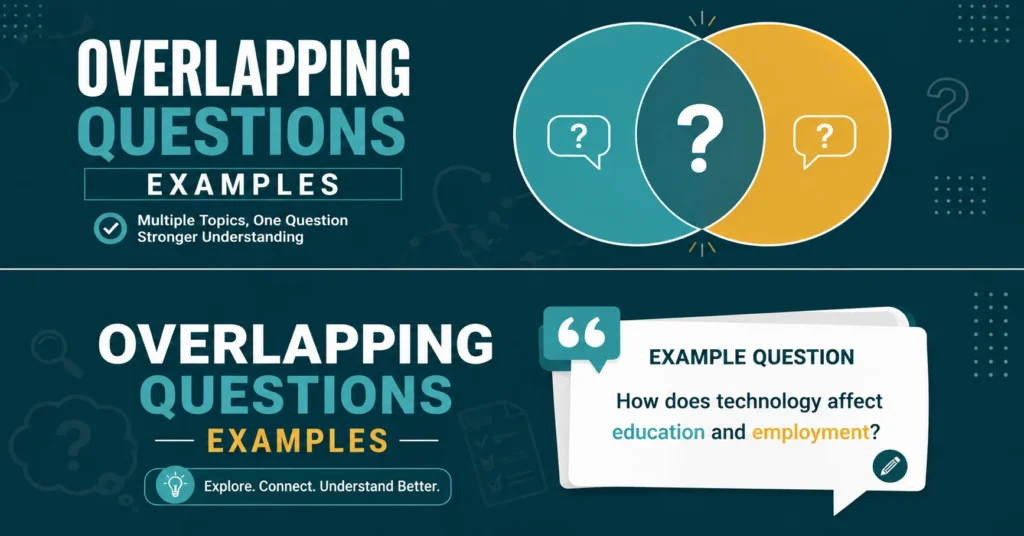
An overlapping question is one where the answer options aren’t mutually exclusive a respondent could honestly belong to more than one category at once. This happens most often with numeric ranges, where a single value like 25 or 50 sits right on the boundary between two response options, and the respondent has no clean way to choose.
The fix sounds simple, but it trips up experienced survey designers constantly: every answer choice should be mutually exclusive and exhaustive, covering all possible answers without any two choices sharing ground. Skip either half of that rule and your response options quietly stop measuring what you think they’re measuring.
Overlapping Questions Examples From Real Surveys
The clearest overlapping questions examples come from age brackets and count-based ranges, because whole numbers sit on category boundaries constantly. A person who is exactly 25 shouldn’t have to guess whether they belong in “18–25” or “25–35” yet that exact setup shows up in survey drafts more than most researchers admit.
Interval data and count data behave differently here, which is where a lot of overlapping questions examples actually originate. Interval ranges can share an endpoint without causing real confusion, but count-based ranges (like number of employees) need a clean break, or two whole numbers end up double-counted.
Example: Age Ranges That Overlap
Confusing question: What is your age? 18–25 / 25–35 / 35–45 / 45–55. Someone exactly 25, 35, or 45 could reasonably pick either neighboring option, and different respondents will resolve that ambiguity differently which quietly corrupts your age-segment comparisons downstream.
Example: Tenure and Headcount Ranges That Overlap
Confusing question: How many different office locations are there at your company? One / 2–4 / 4–8 / 8–12 / More than 12. The numbers 4 and 8 sit inside two choices each, so respondents at exactly those counts get inconsistent treatment, and the resulting data can’t be trusted for segmentation.
How to Fix Overlapping Questions Examples: Make Response Options Mutually Exclusive
The fix for overlapping questions examples is almost always a boundary adjustment, not a full rewrite. Change “18–25 / 25–35” to “18–24 / 25–34,” or “4–8 / 8–12” to “5–8 / 9–12,” and the ambiguity disappears without losing any of the granularity you were originally after.
For approximate or self-reported figures like estimated company size or household income a small endpoint overlap is genuinely harmless, since nobody is measuring to the exact dollar or headcount. Reserve the strict mutually-exclusive rule for anything a respondent can count precisely, like tenure in whole years or number of locations.
Check, Double-Check, and Check Again
Once you know the pattern, overlapping ranges become easy to spot on a second read which is exactly why a dedicated review pass matters more than trying to catch them while you’re still drafting. Read every numeric answer set specifically looking for shared boundaries, separately from checking wording, tone, or question order.
Pretesting with even five or six real respondents will surface boundary confusion that a solo review misses, because you’ll see exactly which option someone picks when their real answer sits on a line. That single round of testing catches most overlapping questions examples before they ever reach your full sample.
Conclusion
Overlapping questions examples are a small, boring-looking mistake with an outsized effect on data quality and the fix costs you nothing but a careful second pass over your numeric ranges. Build the habit of checking every answer set for shared boundaries before launch, and your segmentation data will hold up to real scrutiny instead of quietly reflecting guesswork.
FAQs
Author

Hi, I’m Alex, and I enjoy learning through quizzes, trivia, and interactive questions. I love discovering new conversation starters, relationship topics, and educational challenges. This website is my go-to place for fun, practical, and reliable question-based content. I’m always excited to learn something new and share it with others.