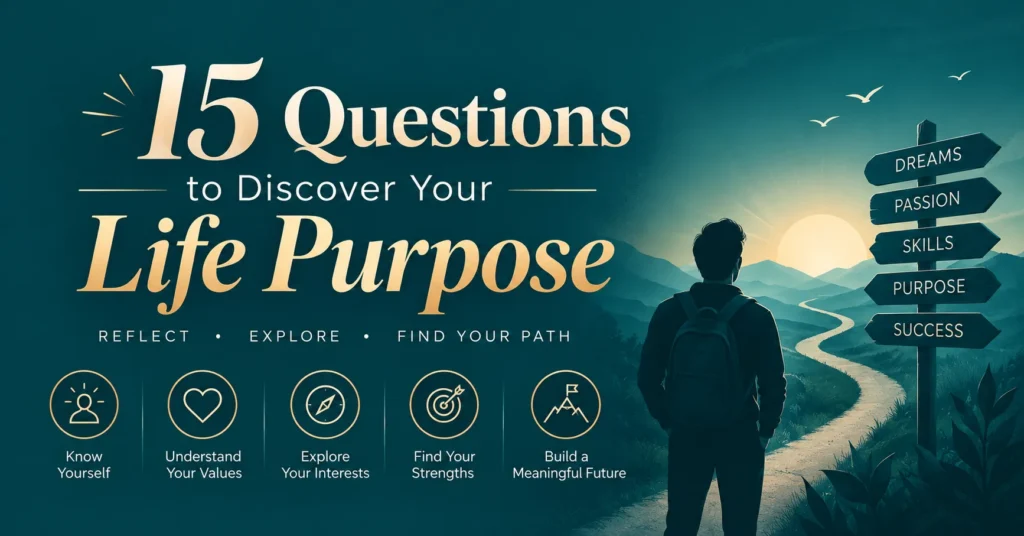
15 questions to discover your life purpose
The 15 questions to discover your life purpose below help you name what energizes you, your natural talents, and your core values. After two decades writing about self-discovery, I’ve watched capable people feel lost, drained, and stuck in work that never quite fit their passions. Sound familiar? You’re not broken; you’re searching.
Purpose rarely arrives as a lightning bolt. It surfaces through honest self-reflection, patient pattern-spotting, and small experiments. Large studies link a stronger sense of purpose with better health, though association isn’t proof. Grab a journal, answer slowly, and turn vague restlessness into meaningful work and one concrete next step.
15 Questions to Discover Your Life Purpose: Why Finding Your Life’s Work Feels So Hard
Purpose hunts often stall at the first wave of doubt. Confusion, comparison, and a crowded calendar make it easy to conclude you simply weren’t given a calling. That’s the wrong diagnosis. Feeling lost is a normal stage of self-discovery, not proof your life purpose is missing.
Part of the difficulty is the myth that purpose is a single job title waiting to be found. In reality, it’s a thread running through your values, curiosity, and experiences. Treat these questions as a listening exercise, and the thread becomes easier to follow.
15 Questions to Discover Your Life Purpose: Uncovering Your Core Values & Patterns
Values and patterns are the quietest clues, and often the most reliable. Your strongest reactions, whether anger, awe, or grief, point toward what matters. Before you chase passions or career moves, name the principles you refuse to compromise. They’ll steer every later answer.
Start here because values keep working when motivation fades. Write quickly, without editing, then circle words that repeat. Those repeated words form a rough personal compass, a blend of self-awareness, emotional honesty, and long-term direction that the next three questions will sharpen.
What Are My Core Values?
List the moments that moved you most, painful or beautiful, then name the principle behind each. Be precise: respect differs from admiration, and security differs from comfort. Specific language turns vague feelings into usable core values, which makes future career choices and personal boundaries much easier.
What Are the Great Themes of My Life?
Scan your story for repeating threads: subjects you return to, problems that keep finding you, even odd coincidences. These recurring patterns act like trail markers. Jot five themes from different decades, and you’ll often see one underlying fascination shaping your passions, relationships, and the work you keep gravitating toward.
What Is My Existential Question?
Under your choices sits a question you’ve been quietly asking for years: What makes a life worthwhile? How do people heal? What is fair? Naming it feels strange at first. Once it’s on paper, your curiosity, career detours, and reading habits suddenly look less random and more deliberate.
15 Questions to Discover Your Life Purpose: Identifying Your Strengths, Talents & Inspirations
Purpose lives where what you do well meets what moves you. Strengths show up in two layers: skills you can list, and instincts others lean on. Together with your sources of inspiration, they narrow a wide field of possibilities into a handful worth testing.
Don’t rely only on your own opinion. Ask three people who know you well what they’d come to you for, then compare their answers with yours. The overlap between self-perception and outside feedback usually reveals strengths you’ve been undervaluing for years.
What Are My Strengths and Talents?
Look past polished skills like writing or design to quieter gifts. Maybe people bring you their secrets, or you stay calm when everything falls apart, or you notice what a team is missing. Those natural talents often point toward meaningful work faster than any résumé keyword.
What Inspires Me?
Notice who and what makes you want to create, build, or improve. List three people, places, or ideas that stir you, then look for the shared thread. Inspiration is rarely random; it usually points toward the values and visions your purpose wants to express.
What Are My Intuitive Feelings?
Your gut often registers misalignment before your logic can explain it. Which obligations leave you empty even though they look smart on paper? Where do you feel a quiet yes? Treat intuition as data, not destiny, and test it with small, low-risk experiments.
15 Questions to Discover Your Life Purpose: Exploring Your Dreams, Challenges & Impact
Dreams, hardships, and the change you want to see form a powerful triangle. Each corner reveals something different: what you long for, what shaped you, and who you want to serve. Looking at all three together keeps your search realistic, courageous, and rooted in lived experience.
Don’t dismiss an ambition because it feels unrealistic or old. A childhood wish to be a pilot might really be a hunger for freedom and perspective. Strip each dream down to its essence, and you’ll find pieces you can bring into your life now.
What Are My Dreams and Aspirations?
Write down the visions that keep tugging at you, however modest or ambitious: learning to fly, opening a bakery, or simply having freer afternoons. Dreams point toward fulfillment you haven’t allowed yourself yet. Focus on the feeling underneath each one, because that feeling guides your next practical move.
What Challenges Have I Overcome?
Your hardest chapters often hold your most useful gifts. Think about the setbacks that changed you, what they taught you, and who might benefit from that knowledge. Resilience earned through divorce, illness, failure, or loss can become guidance, service, or creative work that helps others.
What Impact Do I Want to Have?
Impact doesn’t require a grand stage. Ask who you want to help, how you want people to feel around you, and what contribution would make your days count. Picture a small, specific legacy, like mentoring one student, and let that picture guide your priorities.
What Causes Am I Passionate About?
Notice which injustices make your chest tighten and which kinds of beauty you’d defend. Causes like mental health, climate, education, or community care reveal where concern meets energy. Your purpose often lives where heartbreak and hope overlap, so volunteer once and watch your reaction honestly.
15 Questions to Discover Your Life Purpose: Defining Success & Future Vision
Purpose collapses when you chase someone else’s scoreboard. Defining success on your own terms keeps your future vision honest. Before you commit to any path, decide what a good life includes: time, money, relationships, creativity, service, and how much of each feels like enough.
This final group of questions blends play, sacrifice, curiosity, and ambition. They tell you what you’d do for joy, what you’d pay a price for, and where you still want to grow. Answer them last because they’re easier once earlier patterns are visible.
What Activities Bring Me Joy?
Joy is data. Track which activities leave you energized, absorbed, and strangely unaware of the clock. Psychologist Mihaly Csikszentmihalyi called that absorbed state flow, and people who regularly experience it report more happiness. Write down three flow moments from this month and look for their common ingredients.
What Did I Love as a Child?
Before school, social pressure, and paychecks, you played without a plan. Revisit what held your attention at eight years old: building, performing, collecting, organizing, rescuing animals. Childhood interests often preserve raw curiosity and essential values that adult life has buried beneath responsibilities and other people’s expectations.
What Am I Willing to Sacrifice For?
Every worthwhile purpose costs something: time, comfort, stability, or approval. Ask which difficulty you’d accept without resentment, such as late nights learning a craft or years of slow progress. The sacrifice you’d gladly make usually sits close to the center of your life’s work.
What Do I Want to Learn or Experience?
Curiosity is a quieter, steadier guide than passion. Which topics, skills, or places keep calling you, not because you should, but because you want to? List five. Following that pull, one class or trip at a time, builds evidence for what truly fits.
What Does Success Mean to Me?
Set aside what family, culture, and feeds taught you to want. Finish this sentence honestly: success, to me, is… Then picture what a day of “enough” looks like. A meaningful life might mean freedom, deep friendships, or craft mastery, not a title. That definition frames everything else.
15 Questions to Discover Your Life Purpose: Signs You’re on the Path to Discovering Your Life Purpose
Clarity usually arrives as a handful of small signals, not fireworks. You lose track of time more often, you start questioning old assumptions, and the same themes keep resurfacing. Those shifts suggest your self-reflection is working, even if the full picture feels blurry.
Another sign is mild, productive discontent: gratitude for what you have, plus a sense that something more is possible. As your choices begin matching your core values, expect some hard decisions. Setting boundaries or changing direction often feels uncomfortable precisely because it’s honest.
15 Questions to Discover Your Life Purpose: Understanding Your Natural Talents
Natural talents are the things that feel easy to you and oddly difficult to others. Because they’re effortless, you may dismiss them. Yet compliments you brush off, tasks you finish quickly, and problems you enjoy solving are strong evidence of where you could contribute most.
Talent alone isn’t purpose, though. It matters when it connects to values and serves someone. A steady listener might become a hospice volunteer, an organizer might design smoother clinics, and a storyteller might spark curiosity in classrooms. Ask what your gift could do for others.
How to Discover Your Natural Talents
Run a two-week experiment: keep a daily log of tasks that energize you, ask two colleagues what you do better than most, and take one beginner class outside your field. Compare notes afterward; recurring wins usually expose strengths faster than any single personality test.
Using Your Talents to Make a Difference
Purpose becomes tangible when a talent meets a need. Look for a problem near you, perhaps at work, at church, or in your neighborhood, where your skills could help this month. Small service builds confidence, creates feedback, and shows whether the work energizes you or drains you.
15 Questions to Discover Your Life Purpose: The Role of Personal Growth
Personal growth is the training ground for purpose. Every book, mentor, failure, and course adds to your self-awareness and refines what you want. You don’t need to finish growing before you start acting. Purpose and personal development reinforce each other, month after month.
A growth mindset, the belief that abilities develop with effort, makes the process less frightening. Mistakes become information instead of verdicts. Pair that mindset with specific goals and regular reflection, and your sense of purpose gets clearer through action, not endless thinking.
Learning from Every Experience
After any big moment, good or bad, ask: What surprised me? What did I enjoy or dread? What would I repeat? Five minutes of journaling can turn ordinary days into a classroom for life purpose and personal growth. Keep the answers in one notebook so patterns become visible.
Embracing Change and Uncertainty
Uncertainty feels like failure, but it’s usually the doorway. Staying open to new roles, cities, or ideas lets you collect evidence about what fits. Change a little at a time: shift a responsibility, start a side project, or have a coffee chat with someone doing work you admire.
15 Questions to Discover Your Life Purpose: Aligning Your Career with Your Purpose
Your job doesn’t have to be your purpose, but daily work shouldn’t contradict it. Check which parts of your current role make you feel alive and which parts drain you. That audit shows whether you need a pivot, a redesign, or simply better boundaries.
Alignment rarely happens overnight. Start with one experiment, such as shifting a project toward your strengths, taking a certification, or shadowing someone in a field you admire. If financial pressure is real, keep income stable while testing ideas; purposeful change works best when it’s sustainable.
15 Questions to Discover Your Life Purpose: Integrating What You Discover
Answering all fifteen isn’t the finish line. Read your notes after a week and highlight repeated words, people, and ideas. Three or four themes will probably stand out. Write them as one sentence, such as: I use my curiosity to help people feel understood.
Treat that sentence as a working draft, not a tattoo. Your purpose evolves as your circumstances, relationships, and skills change, so revisit the 15 questions to discover your life purpose every few months. The table below shows how each group of questions turns reflection into a next action.
| Question group | What it reveals | Try this next |
| Core values & patterns (Q1–3) | What you stand for and what keeps recurring | Write a one-sentence values statement |
| Strengths, talents & inspirations (Q4–6) | Where skill meets energy | Ask two people what they rely on you for |
| Dreams, challenges & impact (Q7–10) | Who you want to serve | Volunteer or mentor once this month |
| Joy, childhood & success (Q11–15) | What fuels and sustains you | Block weekly time for one flow activity |
Conclusion
These 15 questions to discover your life purpose won’t hand you a finished answer, and that’s fine. A 2026 analysis of nearly 489,000 people found stronger purpose associated with roughly 30 percent lower risk of earlier death, yet another 2026 analysis suggests baseline health explains much of that link. Purpose is worth having on its own terms.
So choose two questions tonight, write for ten minutes, and share one answer with someone you trust. Small, honest steps build momentum faster than perfect clarity. Your calling is already shaping your choices; these questions simply help you hear it. Which one will you answer first?
FAQs
Author

Hi, I’m Alex, and I enjoy learning through quizzes, trivia, and interactive questions. I love discovering new conversation starters, relationship topics, and educational challenges. This website is my go-to place for fun, practical, and reliable question-based content. I’m always excited to learn something new and share it with others.