50 Marriage Green Card Interview Questions to Expect
Getting ready for a marriage green card interview can feel strangely difficult. You may know your spouse well, have a genuine relationship, and still wonder what the USCIS officer will ask. Will the questions focus on how you met? Your wedding? Your home? Your finances? Or details about your everyday life that you rarely think about?
That uncertainty is what makes preparation stressful.
The good news is that you do not need to memorize a perfect script. USCIS may ask questions that help the officer understand your relationship and evaluate whether the marriage is genuine. The questions can also touch on information in your immigration forms and your eligibility for adjustment of status.
This guide walks through common marriage green card interview questions, from relationship history and wedding details to household routines, immigration history, and potential red flags. More importantly, it explains how to prepare honestly and confidently without trying to sound rehearsed.
Common Marriage Green Card Interview Questions
There is no single list of questions that every couple will receive. USCIS officers can tailor the interview to the circumstances of the case, and the questions may become more detailed when something needs clarification.
Common questions may include:
- How did you and your spouse meet?
- When did you start dating?
- When did you decide to get married?
- Where did you get married?
- Who attended your wedding?
- Where do you currently live?
- What do you usually do together?
- How do you divide household responsibilities?
- What are your spouse’s hobbies?
- When was the last time you celebrated a birthday or anniversary together?
- Have either of you been married before?
- Have you met each other’s families?
- What are your plans for the future?
The best preparation is not memorizing answers word for word. Instead, review the information you submitted and make sure you and your spouse are comfortable discussing your real relationship.
USCIS may interview the petitioner, beneficiary, or both spouses depending on the circumstances.
Marriage Interview Questions About Your Relationship
These questions are designed to explore the history and nature of your relationship.
An officer might ask:
- How did you first meet?
- Who introduced you?
- When did you begin dating?
- How often did you see each other before marriage?
- When did you decide to get married?
- What attracted you to your spouse?
- How did you propose or discuss marriage?
- How do you normally communicate when you are apart?
- What activities do you enjoy together?
- When did you meet each other’s friends?
- Have you traveled together?
- What do you usually do on weekends?
Do not worry if you and your spouse describe an event slightly differently. People naturally remember conversations and minor details differently.
What matters is that your answers are truthful and consistent with the overall history of your relationship. If you genuinely do not remember something, saying that you do not remember is better than inventing an answer.
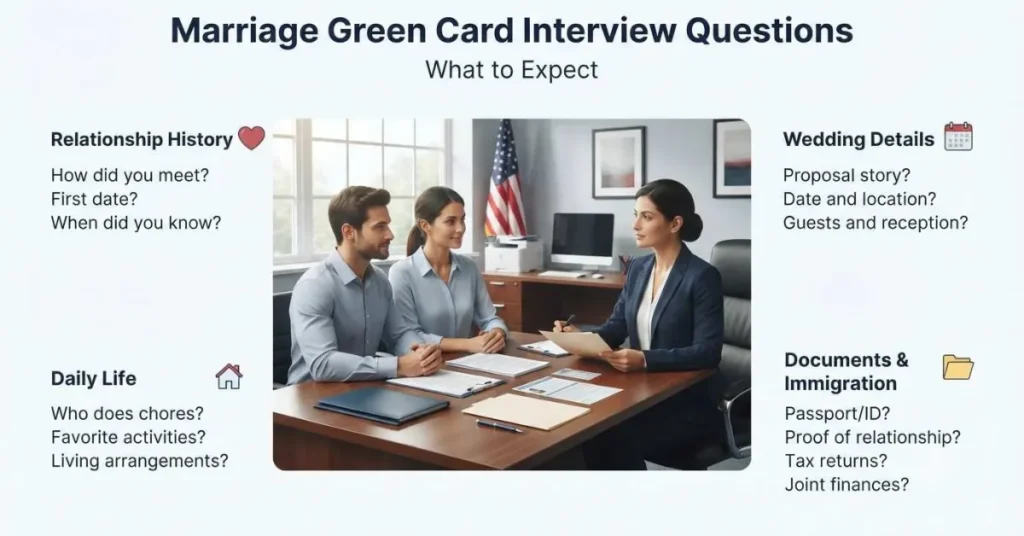
Spouse Background and Personal Information Questions
You should also be familiar with basic information about your spouse.
Possible questions include:
- What is your spouse’s full name?
- When is your spouse’s birthday?
- Where was your spouse born?
- Where does your spouse work?
- What does your spouse do for work?
- What are your spouse’s typical working hours?
- What are your spouse’s hobbies?
- What food does your spouse like?
- Who are your spouse’s close friends?
- What are the names of your spouse’s parents?
- Does your spouse have brothers or sisters?
- Have you met your spouse’s family?
These questions are usually easier when you actually spend time together. You should not treat the interview like a memory contest.
A simple review of your spouse’s basic information can help you avoid unnecessary nervousness.
Relationship History and How You Met
Expect some questions about the beginning of your relationship.
For example:
- Where did you first meet?
- What was your first date?
- Who contacted whom first?
- How long did you date before becoming engaged?
- When did you become engaged?
- How did you tell your families?
- Did you live together before getting married?
- When did you first discuss marriage?
- How did your relationship develop before the wedding?
Think through your actual timeline before the interview.
If you met online, for example, be prepared to explain naturally how you first communicated, when you met in person, and how the relationship progressed afterward.
Wedding and Marriage Questions
Wedding details are another natural area of discussion.
You may be asked:
- When and where did you get married?
- Who attended?
- Who performed the ceremony?
- Did you have a reception?
- What did you do after the ceremony?
- Did your families attend?
- Where did you go after the wedding?
- Did you exchange rings?
- Who helped organize the wedding?
- Did you take photographs?
- Did you go on a honeymoon?
Bring appropriate original documents and supporting evidence requested in your interview notice or applicable USCIS instructions.
Photographs can also help document the history of a relationship, but you should organize evidence logically rather than bringing an enormous pile of unrelated material.
Daily Routine and Household Questions
Some couples find these questions surprisingly difficult because everyday life seems too ordinary to remember.
An officer could ask:
- Who usually wakes up first?
- Who prepares meals?
- Who normally shops for groceries?
- What do you usually eat for dinner?
- Who handles laundry?
- Who cleans the home?
- What time does your spouse normally leave for work?
- What do you do together in the evening?
- How do you spend weekends?
- Who usually pays household bills?
- What television shows or activities do you enjoy together?
There is no “perfect” household routine.
One spouse may cook while the other handles bills. One person may work nights. You may divide chores differently from another married couple.
The important thing is to describe your actual routine.
Home and Living Arrangements Questions
Questions about your home can help establish whether your answers match your real living circumstances.
You might hear questions such as:
- Where do you currently live?
- How long have you lived there?
- Who else lives in the home?
- How many bedrooms are there?
- Where does each person sleep?
- Who has which side of the bedroom?
- Where do you keep your clothes?
- Who normally uses the kitchen?
- Where do you keep important documents?
- What is near your home?
- Do you share household expenses?
If you maintain separate residences for a legitimate reason, do not try to hide it. Be prepared to explain the circumstances honestly and provide supporting documentation when appropriate.
USCIS decisions show that living arrangements and other evidence can become relevant when the bona fide nature of a marriage is questioned.
Bona Fide Marriage Interview Questions
“Bona fide marriage” generally refers to a genuine marital relationship rather than a marriage entered into primarily to obtain an immigration benefit.
Questions may therefore explore the history of the relationship, shared life, family connections, living arrangements, and other circumstances surrounding the marriage.
Examples include:
- Why did you decide to get married?
- When did you decide marriage was right for you?
- How do you spend time together?
- How do you handle household responsibilities?
- Have you met each other’s families?
- What holidays have you celebrated together?
- Have you taken trips together?
- What financial responsibilities do you share?
- What are your plans as a couple?
- Where do you expect to live in the future?
USCIS guidance specifically addresses interviews of spouses and the evaluation of relationships for immigration purposes.
The key point is simple: do not manufacture evidence or rehearse a fictional story. If your marriage is genuine, prepare by organizing your real history and supporting documentation.
I-485 Marriage Green Card Interview Questions
For applicants adjusting status inside the United States, the marriage-based case may involve Form I-485.
Questions can cover both the marriage and information provided in the adjustment application.
You may be asked about:
- Your personal information
- Your current address
- Your immigration history
- Previous marriages
- Previous immigration applications
- Employment history
- Travel history
- Your spouse’s information
- Your relationship
- Your eligibility for adjustment of status
- Information contained in your submitted forms
Review the copies of your forms before attending the interview. Pay particular attention to dates, addresses, employment history, previous immigration information, and other answers you provided.
If you discover an error, do not simply memorize the incorrect information to make your interview answers match it. Consider getting qualified immigration advice about how the error should be handled.
USCIS notes that applicants may receive an interview notice while a case is pending, and case information can be checked through its official online systems.
Admissibility and Immigration Questions
Marriage alone does not automatically resolve every immigration issue. The officer may ask questions relevant to the applicant’s eligibility and admissibility.
Depending on the case, questions may concern:
- Previous immigration status
- Previous visa applications
- Entries into the United States
- Immigration violations
- Previous marriages
- Criminal history
- Misrepresentation or false information
- Prior immigration petitions
- Other information relevant to admissibility
These questions can be particularly important because an applicant’s history may involve issues that are not obvious from the relationship itself.
If your case includes complicated immigration history, previous removals, arrests, prior immigration fraud allegations, or other significant issues, consider speaking with a qualified immigration attorney before the interview.
Marriage Green Card Interview Red Flags
A “red flag” does not automatically mean that a marriage-based case will be denied. It simply means that certain circumstances may lead an officer to ask for additional explanation or evidence.
Potential concerns can include:
- Major unexplained inconsistencies
- Information that conflicts with submitted forms
- Significant unexplained gaps in the relationship timeline
- Contradictory accounts of important events
- Questions about whether the couple actually maintains a shared life
- Evidence suggesting the marriage was entered into for an immigration benefit
- Previous immigration or marriage-related issues
USCIS materials describe the importance of establishing a bona fide marital relationship and address circumstances involving suspected marriage fraud.
That does not mean couples must have identical answers to every small question.
For example, spouses might remember different details about what restaurant they visited several months ago. That is very different from giving fundamentally conflicting accounts about major events in the relationship.
If an officer asks about something you do not remember, answer honestly. Guessing can create a problem that did not need to exist.
How to Prepare for Your Marriage Green Card Interview
Good preparation is less about memorizing hundreds of marriage green card interview questions and more about knowing your own case.
Review your immigration forms
Read through the copies of your I-130, I-130A, I-485, and any other forms relevant to your case.
Check:
- Addresses
- Dates
- Employment history
- Previous marriages
- Immigration history
- Travel information
- Personal details
You want to understand what was submitted on your behalf.
Review your relationship timeline
Sit down together and talk through the major events:
- How you met
- When you began dating
- Important relationship milestones
- Engagement
- Wedding
- Major trips or events
- Where you have lived
- Important changes in your life together
You do not need to memorize a speech. The goal is simply to refresh your memory.
Organize your evidence
Keep relevant documents organized so you can locate them quickly if requested.
Depending on your circumstances, evidence may include documentation showing shared residence, finances, insurance, correspondence, photographs, travel, or other aspects of your life together.
Only use genuine evidence. Never create, alter, or misrepresent documents.
Practice talking, not performing
This is one of the most useful preparation tips.
Ask each other natural questions about your relationship. Talk about how you met, your wedding, your home, your families, and your everyday life.
Avoid turning practice into a memorization exercise.
If you sound like you have memorized identical answers, that can make you more nervous, not less.
Be truthful when you do not know
Nobody remembers everything.
If you cannot remember an exact date, say so. If you misunderstand a question, ask the officer to repeat or clarify it.
A calm, honest answer is usually better than guessing simply because you feel pressured to respond immediately.
Bring what your notice requires
Read your interview notice carefully and follow the instructions for documents and identification.
USCIS can issue interview notices and other case-related notices through its established notification systems.
If your circumstances have changed since filing, such as a new address or other significant information, make sure you understand what USCIS needs from you.
Remember that every case is different
There is no guaranteed set of questions.
An officer may spend more time on the relationship, while another case may involve more questions about immigration history or information contained in the application.
That is why preparing your actual case is more useful than trying to memorize a list found online.
Final preparation checklist
Before the interview, make sure you have:
- Reviewed your submitted forms
- Reviewed your relationship timeline
- Checked important dates and addresses
- Organized requested documents
- Reviewed your immigration history
- Discussed major relationship events with your spouse
- Prepared to explain unusual circumstances honestly
- Read your interview notice carefully
- Allowed enough time to arrive at the interview location
Most importantly, do not try to turn your marriage into a performance.
The strongest preparation is knowing your own story, understanding what you submitted, bringing legitimate supporting evidence, and answering questions truthfully.
Conclusion
Preparing for marriage green card interview questions is really about preparing to discuss your life as a couple, not memorizing a script. The questions can range from how you met and got married to your home, daily routine, family, immigration history, and information included in your applications.
Take time to review your forms, refresh your relationship timeline, organize the documents requested for your case, and talk naturally with your spouse about the important events in your marriage. If you do not remember a minor detail, it is better to say so than guess.
Every case is different, and USCIS may ask questions based on the circumstances of the individual petition and application.
Go in prepared, but stay genuine. You are not trying to give rehearsed answers. You are explaining your real relationship clearly and truthfully.
FAQs
Author

Hi, I’m Alex, and I enjoy learning through quizzes, trivia, and interactive questions. I love discovering new conversation starters, relationship topics, and educational challenges. This website is my go-to place for fun, practical, and reliable question-based content. I’m always excited to learn something new and share it with others.