
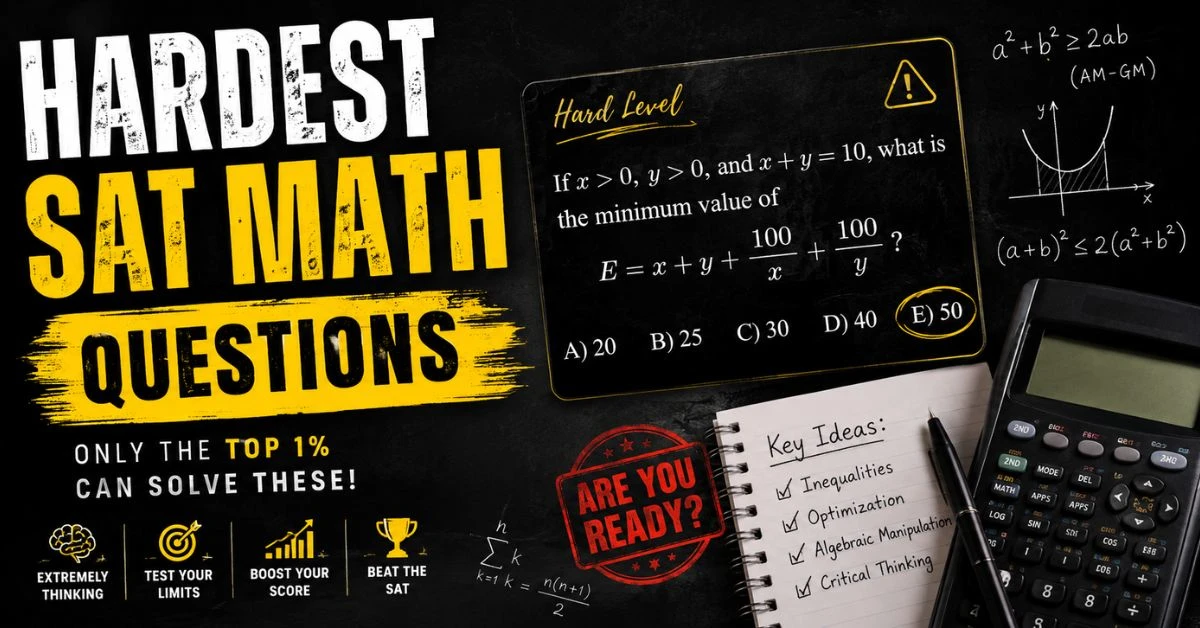
15 Hardest SAT Math Questions With Expert Solutions
If you’ve ever felt confident solving SAT math problems only to get stuck on a few questions that seem impossible, you’re not alone. The hardest SAT math questions are designed to test more than formulas. They challenge your reasoning, pattern recognition, and ability to stay calm under pressure. Even students who consistently score well can lose valuable points on these high-difficulty problems, making them one of the biggest obstacles to a top score.
That matters because just a handful of difficult questions can separate an excellent SAT Math score from an exceptional one. Learning how these questions work is often more valuable than simply memorizing more formulas or shortcuts.
In this guide, you’ll explore some of the hardest SAT math questions, understand why they’re so challenging, and learn practical strategies to solve them with confidence. You’ll also find hard SAT math questions for practice, along with SAT practice math questions that help you build the skills needed for test day.
Quick Answer What Makes an SAT Math Question Hard
The hardest SAT Math questions aren’t hard because they use obscure math. They’re hard because they stack multiple concepts, use convoluted wording, and demand several clean steps in a row under time pressure. A question testing basic linear equations can become one of the toughest items on the test simply by adding an extra variable or an unfamiliar real-world context.
Digital SAT Math Overview Sections, Timing & Scoring
The Digital SAT Math section has two modules of 22 questions each, for 44 questions total, with calculator use allowed throughout (via the built-in Desmos tool). You get roughly 70 minutes combined.
| Domain | Approx. Weight | What It Covers |
| Algebra | ~35% | Linear equations, inequalities, systems of equations |
| Advanced Math | ~35% | Quadratics, polynomials, functions, exponential expressions |
| Problem-Solving & Data Analysis | ~15% | Ratios, percentages, statistics, graph interpretation |
| Geometry & Trigonometry | ~15% | Area, volume, circles, right triangles, radians |
How the Digital SAT’s Adaptive Format Changes Question Difficulty
Because the Digital SAT is section-adaptive, your performance on Module 1 determines the difficulty level of Module 2. Students who do well early get routed into a harder second module which is exactly where most of the hardest SAT math questions live. This means two students can take “the same test” and face very different levels of challenge, simply based on how Module 1 went.

Should You Be Focusing on Hard Questions Right Now?
Not necessarily. If you’re regularly missing medium-difficulty questions, hardest-question practice won’t move your score much. Focus here if:
- You’re consistently scoring 700+ and want to close the gap to 800
- You’ve already mastered the core algebra and functions content
- You’re missing questions specifically in Module 2 on practice tests
If none of that applies yet, build your foundation first the hardest questions will still be there later.
The 20 Hardest SAT Math Questions
Rather than reproduce official College Board items (which are copyrighted and rotate constantly), here’s a breakdown of the question categories that consistently rank as the toughest on recent Digital SAT administrations, based on patterns across dozens of released practice tests:
| # | Category | Core Skill Tested |
| 1–3 | Systems of nonlinear equations | Substitution, graphing intersections |
| 4–5 | Multi-step word problems with rates | Unit conversion, proportional reasoning |
| 6–7 | Quadratic functions in context | Vertex form, real-world modeling |
| 8–9 | Complex numbers | Operations with i, simplification |
| 10–11 | Circle equations | Completing the square, center/radius |
| 12–13 | Function composition | Nested functions, domain/range |
| 14–15 | Exponential growth/decay | Interpreting rate constants |
| 16–17 | Statistics and data inference | Standard deviation, sampling logic |
| 18–19 | Trigonometric identities | Unit circle, radian conversion |
| 20 | Polynomial division | Remainder theorem |
Practice tip: Work through official Bluebook practice tests for the exact, current versions of these question types the format and phrasing shift slightly with each College Board release.
Full Answer Key & Explanations
For each category above, the fastest path to a correct answer follows a repeatable pattern:
- Identify the domain is this algebra, geometry, or data analysis?
- Translate the wording into an equation or diagram before solving
- Check for shortcuts plugging in answer choices is often faster than solving algebraically
- Verify units and constraints stated in the problem
- Re-read the question to confirm you’re answering what’s actually asked
What the Hardest SAT Math Questions Have in Common
- Test several concepts at once algebra and geometry combined in a single item
- Involve multiple steps no single-formula shortcuts
- Cover less-familiar content like piecewise functions or complex numbers
- Use convoluted wording the math is easy once you translate the sentence
- Introduce extra variables making substitution error more likely
The Math Topics Most Likely to Appear in Hard Questions
Based on released Digital SAT data, the most frequently tested advanced topics are:
- Systems of equations (linear and nonlinear)
- Quadratic and exponential functions
- Coordinate geometry and circle equations
- Trigonometric ratios and identities
- Complex numbers and polynomial operations
Step-by-Step Framework for Solving Any Hard SAT Math Problem
- Read the question twice before touching your calculator
- Write down what’s given and what’s being asked
- Choose your method: algebraic solving, graphing on Desmos, or plugging in answers
- Solve methodically, checking each step
- Sanity-check your answer against the context of the problem
What to Do When You’re Completely Stuck on Test Day
- Skip and flag it don’t burn more than 90 seconds before moving on
- Eliminate answer choices that are obviously out of range
- Plug numbers back in to test which answer choice satisfies the equation
- Come back with fresh eyes if time allows you’ll often spot the trick you missed
Common Mistakes Students Make on Hard Math Questions
- Solving for the wrong variable
- Ignoring units or domain restrictions
- Rushing the word-problem translation step
- Over-relying on the calculator for problems that need algebraic reasoning
- Not double-checking whether the answer makes sense in context
Calculator-Allowed vs No-Calculator Which Has Harder Questions?
The current Digital SAT allows a calculator on all Math questions, unlike the older paper format, which had a no-calculator section. This doesn’t make the test easier it shifts difficulty toward questions that look calculator-solvable but actually require algebraic understanding, like circle equations disguised as graphing problems.
How Many Questions You Can Miss and Still Score 700 / 750 / 800
| Target Score | Approx. Questions You Can Miss (out of 44) |
| 800 | 0–1 |
| 750 | 2–4 |
| 700 | 5–7 |
These figures vary slightly by test curve, since the Digital SAT’s adaptive scoring adjusts based on module difficulty.
SAT Math vs ACT Math Which Is Actually Harder?
SAT Math leans toward fewer, more layered questions that test reasoning depth. ACT Math covers more questions in less time per question, with a broader range of topics including more advanced trigonometry. Neither is universally “harder” it depends on whether you struggle more with speed (ACT) or multi-step reasoning (SAT).
Free Practice Resources for Hard SAT Math Questions
- College Board Bluebook app official adaptive practice tests
- Khan Academy’s official SAT practice free, aligned to the Digital SAT
- Past released Digital SAT practice tests (Bluebook Tests 1–8)
Key Takeaways
The hardest SAT Math questions aren’t about knowing obscure formulas they’re about stacking familiar concepts, working through multi-step logic, and staying calm under convoluted wording. Build your foundation first, then target these specific patterns as your score climbs toward 700+.
Conclusion
The hardest SAT math questions are designed to test more than formulas. They challenge how well you recognize patterns, connect concepts, and stay calm when a problem looks unfamiliar. The good news is that these skills improve with consistent practice and thoughtful review. Every difficult question you solve builds the confidence and problem-solving habits you’ll need on test day. Instead of avoiding the toughest problems, use them as opportunities to strengthen your understanding and identify areas that need more attention. With the right study approach, even the most challenging SAT math questions become manageable. Keep practicing, learn from your mistakes, and focus on steady progress. The effort you put in today can make a real difference when it matters most.
FAQs
Author

Hi, I’m Alex, and I enjoy learning through quizzes, trivia, and interactive questions. I love discovering new conversation starters, relationship topics, and educational challenges. This website is my go-to place for fun, practical, and reliable question-based content. I’m always excited to learn something new and share it with others.