
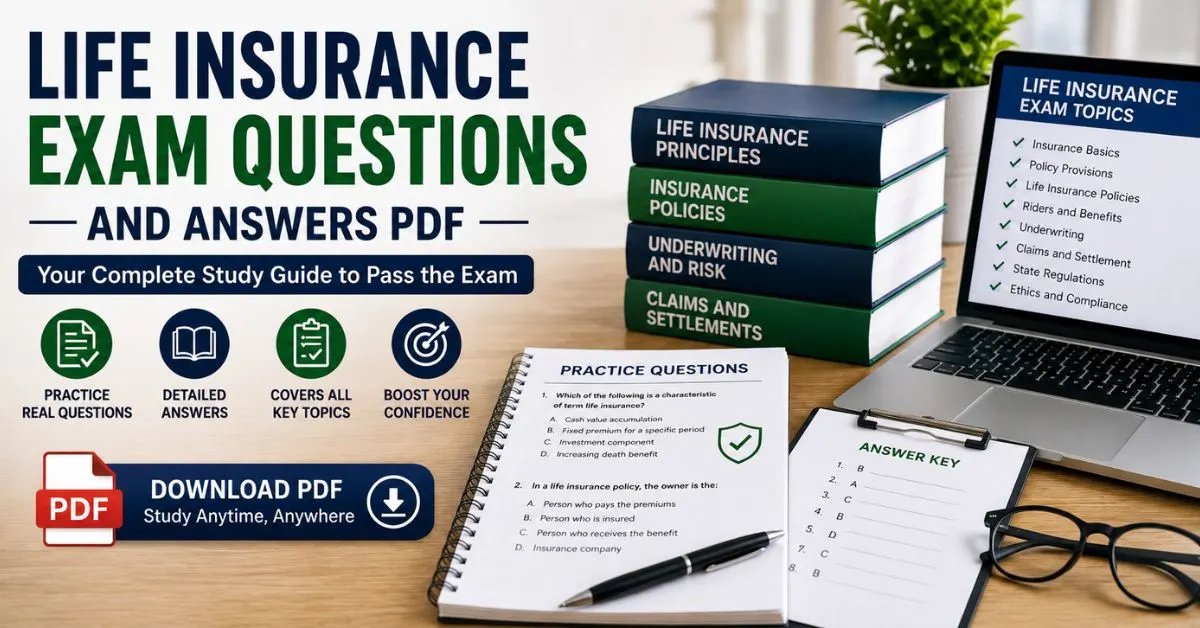
Life Insurance Exam Questions and Answers PDF Guide
Many people underestimate the life insurance licensing exam until they open a practice test and realize how detailed the questions can be. From policy provisions and insurance laws to underwriting and ethics, it’s easy to feel overwhelmed if you’re not studying the right material. If you’re searching for a life insurance exam questions and answers PDF, you’re likely looking for a smarter way to prepare instead of memorizing random facts.
The truth is, using realistic practice questions can make a huge difference in how confident you feel on exam day. They help you identify weak areas, understand the wording of actual exam-style questions, and improve your test-taking skills before it really counts. This is especially important if you’re preparing with Texas life insurance exam questions and answers PDF resources that focus on state-specific requirements.
In this guide, you’ll find quality practice questions, detailed answer explanations, effective study tips, and useful resources to help you prepare more efficiently and increase your chances of passing the exam on your first attempt.
What Is the Life Insurance Licensing Exam?
The life insurance licensing exam is a state-administered test that verifies you understand insurance law, policy types, and ethical sales practices before you’re allowed to sell life insurance products to the public. You must pass it along with a background check and pre-licensing education hours to receive your producer license.
Life Insurance Exam Format, Duration & Passing Score
Most states require a 70% or higher to pass. The exact number of questions, time limit, and format depends on your state and whether you’re taking a combined life and health exam or separate sections.
| Exam Type | Questions | Time Limit | Passing Score |
| Life Only | 50–110 | 1–2 hours | 70% (varies by state) |
| Life & Health Combined | 85–170 | 2–3 hours | 70% (varies by state) |
| Health Only | 50–100 | 1–2 hours | 70% (varies by state) |
Questions typically appear in three styles: incomplete sentence, direct question, and “all of the following except” so practicing with varied question formats matters as much as knowing the content.
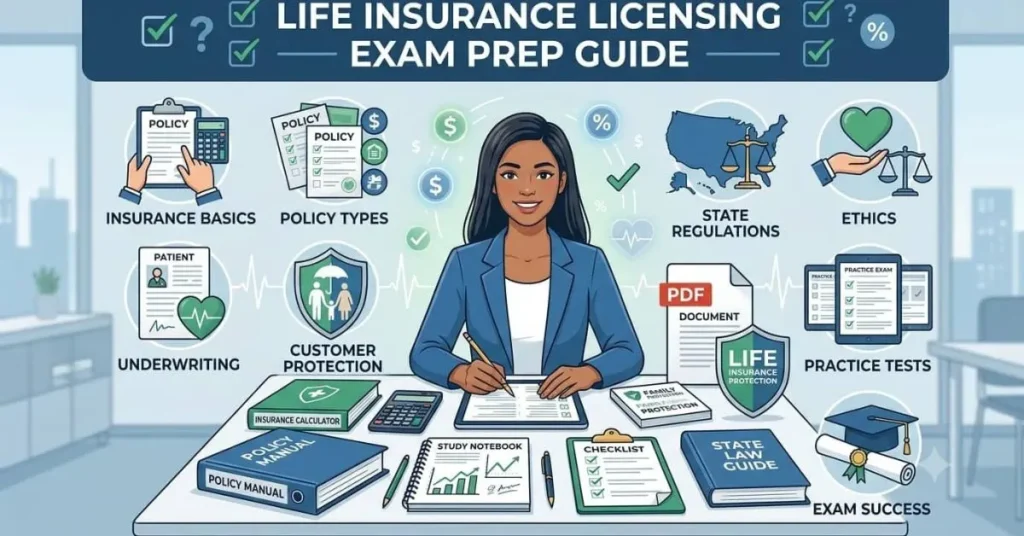
State-Wise Life Insurance Exam Requirements
Every state sets its own pre-licensing education hours, exam vendor, and renewal cycle, but the core subject matter tested is nearly identical nationwide. Before scheduling your test:
- Confirm your state’s required pre-licensing course hours (commonly 20–40 hours)
- Check which testing vendor your state uses (Pearson VUE and PSI are the most common)
- Verify your license renewal period, typically every 1–2 years
- Review any state-specific continuing education (CE) requirements
Life Insurance Exam Syllabus: Topics You Must Know
Your exam will draw from these core content areas, weighted differently by state:
- Insurance basics and contract law offer, acceptance, consideration, insurable interest
- Types of life insurance policies term, whole, universal, variable
- Policy provisions, riders, and options
- Underwriting and the application process
- Premiums, cash value, and dividend options
- Beneficiary designations and settlement options
- Federal tax treatment of life insurance and annuities
- State insurance law and regulations
- Annuities fixed, variable, and immediate
Life Insurance Exam Questions & Answers (Top 50+)
Here’s a sample of the question styles you’ll actually see on test day, with brief explanations so you understand the why, not just the what.
Q: What is an actuary? A: A professional who analyzes statistical probability of events (like death) to help price insurance premiums accurately.
Q: Under a free-look provision, what right does a policyholder have? A: The right to review the policy for a set number of days (usually 10–30) and cancel for a full refund if unsatisfied.
Q: If both the primary and contingent beneficiaries die before the insured, who receives the death benefit? A: It typically pays to the insured’s estate, unless a tertiary beneficiary was named.
Q: What happens under a waiver of premium rider? A: Premiums are waived if the insured becomes totally disabled, usually after a elimination period of about six months.
Q: What’s the difference between a stock insurer and a mutual insurer? A: A stock insurer is owned by shareholders and pays dividends to them; a mutual insurer is owned by policyholders and may pay policyholder dividends.
Practicing 100+ questions like these across multiple mock exams and reviewing every wrong answer is the single most effective prep method according to licensed instructors.
Types of Life Insurance Policies Explained (Term, Whole, Universal)
| Policy Type | Coverage Length | Cash Value | Premium Flexibility |
| Term Life | Fixed period (10–30 yrs) | None | Fixed |
| Whole Life | Lifetime | Yes, guaranteed growth | Fixed |
| Universal Life | Lifetime | Yes, adjustable | Flexible |
| Variable Life | Lifetime | Yes, market-based | Fixed or flexible |
Understanding the trade-offs between permanent insurance and temporary coverage is one of the most heavily tested concepts on the exam, so don’t just memorize definitions know how each product behaves in real scenarios (missed premium, policy loan, surrender).
Key Life Insurance Terms & Definitions (Mini Glossary)
- Insurable interest a financial or emotional stake in the insured’s life
- Cash surrender value the amount payable if a policy is cancelled
- Grace period the window after a missed premium before a policy lapses
- Incontestability clause prevents insurers from contesting a claim after 2 years
- Nonforfeiture options choices available when a policy lapses with cash value
- Reinstatement restoring a lapsed policy under specific conditions
Life Insurance Exam Math & Calculation Questions
A small but consistent portion of the exam tests basic premium and cash value calculations. You’ll rarely need more than simple arithmetic the goal is understanding when to apply a formula, not complex math. Common calculation scenarios include:
- Prorating a refund after policy cancellation
- Calculating net amount at risk on a whole life policy
- Determining surrender charges on early cancellation
Common Mistakes Students Make on the Exam
- Memorizing one version of a question instead of understanding the underlying concept
- Skipping riders and provisions, which make up a large share of scored questions
- Ignoring state-specific law in favor of only general insurance principles
- Running out of time because they didn’t practice under timed conditions
- Not reviewing wrong answers from practice tests before moving on
How to Study for the Life Insurance Exam: Proven Strategy
- Complete your required pre-licensing course fully don’t skim it
- Take a full-length practice exam to establish your baseline
- Review every incorrect answer and understand the reasoning, not just the correct letter
- Use flashcards for terminology you keep missing
- Retake practice exams until you consistently score 85%+ (a buffer above the 70% passing line)
- Do a final review of state-specific regulations the night before
Free Life Insurance Exam Study Resources (Flashcards, PDFs, Practice Tests)
You don’t need to pay for prep to pass. Useful free resources include:
- Downloadable Q&A PDF guides with explained answers
- Digital flashcard sets for terminology drilling
- Full-length timed practice exams with score breakdowns
- Glossary eBooks covering exam-specific vocabulary
- Short daily “question of the day” drills to build consistency
Best Life Insurance Exam Prep Courses Compared
| Prep Option | Best For | Cost |
| State-approved online course | Meeting mandatory hour requirements | $$ |
| Practice-test platforms | Reinforcing weak areas | Free–$ |
| Flashcard apps | Quick daily review | Free |
| Live webinars | Auditory learners, live Q&A | Free–$ |
Conclusion
Passing the life insurance licensing exam comes down to structured, consistent practice rather than last-minute cramming. Focus on understanding why each answer is correct, drill your weak areas with flashcards and timed practice tests, and review your state’s specific requirements before test day. With the right prep strategy, most candidates pass on their first attempt and open the door to a flexible, commission-driven career in insurance sales.
What Happens After You Pass the Exam? (Licensing Steps)
- Submit your license application to your state’s Department of Insurance
- Complete a background check and fingerprinting if required
- Pay the licensing fee
- Receive your producer license number
- Get appointed by an insurance carrier to begin selling
Careers You Can Pursue With a Life Insurance License
- Life insurance agent direct-to-consumer sales
- Insurance broker representing multiple carriers
- Financial services representative combining insurance with investment products
- Claims adjuster evaluating and processing claims
- Underwriter assessing risk on new applications
How Much Do Licensed Life Insurance Agents Earn?
Earnings vary widely because most agents work on commission. New agents often earn modestly in their first year while building a client base, while experienced agents with renewal commissions and larger books of business can earn significantly more. Income potential depends heavily on sales volume, product mix, and whether you work captive or independent.
Downloadable Life Insurance Exam Q&A Guide (PDF)
Want to study on the go? Download the full Life Insurance Exam Q&A Guide as a PDF, including all practice questions, answer explanations, and the glossary perfect for offline review before test day.
FAQs

Hi, I’m Alex, and I enjoy learning through quizzes, trivia, and interactive questions. I love discovering new conversation starters, relationship topics, and educational challenges. This website is my go-to place for fun, practical, and reliable question-based content. I’m always excited to learn something new and share it with others.


2 Comments